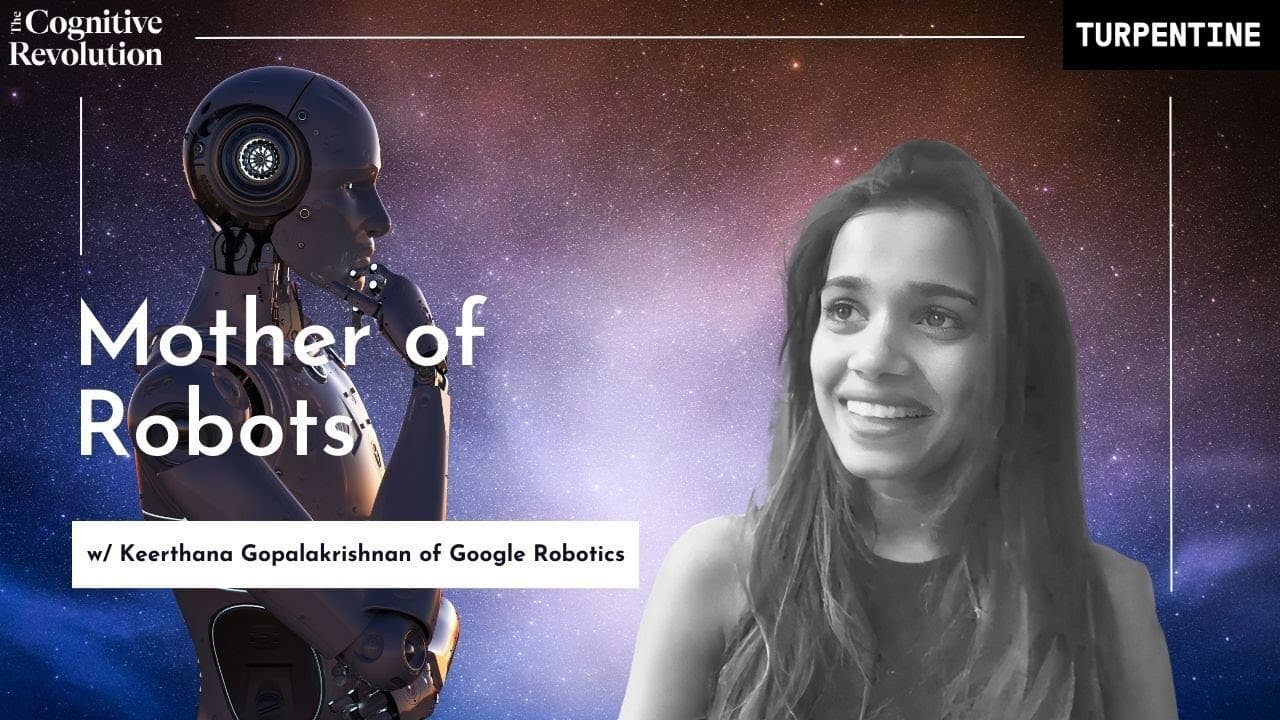
Who Is Keerthana Gopalakrishnan, the Mother of Robots at Google Robotics?
TL;DR
Keerthana Gopalakrishnan is a robotics and machine learning engineer conducting advanced robotics research at Google AI. Known as the Mother of Robots, she contributed to SayCan, which uses language models for robotic planning, and Robotics Transformer, or RT-1, which achieved a 97% success rate across about 700 tasks. Read on to explore her work on robot control, reasoning, safety, and human interaction.
Transcript
that's why I'm so excited about robotics because it's like we are inventing ourselves right it is in many ways a quest to understand us and our intelligence and it's so hard to put down onto paper how we detect like a cup or how we are doing these things or how we are planning tasks like you know how software Engineers say the best way to learn som... Read More
Key Insights
- Robotics at Google is advancing through supervised learning where humans initially guide robots to perform tasks.
- Language models are used to translate high-level commands into actionable steps for robots.
- Robots are trained in controlled environments to perform specific tasks like picking objects and opening cabinets.
- The challenge in robotics includes scaling data collection and ensuring robots can generalize tasks across different environments.
- Safety in robotics involves both hard control limits and ethical considerations to prevent harmful actions.
- Robots are expected to integrate into daily life by performing domestic tasks, but must first overcome generalization and safety challenges.
- The form factor of robots is crucial, with current models focusing on single-arm manipulators and future models potentially adopting humanoid forms.
- Robotics research aims to enhance human understanding by building machines that mimic human intelligence and capabilities.
Install to Summarize YouTube Videos and Get Transcripts
Explore YouTube Video Summarizer or Get YouTube Transcript Extractor
Questions & Answers
Q: Who is Keerthana Gopalakrishnan?
Keerthana Gopalakrishnan is a robotics and machine learning engineer conducting advanced robotics research at Google AI. She is known as the Mother of Robots and has authored influential work including SayCan and Robotics Transformer, or RT-1.
Q: What does Keerthana Gopalakrishnan research at Google AI?
She researches how robots can use transformers for control, language for human interaction, and foundation models for reasoning. Her work explores robots that understand natural-language instructions, plan in visual and language spaces, and act in the real world.
Q: What is SayCan in Google Robotics?
SayCan demonstrated that language models can serve as the executive planning function of a robotic system. It enables robots to assess situations, break problems into parts, and issue logical next-step commands for their bodies to execute.
Q: What did Robotics Transformer, or RT-1, demonstrate?
RT-1 demonstrated that the large-scale pre-training approach used in other domains can also work for robotics. It delivered a 97% success rate across about 700 different tasks.
Q: How does Keerthana Gopalakrishnan expect people to interact with robots?
She expects humans to interact with robots through natural language. The robots would follow many real-world instructions while using visual and language representations to think and plan.
Q: How does Google train robots to perform everyday tasks?
Google Robotics uses supervised learning, with humans initially guiding or teleoperating robots as they perform tasks. The resulting data helps train robots to act autonomously in controlled settings such as mock kitchens and office environments.
Q: What tasks are Google robots being trained to perform?
The robots are trained on actions such as picking up objects, opening cabinets, and working in office environments. Gopalakrishnan also considers domestic service tasks such as doing dishes and putting away children's toys realistic within the decade.
Q: Why does Keerthana Gopalakrishnan consider robotics a way to understand human intelligence?
She describes robotics as a quest to understand ourselves by building systems that reproduce abilities humans find difficult to explain, such as detecting a cup or planning a task. Her view is that building intelligent machines can reveal how human perception, reasoning, and action work.
Summary & Key Takeaways
-
Google Robotics uses supervised learning to train robots, allowing them to perform tasks through human guidance. Language models help translate commands into actions, enhancing robots' ability to execute tasks in varied environments. Safety and ethical considerations are paramount in ensuring robots operate without causing harm.
-
The integration of AI in robotics is aimed at better understanding human intelligence by creating machines that mimic human capabilities. This involves overcoming challenges in data scalability and ensuring robots can generalize tasks effectively across different settings.
-
Robots are expected to become part of everyday life by performing routine tasks, but must first address issues of safety, generalization, and form factor. The future of robotics involves continuous learning and adaptation to human environments, with potential advancements in humanoid forms and autonomous task execution.
Read in Other Languages (beta)
Share This Summary 📚
Summarize YouTube Videos and Get Video Transcripts with 1-Click
Try YouTube Summary with ChatGPT & Claude or YouTube Transcript Generator
Explore More Summaries from Cognitive Revolution "How AI Changes Everything" 📚

Summarize YouTube Videos and Get Video Transcripts with 1-Click
Try YouTube Summary with ChatGPT & Claude or YouTube Transcript Generator