What Is The Distance To Mars?
TL;DR
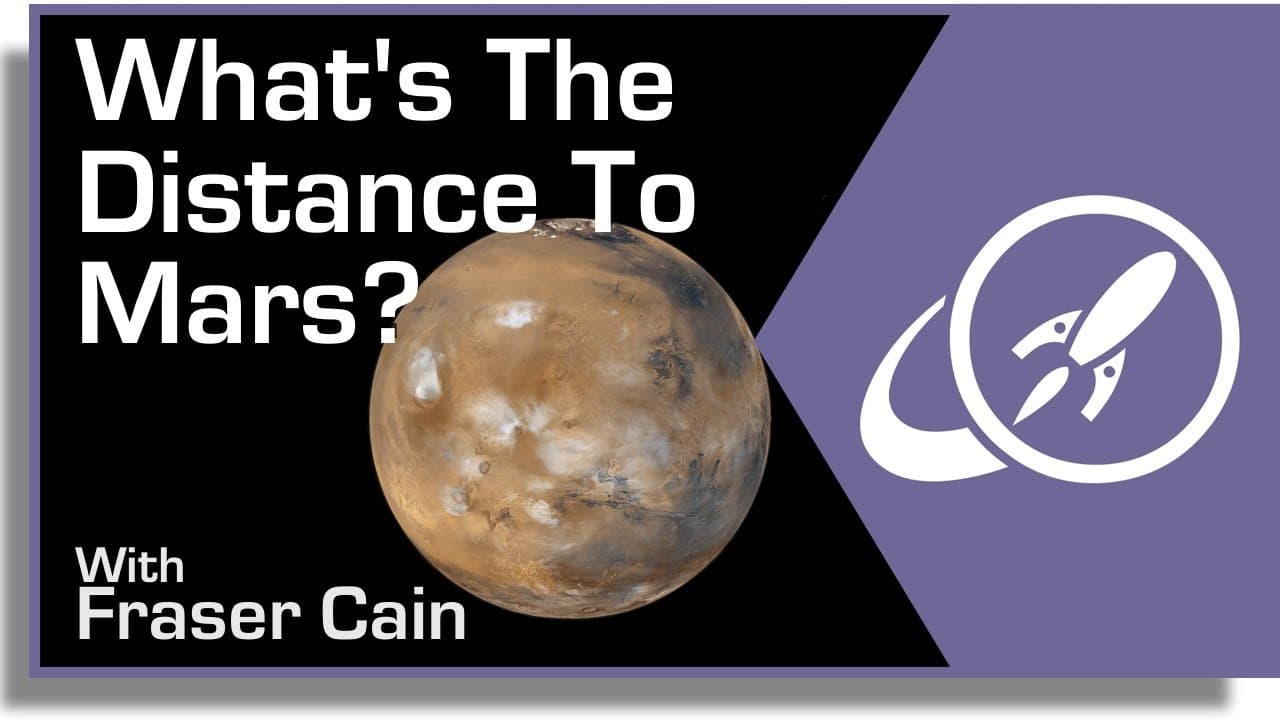
The distance from Earth to Mars continually changes, ranging in the examples given from 56 million to 384 million kilometers. Both planets orbit the Sun on elliptical paths, producing closer oppositions and more distant conjunctions. That changing gap makes a round-trip signal take about 8 minutes at the closest point and 40 minutes at the most distant, so read on to see how the distance is measured and why it matters.
Transcript
What is the Distance to Mars? When we see all these beautiful images of Mars coming back from the Curiosity Rover, it's easy to forget... that's another planet! And that planet is really really far away. So, how far away is Mars? The answer to that question changes from moment to moment because Earth and Mars are orbiting the Sun. At times they're ... Read More
Key Insights
- 😚 Mars can be as close as 56 million kilometers and as far as 384 million kilometers from Earth due to the elliptical orbits of both planets.
- 🧡 Communication with Mars is impacted by its distance, with signal travel times ranging from 8 to 40 minutes.
- 🇲🇭 The first accurate calculation of the distance to Mars was achieved using the parallax method by astronomers Giovanni Cassini and Jean Richer.
- 🙂 Modern methods of distance measurement involve using the speed of light and radar technology.
Install to Summarize YouTube Videos and Get Transcripts
Explore YouTube Video Summarizer or Get YouTube Transcript Extractor
Questions & Answers
Q: What is the distance from Earth to Mars?
The distance changes continuously because Earth and Mars both orbit the Sun. The examples given range from 56 million kilometers during the close approach in 2003 to 384 million kilometers at the conjunction in June 2015.
Q: Why does the distance between Earth and Mars change?
Earth and Mars are constantly moving around the Sun, and both follow elliptical orbits. Their distance depends on where each planet is along its orbit at a given moment.
Q: What are opposition and conjunction for Mars?
Opposition occurs when Earth and Mars are on the same side of the Sun, placing Mars and the Sun on opposite sides of Earth’s sky. Conjunction occurs when Mars is on the other side of the Sun, with Mars and the Sun appearing in roughly the same part of the sky.
Q: How close can Mars get to Earth?
Mars came within 56 million kilometers of Earth in 2003, its closest approach in thousands of years. At the opposition on April 8, 2014, it was expected to come within 93 million kilometers.
Q: How far away can Mars be from Earth?
At the April 2013 conjunction, Mars was 364 million kilometers from Earth on the other side of the Sun. At the June 2015 conjunction, the distance was expected to reach 384 million kilometers.
Q: How long does communication with Mars take?
At Mars’s closest point, light takes about 4 minutes to travel there and another 4 minutes to return. At its most distant point, a signal takes 20 minutes each way, producing a 40-minute round trip.
Q: Who first calculated the distance to Mars?
Astronomer Giovanni Cassini calculated the distance using observations made in 1672 from Paris. His colleague Jean Richer simultaneously observed Mars from Cayenne, French Guiana, allowing them to use parallax and obtain a surprisingly accurate result.
Q: How do astronomers measure the distance to Mars?
Cassini and Richer used parallax by comparing observations of Mars from two different locations on Earth. Modern astronomers measure how long light-speed signals take to reach spacecraft orbiting other planets or bounce radar off a planet and time its return.
Summary & Key Takeaways
-
Earth and Mars are constantly moving in their orbits around the Sun, resulting in their distance from each other changing.
-
Mars can be as close as 56 million kilometers or as far as 384 million kilometers from Earth depending on their positions in orbit.
-
The varying distance between Earth and Mars impacts communication between the two planets, affecting the time it takes for signals to reach and return.
Read in Other Languages (beta)
Share This Summary 📚
Summarize YouTube Videos and Get Video Transcripts with 1-Click
Try YouTube Summary with ChatGPT & Claude or YouTube Transcript Generator
Explore More Summaries from Fraser Cain 📚
Summarize YouTube Videos and Get Video Transcripts with 1-Click
Try YouTube Summary with ChatGPT & Claude or YouTube Transcript Generator