Why Are Go and Chess So Challenging for AI?
TL;DR
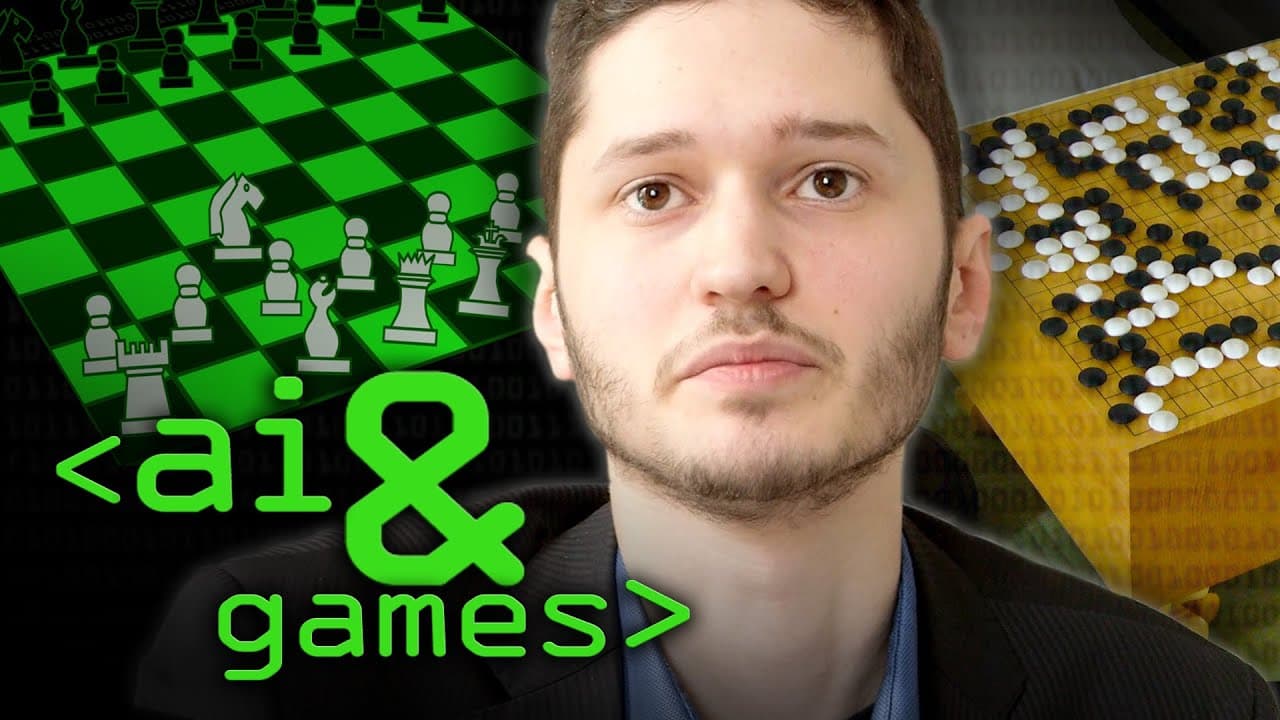
Go and chess are difficult for AI due to their high branching factors and complex evaluation criteria. While chess uses heuristics based on piece values, Go presents an even greater challenge with over 200 possible moves per turn and no straightforward evaluation method, making traditional AI approaches less effective.
Transcript
so go is a very very simple game in terms of the rules but it's very difficult computationally um there's an enormous depth of complexity that comes out of the very simple rules which is uh i think part of what makes people love it so much as a game so to understand why it's hard for computers i guess you have to go back a whole bunch and talk abou... Read More
Key Insights
- 👾 Games with perfect information allow for optimal decision-making, while games with hidden information require considering uncertainty.
- 👾 The minimax algorithm is an effective strategy for games with perfect information but becomes computationally infeasible for games with high branching factors.
- 🧘 Chess AI relies on heuristic evaluation, such as counting piece values, due to the complexity of evaluating positions.
- ✋ Go presents significant computational challenges due to its extremely high branching factor and the absence of simple heuristics for position evaluation.
Install to Summarize YouTube Videos and Get Transcripts
Explore YouTube Video Summarizer or Get YouTube Transcript Extractor
Questions & Answers
Q: Why are games like tic-tac-toe considered perfect information games?
In perfect information games, all players have complete knowledge of the game state and available moves, allowing for optimal decision-making.
Q: How does the minimax algorithm work?
The minimax algorithm aims to minimize the maximum value for one player and maximize the minimum value for the other player, determining the best decision based on this principle.
Q: Why is it computationally challenging to apply the min-max algorithm to chess?
Chess has a higher branching factor, which refers to the number of possible moves at each turn, making it impractical to construct and evaluate the entire game tree.
Q: How is heuristic evaluation used in chess AI?
Heuristic evaluation assigns values to certain aspects of the game, such as counting piece values, to estimate the strength of a position.
Q: Why is evaluating a position in Go more complex than in chess?
Go has a much higher branching factor compared to chess, and there are no easy heuristic indicators of a good position. The evaluation relies on emergent properties of the gameplay pattern.
Summary & Key Takeaways
-
Go and chess are both simple in terms of rules but are computationally complex, with a high branching factor and no straightforward evaluation system.
-
In games like tic-tac-toe, perfect information is available to all players, but in imperfect information games like poker, uncertainty must be considered in decision-making.
-
The minimax algorithm, which involves maximizing the minimum value, is used to make principled decisions in games like tic-tac-toe.
-
Chess has a higher branching factor than tic-tac-toe, making it computationally infeasible to apply the same strategy. Heuristic evaluation, such as counting piece values, is used in chess AI.
-
Go has an even higher branching factor and lacks the heuristics of chess. The evaluation of a position in Go is complex and requires new approaches.
Read in Other Languages (beta)
Share This Summary 📚
Summarize YouTube Videos and Get Video Transcripts with 1-Click
Try YouTube Summary with ChatGPT & Claude or YouTube Transcript Generator
Explore More Summaries from Computerphile 📚



Summarize YouTube Videos and Get Video Transcripts with 1-Click
Try YouTube Summary with ChatGPT & Claude or YouTube Transcript Generator