How Does Cybersecurity Protect Connected Aviation?
TL;DR
Aviation cybersecurity depends on outthinking adversaries while protecting a deeply connected ecosystem of aircraft, airports, air traffic systems, space services, maintenance operations, and suppliers. Digitization enables predictive maintenance and remote control services, but it also expands the attack surface through open legacy links, Wi-Fi, Bluetooth, software updates, internet protocols, and complex organizational dependencies.
Transcript
Morning, everybody. Um, thank you very much for joining us, uh, on, uh, the final day of RSA, uh, to talk about what, what we think is a hugely important topic on a, on a hugely important sector. Um, but I think that first it- it's probably quite good to, to ground us, having just had, um, three days of blockchain, AI, quantum, and dancers when we'... Read More
Key Insights
- Aviation cybersecurity is primarily a challenge of people, strategy, and adversarial thinking, not merely a technology problem. The industry must make the best use of available technology while understanding how opponents might exploit connected operational processes and the relationships among many participating organizations.
- Modern aviation is a global, interconnected, and interdependent system that remains safe, prosperous, trusted, growing, and resilient. Its critical role comes from providing worldwide connectivity while supporting a broad ecosystem of aircraft operators, airports, air traffic services, manufacturers, suppliers, and maintenance organizations.
- A single flight can generate tens of terabytes of aircraft data, with additional information coming from air traffic systems, airports, and supply chains. This expanding data environment supports more capable operations, but it also increases the number of systems, interfaces, and information flows requiring protection.
- Predictive maintenance works by analyzing aircraft information and notifying maintenance teams while an aircraft is airborne that a part should be replaced and ordered for arrival. This replaces some time-based processes with digital decisions and connects aircraft operations directly to ground maintenance and supply activities.
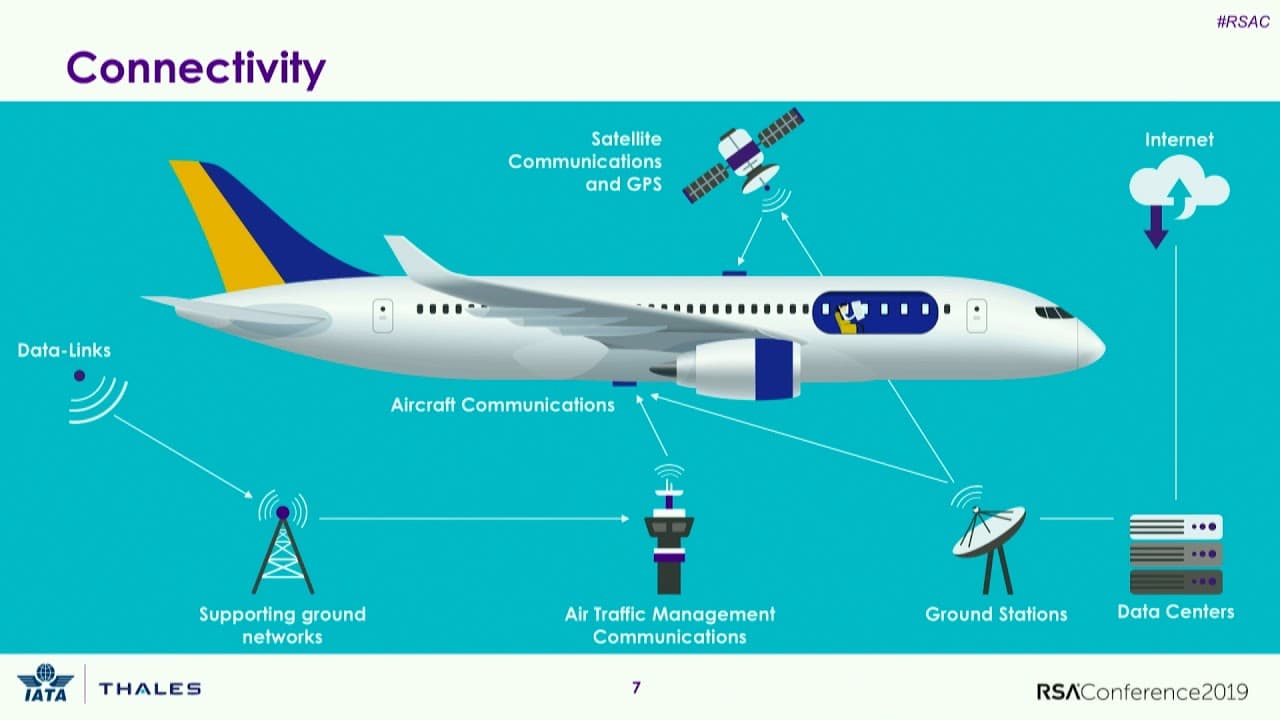
- Aircraft connectivity includes separate links for airlines, engine suppliers, manufacturers, entertainment providers, cockpit systems, and cabin systems. Wi-Fi and Bluetooth add further connections, while growing dependence on satellite communications, GPS, ground stations, and internet providers extends the security boundary far beyond the aircraft.
- Some air traffic communication links are not encrypted because they were designed years ago and remain effectively open to observation. As air traffic management shifts from voice-based procedures toward digital communications, these legacy characteristics become part of the industry's broader cybersecurity and safety challenge.
- Remote air traffic control works through cameras, sensors, microphones, and digital data links installed at an airport and connected to controllers located elsewhere. This model demonstrates how aviation digitization can move critical operational functions away from the physical site while creating dependence on connected infrastructure.
- Air-gapped aviation systems are becoming difficult to identify because aircraft, airport equipment, maintenance tools, security systems, and service providers are increasingly connected. Aircraft may connect automatically at a gate through Wi-Fi, while engineers use tablets to diagnose systems and upload software alongside replacing hardware.
Install to Summarize YouTube Videos and Get Transcripts
Explore YouTube Video Summarizer or Get YouTube Transcript Extractor
Questions & Answers
Q: How should the aviation industry approach cybersecurity?
The aviation industry should treat cybersecurity as a problem of people, strategy, and adversarial thinking rather than assuming technology alone will provide protection. Organizations need to understand what critical operations depend on, use their available technology effectively, and anticipate how adversaries may exploit connections among aircraft, airports, air traffic systems, maintenance operations, space services, and supply-chain participants.
Q: Why is aviation's cyberattack surface expanding?
Aviation's attack surface is expanding because aircraft and ground operations increasingly exchange data through digital systems. Connections now involve airlines, engine suppliers, manufacturers, entertainment providers, cockpit and cabin systems, satellites, ground stations, Wi-Fi, and Bluetooth. Airports, maintenance processes, security doors, and air traffic services are also digitized, so cybersecurity must cover many interconnected systems and organizations.
Q: How does predictive aircraft maintenance use connectivity?
Predictive maintenance uses aircraft data and analytics to identify a part that needs replacement instead of relying only on a time-based schedule. While the aircraft is still airborne, it can notify maintenance that the part should be changed and request that it be ordered for arrival. This capability links aircraft systems, communications, analytics, maintenance teams, and supply processes.
Q: Why are legacy aviation communication links a concern?
Some communication links used for air traffic management were designed years ago and are not encrypted, leaving them effectively open for others to observe. These links were created for an earlier operational environment, but aviation is now moving from predominantly voice-based and procedural coordination toward digital communication. Their original design therefore matters within the industry's connected cybersecurity and safety challenge.
Q: How do remote air traffic control towers operate?
Remote air traffic control uses cameras, sensors, microphones, and digital data links at an airport to send operational information to controllers at another location. The controllers managing the airport may be hundreds of miles away rather than inside a local tower. This arrangement illustrates both the operational reach of digitization and the dependence of critical aviation services on connected systems.
Q: Why is airport cybersecurity an ecosystem problem?
An airport is not a single organization but a collection of companies and organizations delivering multiple services. Its digitally connected environment can include operational systems, security systems, online doors, maintenance processes, aircraft connections, and service providers. Protecting the airport therefore requires attention to organizational dependencies and shared technology, not just defenses around one airport operator or one technical platform.
Q: How has digitization changed aircraft maintenance work?
Aircraft maintenance has shifted from paper records, repeated signatures, and manual checks toward digitized processes. Engineers may carry tablets, connect them to aircraft, diagnose system conditions, upload software, update multiple systems, and replace hardware. Maintenance now combines physical and digital work, which means the safety of the aircraft increasingly depends on the security of tools, software, data, and connections.
Q: Why are air-gapped assumptions unsuitable for modern aviation?
Air-gapped assumptions are unsuitable because connectivity now reaches aircraft, airport systems, maintenance equipment, air traffic management, suppliers, satellites, and internet providers. Some aircraft automatically connect through Wi-Fi after reaching a gate so they can update systems such as in-flight entertainment. Engineers also connect tablets to aircraft, while many security and operational systems at airports are digitally connected and online.
Summary & Key Takeaways
-
Aviation has evolved from mechanical controls, paper records, voice communications, and manual navigation into a global digital ecosystem. Aircraft, airports, air traffic management, space capabilities, manufacturers, airlines, maintenance teams, and service providers exchange growing volumes of data, creating operational benefits alongside a much broader cybersecurity and safety challenge.
-
Connected aircraft maintain numerous links with airlines, engine suppliers, manufacturers, entertainment providers, cockpit systems, and cabin systems. Wi-Fi, Bluetooth, satellite communications, ground stations, and movement toward IP-based components add further connectivity. Some older aviation communication links remain unencrypted because they were designed before present connectivity demands emerged.
-
Cybersecurity must address the aviation ecosystem rather than any isolated aircraft or airport. Airports contain many independent organizations, while supply chains include large and very small suppliers, contractors, and subcontractors. Digitized maintenance, remote towers, connected security doors, automated gate connections, and software uploads demonstrate why traditional assumptions about air-gapped aviation systems no longer hold.
Read in Other Languages (beta)
Share This Summary 📚
Summarize YouTube Videos and Get Video Transcripts with 1-Click
Try YouTube Summary with ChatGPT & Claude or YouTube Transcript Generator
Explore More Summaries from RSAC Cybersecurity 📚





Summarize YouTube Videos and Get Video Transcripts with 1-Click
Try YouTube Summary with ChatGPT & Claude or YouTube Transcript Generator