What Is Geometric Probability and the Birthday Paradox?
TL;DR
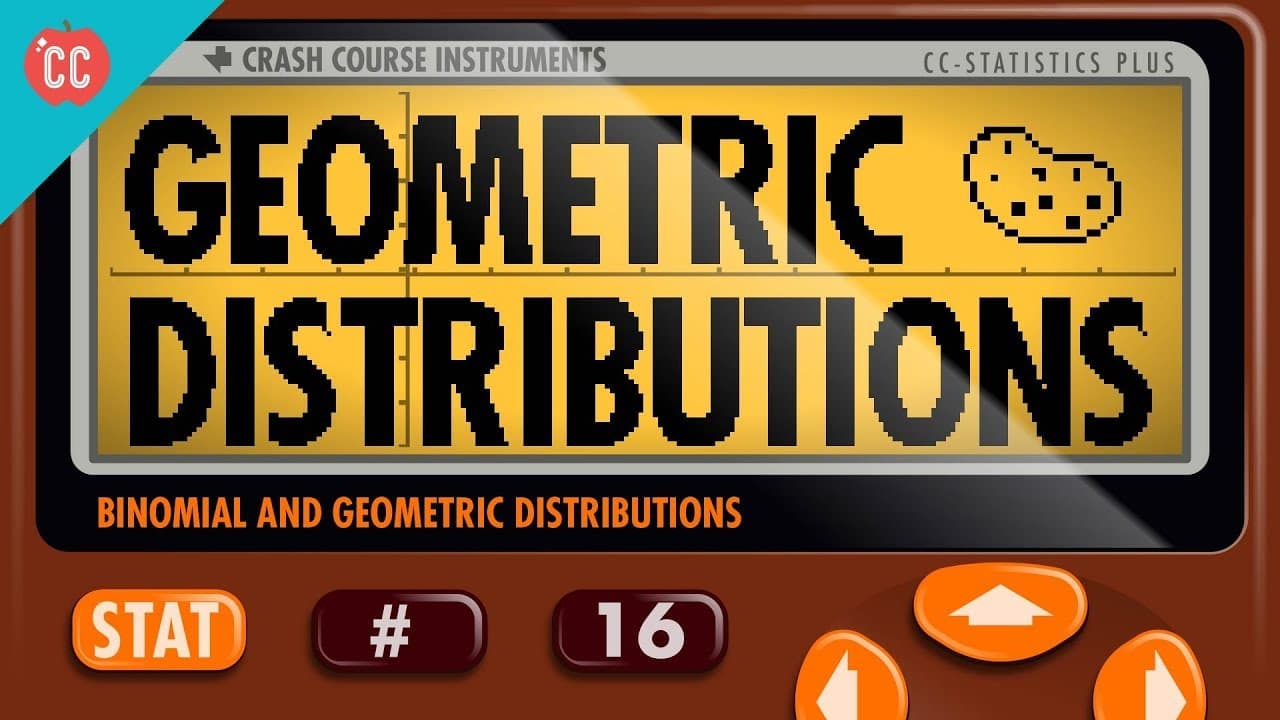
Geometric probability helps estimate how long it takes to achieve a specific outcome, such as the likelihood of getting a vomit-flavored jelly bean on the nth try. The Birthday Paradox shows that in a group of 23 people, there's a 50% chance that at least two will share a birthday, challenging common intuition. Understanding these concepts can aid in decision-making by quantifying uncertainties.
Transcript
Hi, I’m Adriene Hill, and Welcome back to Crash Course, Statistics. We have to wait for a lot of things in life. We wait until we’re old enough to live on our own, or go to college, or drive a car. Waiting can suck, and it’s even worse when you don’t know how long you’ll have to wait. Luckily, in certain situations, probabilities can help you guess... Read More
Key Insights
- Geometric probabilities help estimate how long it will take for a specific event to occur, such as eating a vomit-flavored jelly bean.
- The Geometric Probability Formula calculates the likelihood of an event occurring on the nth try, considering the probability of prior failures.
- Cumulative geometric distributions are useful for determining the probability of achieving success within a certain number of attempts.
- The mean of a geometric distribution can predict the average number of trials needed before success, depending on the probability of success.
- The Birthday Paradox demonstrates that in a group of 23 people, there's a 50% chance of two people sharing a birthday, counterintuitive to many.
- Probabilities can guide decision-making by quantifying uncertainties, such as choosing between buying Pokemon cards or a Blu-Ray.
- Understanding geometric distributions and probabilities can help in everyday situations, like estimating chances in games or lotteries.
- Probabilities assign numerical values to common sense, allowing for more precise decision-making and predictions.
Install to Summarize YouTube Videos and Get Transcripts
Explore YouTube Video Summarizer or Get YouTube Transcript Extractor
Questions & Answers
Q: What is the Geometric Probability Formula?
The Geometric Probability Formula calculates the probability that the first success will occur on the nth try. It involves multiplying the probability of failure raised to the power of k-1 by the probability of success. This formula helps predict when a specific event will happen, considering prior failures.
Q: How does the Birthday Paradox challenge intuition?
The Birthday Paradox shows that in a group of just 23 people, there's a 50% chance that two people will share a birthday. This probability increases to 99.9% in a group of 70, which is much higher than most people intuitively expect, demonstrating the counterintuitive nature of probability.
Q: What is the significance of cumulative geometric distributions?
Cumulative geometric distributions calculate the probability of achieving success within a certain number of trials. This is useful for determining the likelihood of an event occurring before a specific attempt, aiding decision-making in situations with uncertainty, such as games or purchases.
Q: How can probabilities assist in decision-making?
Probabilities provide numerical values to assess the likelihood of various outcomes, helping to make informed decisions. By quantifying uncertainties, probabilities guide choices in everyday situations, such as estimating the chances of winning a game or deciding between different purchasing options.
Q: What role does the mean play in geometric distributions?
The mean of a geometric distribution indicates the average number of trials needed before achieving success. It is calculated as the inverse of the probability of success. A lower probability of success results in a higher mean, indicating more trials are needed on average for success.
Q: How do geometric probabilities apply to everyday scenarios?
Geometric probabilities are used in everyday scenarios to estimate waiting times for specific outcomes. For instance, they can predict how many jelly beans one might eat before encountering a specific flavor or how many attempts are needed to achieve a goal in games or tasks.
Q: Why are probabilities considered common sense reduced to calculus?
Probabilities are described as common sense reduced to calculus because they provide a mathematical framework to quantify and analyze intuitive feelings about the likelihood of events. This allows for more precise and calculated decision-making, transforming instinctual judgments into numerical evaluations.
Q: What is the practical application of understanding geometric distributions?
Understanding geometric distributions helps assess the likelihood and timing of specific events, aiding in planning and decision-making. It is practical in scenarios like estimating the number of attempts needed to achieve a goal, determining the risk of certain outcomes, and optimizing strategies in uncertain situations.
Summary & Key Takeaways
-
Geometric probabilities help predict how long it might take for a specific event to occur, such as eating a vomit-flavored jelly bean. The Geometric Probability Formula calculates the likelihood of success on the nth try, factoring in prior failures and successes.
-
Cumulative geometric distributions allow for the calculation of the probability of achieving success within a certain number of attempts. This is useful for decision-making in uncertain situations, such as choosing between purchasing Pokemon cards or a Blu-Ray.
-
The Birthday Paradox reveals that in a group of 23 people, there's a 50% chance of two sharing a birthday, challenging intuitive assumptions. Probabilities quantify common sense, aiding in precise decision-making and predictions in everyday scenarios.
Read in Other Languages (beta)
Share This Summary 📚
Summarize YouTube Videos and Get Video Transcripts with 1-Click
Try YouTube Summary with ChatGPT & Claude or YouTube Transcript Generator
Explore More Summaries from CrashCourse 📚




Summarize YouTube Videos and Get Video Transcripts with 1-Click
Try YouTube Summary with ChatGPT & Claude or YouTube Transcript Generator