Stanford XCS224U: NLU I Analysis Methods for NLU, Part 1: Overview I Spring 2023
TL;DR
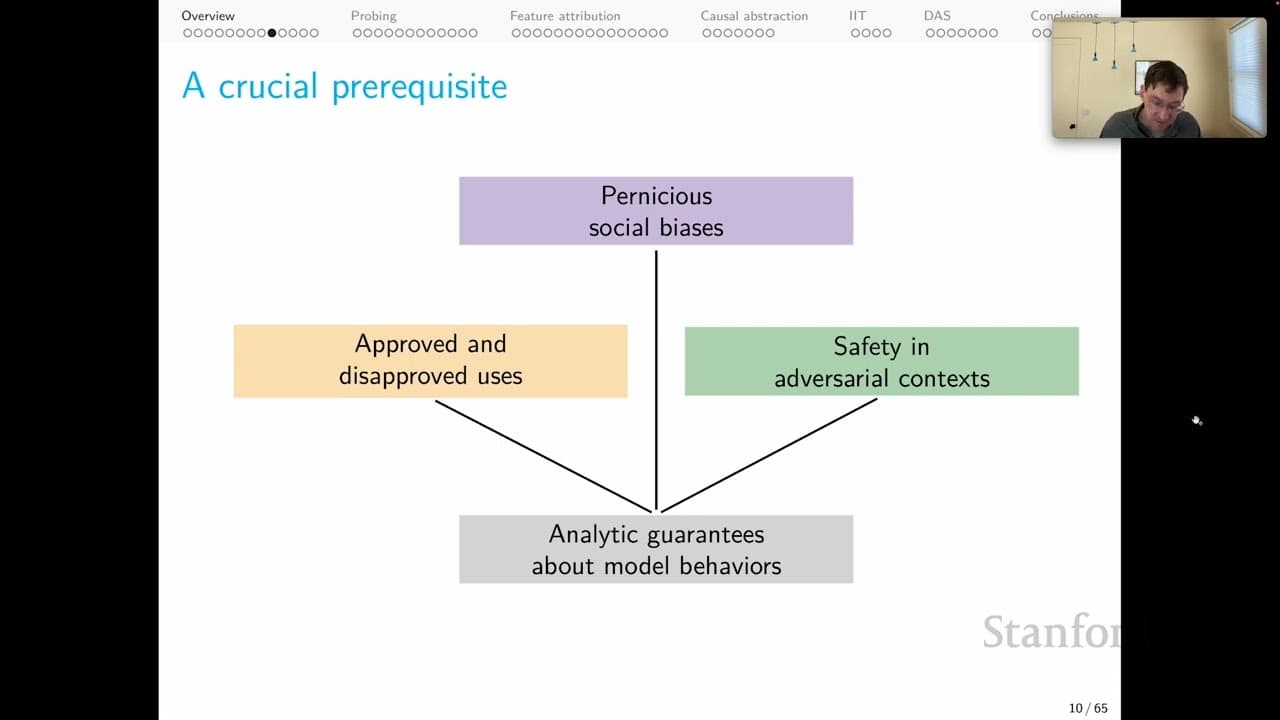
This screencast introduces structural analysis methods in natural language processing (NLP) and highlights the limitations of behavioral testing in understanding model behavior. Probing, feature attribution, and intervention-based methods are discussed as ways to gain insights into NLP models.
Transcript
welcome everyone this screencast kicks off our unit on analysis methods in NLP in the previous unit for the course we were very focused on behavioral testing and we looked in particular at hypothesis driven Challenge and as adversarial tests as a vehicle for deeply understanding how our models will behave in especially unfamiliar scenarios what we'... Read More
Key Insights
- ❓ Behavioral testing has limitations in understanding NLP model behavior, as it may not reveal crucial weaknesses or provide comprehensive insights.
- 🖤 Probing methods help characterize internal representations in NLP models but lack causal guarantees.
- ❓ Feature attribution methods offer causal insights but provide only limited characterizations of internal representations.
- ⚾ Intervention-based methods, favored by the presenter, offer the ability to characterize representations, provide causal guarantees, and facilitate model improvements.
- ❓ Understanding the systematicity and compositional aspects of NLP models is crucial for validating their behavior.
- 😒 Complex NLP models, lacking symbolic representations, are challenging to interpret, requiring the use of appropriate techniques and perspectives.
- 💨 Structural analysis methods, including probing, feature attribution, and intervention-based methods, offer ways to delve deeper into NLP model behavior and causal mechanisms.
Install to Summarize YouTube Videos and Get Transcripts
Explore YouTube Video Summarizer or Get YouTube Transcript Extractor
Questions & Answers
Q: What are the limitations of behavioral testing in understanding NLP model behavior?
Behavioral testing alone is limited in providing comprehensive insights into NLP models as it may only reveal their performance in specific scenarios, and crucial examples that expose model weaknesses can be missed.
Q: What is the purpose of probing in NLP analysis?
Probing involves fitting small supervised models to different layers in the NLP model architecture to understand the presence of systematic information. It helps characterize internal representations but does not offer causal guarantees for model performance.
Q: How do feature attribution methods contribute to understanding NLP models?
Feature attribution methods analyze the gradients of a deep learning model to identify which neurons or neuron collections influence its input-output behavior. While they provide causal insights, they offer only faint characterizations of internal representations.
Q: How do intervention-based methods contribute to understanding NLP models?
Intervention-based methods involve manipulating the internal states of NLP models and studying the resulting effects on behavior. They offer insights into the causal mechanisms shaping model behavior and provide a path for improving models based on these insights.
Summary & Key Takeaways
-
The screencast introduces structural methods, including probing, feature attribution, and intervention-based methods, to go beyond behavioral testing in understanding NLP models.
-
The limitations of behavioral testing are highlighted using an example of an even odd detector model.
-
The complexity of understanding NLP models is discussed, including the difficulty in interpreting their internal mechanisms.
-
The importance of systematicity and compositional understanding in validating model behavior is emphasized.
Read in Other Languages (beta)
Share This Summary 📚
Summarize YouTube Videos and Get Video Transcripts with 1-Click
Try YouTube Summary with ChatGPT & Claude or YouTube Transcript Generator
Explore More Summaries from Stanford Online 📚
Summarize YouTube Videos and Get Video Transcripts with 1-Click
Try YouTube Summary with ChatGPT & Claude or YouTube Transcript Generator