How to Choose High-Potential Startup Opportunities
TL;DR
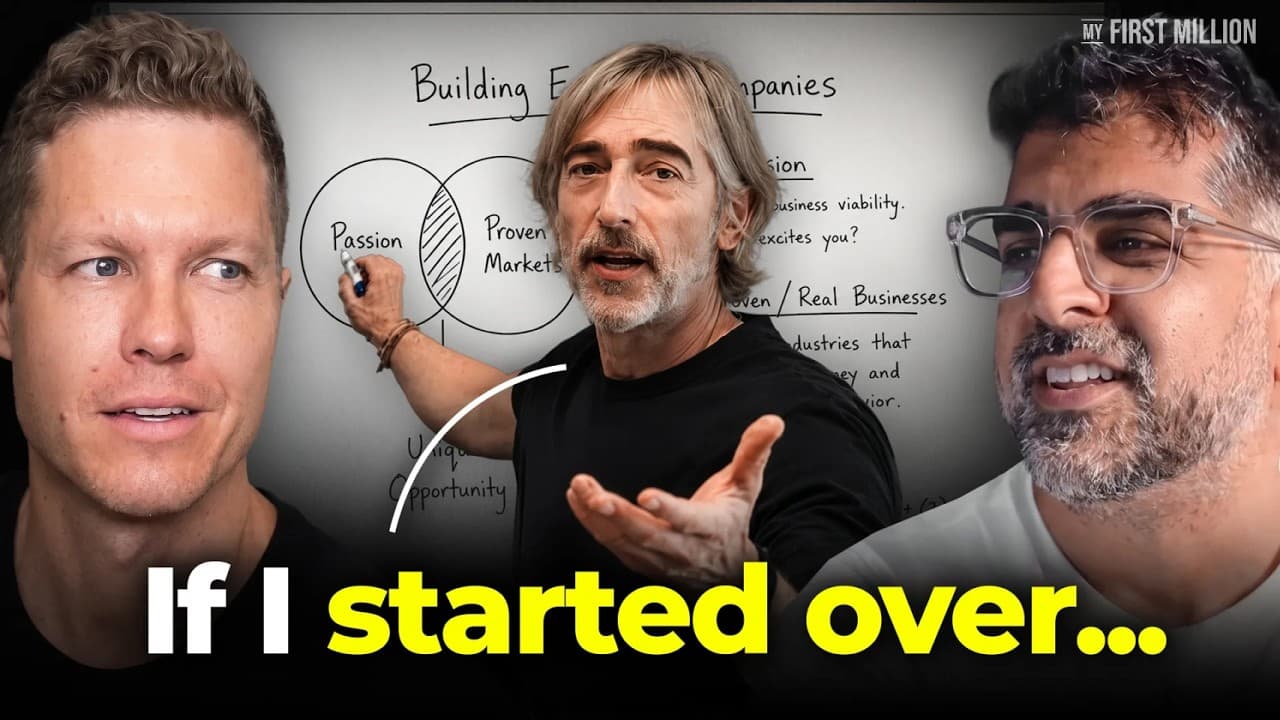
Choose a promising market before obsessing over the perfect product, because a strong underlying trend can carry imperfect early ideas. Use real adoption and engagement as evidence, remain willing to abandon concepts that are not working, and improve proven models instead of letting pride or discomfort about imitation prevent useful innovation.
Transcript
You don't have a lot of money, but you have access to AI out loud. Let's go through this framework. >> I almost want to turn this to my whiteboards. >> Awesome. Great. >> This is like showing us nudes for for my first million. This is like exactly what we like. >> So, all right. You've done everything. You built a $10 billion company. You're I I th... Read More
Key Insights
- Market selection is more consequential than perfect product selection because a favorable technological or consumer wave can support several viable businesses. Pincus compares this decision to choosing the right body of water, where even an imperfect boat can progress.
- AI is presented as a major opportunity for entrepreneurs who have little money but can access powerful technology. The discussion frames AI as comparable to the internet in its breadth, making it a promising area in which to search for useful products and businesses.
- Strong engagement metrics can matter more than a founder's appearance or conventional professionalism. Zuckerberg's casual behavior seemed unusual, but Facebook's rapid school adoption and reported 60–80% daily engagement demonstrated that the product had achieved unusually compelling usage.
- Access to exceptional opportunities is itself a valuable entrepreneurial capability. Pincus says his Facebook investment was not brilliant because others would likely have made it too, while being positioned so Zuckerberg and Sean Parker entered his office was the more impressive accomplishment.
- Persistence is harmful when it becomes attachment to an idea that users do not want. Pincus describes Tribe as overly complicated and unsuccessful despite a favorable social-networking market, showing that founders must distinguish resilient execution from pride-driven refusal to change.
- Trust is a central product-design problem for social networks. Pincus concluded that Facebook had solved trust more effectively than Tribe because its profiles reflected real identities and personal information, helping users participate in a more credible and connected online environment.
- Proven-better-new is Pincus's framework for building from existing evidence while adding meaningful improvement. He argues that exact copies may fail, but adapting a validated idea and developing it further can create genuine innovation and improve market efficiency.
- Creative intensity works better when paired with deliberate focus and personal balance. Pincus describes himself as a hummingbird with extreme ADD, yet says he performs better when focused and has added breathing and meditation to support greater steadiness in his home life.
Install to Summarize YouTube Videos and Get Transcripts
Explore YouTube Video Summarizer or Get YouTube Transcript Extractor
Questions & Answers
Q: How should entrepreneurs choose which startup idea to pursue?
Entrepreneurs should begin by choosing a promising market or technological wave, then evaluate ideas within it using observable demand. Pincus compares this to selecting the right body of water before selecting a boat. A favorable market can support several approaches, but even a strong product may struggle in the wrong environment. Adoption, engagement, waiting lists, and repeated user behavior provide stronger evidence than personal enthusiasm alone.
Q: Why does choosing the right market matter for a startup?
Choosing the right market matters because broad changes in technology or consumer behavior can create room for many successful products. Pincus says the internet was the right body of water and identifies AI as a similarly broad opportunity. His experience with early internet companies suggests that market momentum can compensate for an imperfect initial approach, while the best execution may not overcome weak underlying demand.
Q: What can founders learn from Mark Pincus's experience with Tribe?
Tribe shows that persistence should not become unquestioned loyalty to one complicated idea. Pincus says the company got trust wrong and failed while several other social networks from the same period succeeded. His lesson is to examine whether users genuinely want the product, preserve personal dignity when evidence is unfavorable, and change direction instead of treating stubborn attachment as heroic commitment.
Q: Why did Mark Pincus invest $38,000 in Facebook?
Pincus invested after Sean Parker brought Mark Zuckerberg to his Tribe office and described Facebook's performance across schools. New school launches reportedly reached 80% of users in the first week and the remaining 20% in the following week. Pincus also observed that roughly 60–80% of users logged in daily or remained logged in, making the investment appear straightforward despite Zuckerberg's unconventional demeanor.
Q: What mattered most about Facebook's early user metrics?
Facebook's early metrics indicated rapid adoption and sustained engagement rather than temporary curiosity. According to the conversation, schools wanted the service before it arrived, launches spread quickly through each campus, and approximately 60–80% of users logged in every day or stayed connected. Those behaviors showed that Facebook had solved an important user need and built a product people incorporated into their daily lives.
Q: How can founders use existing successful ideas ethically and effectively?
Founders can study what an existing product has proven, identify what could be improved, and build a meaningfully different version. Pincus calls this approach proven-better-new. He argues that somebody will often copy a successful internet concept because markets spread useful ideas efficiently. Exact imitation may fail, but combining validated demand with better execution or a new contribution can produce real innovation.
Q: How can entrepreneurs distinguish persistence from harmful pride?
Persistence remains useful when evidence shows that customers value the product and focused execution can solve identifiable problems. It becomes harmful when founders ignore weak adoption, preserve unnecessary complexity, or remain attached because changing course feels embarrassing. Pincus's reflection on Tribe suggests that founders should compare their assumptions with actual usage and allow strong competing products to reveal what their own model misunderstood.
Q: How does Mark Pincus balance creativity with focus?
Pincus describes himself as highly generative and compares his nature to a hummingbird, while his partner is more like a tree. He does not want to stop creating businesses, but he seeks greater steadiness in his personal life. Breathing and meditation form part of his morning practice, and he says that although his extreme ADD supports creativity, he performs better when he focuses.
Summary & Key Takeaways
-
Mark Pincus describes entrepreneurship as choosing the right body of water before choosing the right boat. His internet experience convinced him that a powerful market can create multiple opportunities, while an excellent product in an unfavorable market may still struggle. He identifies AI as another broad environment with significant potential.
-
Pincus recalls investing $38,000 in Facebook after Sean Parker introduced Mark Zuckerberg at the Tribe office. Facebook had a waiting list from schools, captured users rapidly after each launch, and reportedly had 60–80% of users logging in daily or remaining logged in. Those metrics outweighed Zuckerberg's unconventional presentation.
-
Tribe taught Pincus that perseverance becomes harmful when it protects a complicated, unsuccessful idea. He believes he should have recognized Facebook's solution to online trust and adapted sooner. His broader framework favors observing working products, combining proof with improvement, and balancing instinctive creativity with focus and honest self-assessment.
Read in Other Languages (beta)
Share This Summary 📚
Summarize YouTube Videos and Get Video Transcripts with 1-Click
Try YouTube Summary with ChatGPT & Claude or YouTube Transcript Generator
Explore More Summaries from My First Million 📚


Summarize YouTube Videos and Get Video Transcripts with 1-Click
Try YouTube Summary with ChatGPT & Claude or YouTube Transcript Generator