What Factors Affect Carbocation Stability?
TL;DR
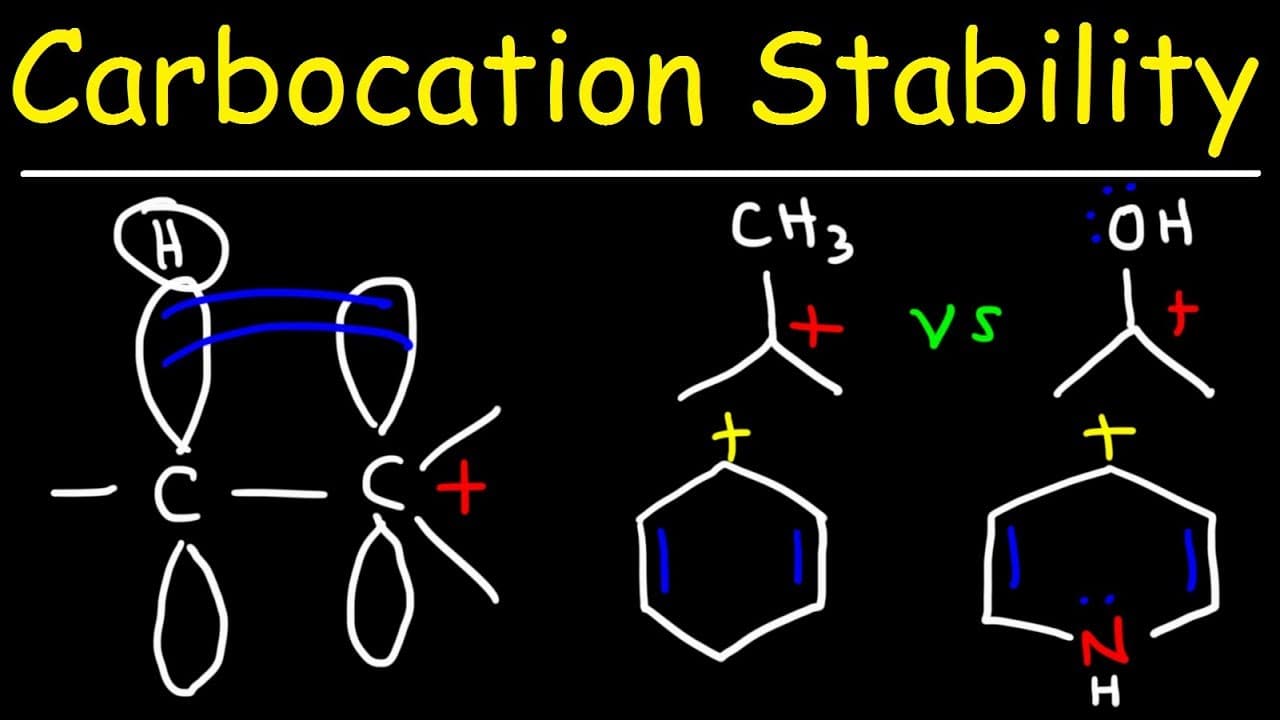
Carbocation stability is influenced by the number of electron-donating groups attached to the carbon atom. Tertiary carbocations are the most stable due to hyperconjugation and inductive effects, followed by secondary and primary carbocations. Electron-withdrawing groups, like carbonyls, destabilize carbocations, while groups like hydroxyls can stabilize them through resonance despite also having inductive effects.
Transcript
in this video we're going to go over carbocation stability so what exactly is a carbocation a carbocation is a carbon with a positive charge now what you need to know is that tertiary carbocations are more stable than secondary carbocations and in turn secondary carbocations are more stable than primary carbocations and these are more stable than a... Read More
Key Insights
- 👥 Tertiary carbocations are the most stable due to the presence of three electron-donating groups, which stabilize the positive charge through inductive effects and hyperconjugation.
- 👥 Oxygen-containing groups can stabilize adjacent carbocations by donating electron density through resonance, despite their electron-withdrawing nature caused by the inductive effect.
- 🥺 Carbonyl groups are electron-withdrawing and destabilize carbocations, as they can form resonance structures that lead to unfavorable positive charges.
- 💄 Resonance structures stabilize carbocations by distributing the positive charge and satisfying the octet rule, making them more stable than carbocations without resonance.
- 🥺 The presence of a nitrogen atom in a carbocation structure can lead to enhanced stability due to factors such as aromaticity and octet rule adherence.
- 🈂️ The destabilizing effect of electron-withdrawing groups on carbocations can be explained by their ability to acquire a positive charge through resonance, leading to an unstable arrangement of positive charges.
- 👥 The stability of carbocations can be understood by considering both the inductive and resonance effects of neighboring functional groups.
Install to Summarize YouTube Videos and Get Transcripts
Explore YouTube Video Summarizer or Get YouTube Transcript Extractor
Questions & Answers
Q: Why are tertiary carbocations more stable than primary carbocations?
Tertiary carbocations have three electron-donating groups, which can stabilize the positive charge through inductive effects and hyperconjugation. In contrast, primary carbocations lack these stabilizing groups, making them less stable.
Q: How can oxygen-containing groups stabilize carbocations?
Oxygen-containing groups, like hydroxyl groups, can stabilize carbocations through resonance effects. Oxygen can donate a pair of electrons to the carbocation, forming a resonance structure where the oxygen carries the positive charge. This stabilization is primarily due to the neutralizing effect on the carbon atom and adherence to the octet rule.
Q: Why do carbonyl groups destabilize carbocations?
Carbonyl groups are electron-withdrawing groups, meaning they pull electron density away from the carbocation. This leads to an unstable situation where the carbonyl group itself can acquire a positive charge through resonance. Having two positive charges next to each other destabilizes carbocations, making the presence of a carbonyl group unfavorable.
Q: Which of the provided structures is the most stable carbocation?
The carbocation with a nitrogen atom in the ring is the most stable. It can donate electron density through resonance effects, forms an aromatic pyridine-like structure, and satisfies the octet rule. This stability surpasses those with carbocations adjacent to double bonds or simple positive charges.
Summary & Key Takeaways
-
Carbocations are carbon atoms with a positive charge. Tertiary carbocations, with three electron-donating groups, are the most stable, followed by secondary, primary, and methyl carbocations.
-
The stability of carbocations can be attributed to the inductive effects of electron-donating groups and the hyperconjugation between adjacent sigma bonds.
-
Oxygen-containing groups, like hydroxyl groups, can stabilize carbocations through resonance effects, while carbonyl groups destabilize carbocations due to their electron-withdrawing nature.
Read in Other Languages (beta)
Share This Summary 📚
Summarize YouTube Videos and Get Video Transcripts with 1-Click
Try YouTube Summary with ChatGPT & Claude or YouTube Transcript Generator
Explore More Summaries from The Organic Chemistry Tutor 📚



Summarize YouTube Videos and Get Video Transcripts with 1-Click
Try YouTube Summary with ChatGPT & Claude or YouTube Transcript Generator