What Are Black Holes? | Crash Course Pods: The Universe #5
TL;DR
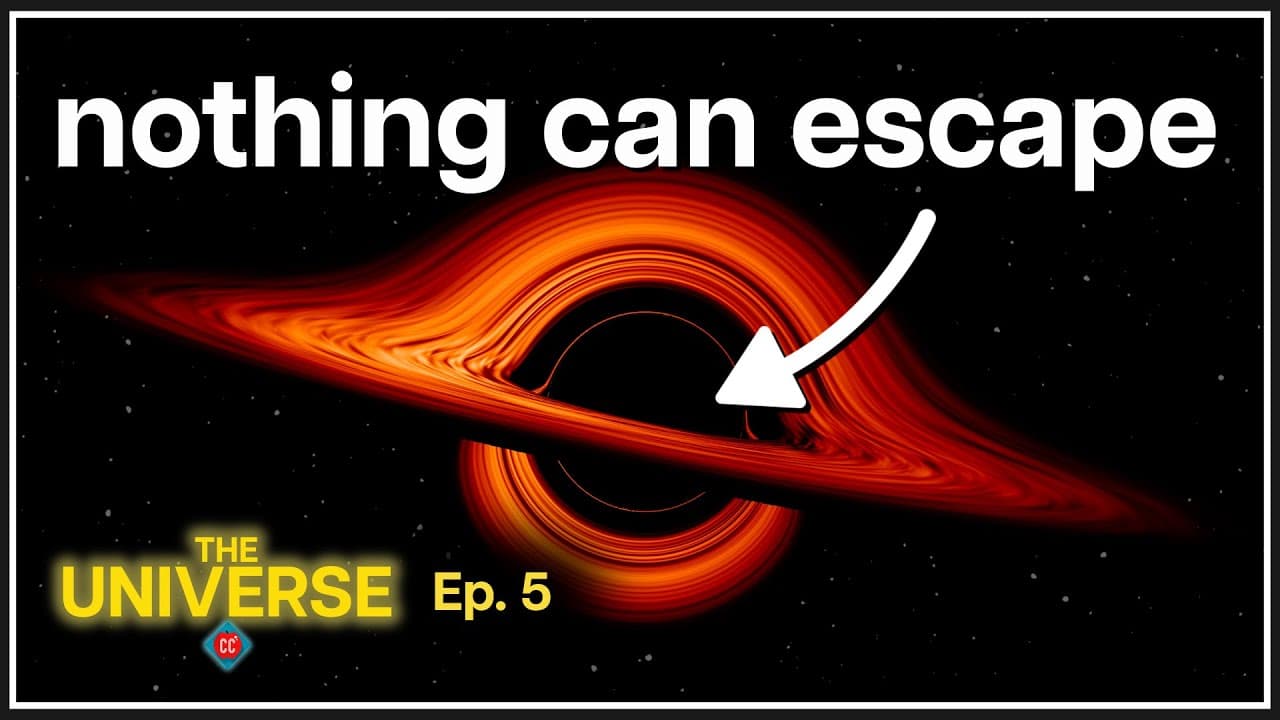
Black holes are bizarre space-time objects that form when really massive stars die and challenge both intuitive and detailed understandings of physics. Astronomers can identify around 50 in our galaxy, but estimate that it contains closer to 100 million, including a supermassive black hole at its center. Read on to discover how stars form black holes, why these objects are useful, and what remains unknowable.
Transcript
God I'm so old do you ever like see yourself in in a zoom and just be absolutely shocked sometimes but you can you can put on the uh you can do the the touchup my appearance thing on Zo can do like a baby filter that turns me into like a 9-year-old no no but it'll it'll smooth you so you'll be like an inhumanly smooth person that's that's always an... Read More
Key Insights
- Black holes are formed when massive stars collapse under their own gravity, creating a point of infinite density known as a singularity.
- The universe contains millions of black holes, with supermassive black holes residing at the centers of most galaxies.
- Black holes have a significant effect on space and time, warping them due to their immense gravity.
- An event horizon is the boundary around a black hole beyond which nothing can escape, not even light.
- Supermassive black holes grow by accumulating mass over time and are crucial in shaping the galaxies they inhabit.
- Neutron stars, another result of stellar collapse, are incredibly dense and can emit radiation beams due to their magnetic fields.
- The concept of spaghettification refers to the stretching effect experienced by objects falling into a black hole due to intense gravitational forces.
- The existence of black holes challenges our understanding of physics, particularly regarding information loss and the nature of singularities.
- "there are somewhere around 50 that we can identify and point at and say we know that there is a black hole right there" (2:30)
- "but the estimate is that there's probably closer to like 100 million in our galaxy" (2:41)
- "pretty much every large Galaxy appears to have a super massive black hole in the center" (3:11)
- "there are things about black holes we still don't understand especially in the Interiors" (3:47)
- "a black hole is something that happens when a really massive star dies" (4:58)
Install to Summarize YouTube Videos and Get Transcripts
Explore YouTube Video Summarizer or Get YouTube Transcript Extractor
Questions & Answers
Q: What is a black hole?
A black hole is an object that can form when a really massive star dies. Its unusual properties make it one of the places where both intuitive and detailed understandings of physics are strongly challenged.
Q: How do black holes form?
Some stars become black holes when they die. A star's life cycle and eventual outcome depend on how much mass it starts with, and black holes result from really massive stars.
Q: How many black holes are in our galaxy?
Astronomers can identify and locate around 50 black holes in our galaxy. The estimate for the actual population is much larger, closer to 100 million.
Q: Are black holes common in the universe?
Yes. The process that turns some dying stars into black holes happens often enough that black holes are found throughout the universe.
Q: Do galaxies have supermassive black holes at their centers?
Our galaxy has a supermassive black hole at its center. Pretty much every large galaxy also appears to have a supermassive black hole in the center.
Q: Why are black holes useful to astrophysicists?
Black holes are useful partly because supermassive black holes tend to be among the brightest things visible in the cosmos. Astronomers use them to help map the cosmos.
Q: What remains unknown about black holes?
Scientists still do not understand some aspects of black holes, especially their interiors. Their nature may permanently prevent access to certain information about them.
Q: How does a star begin its life cycle?
A collection of gas first comes together in a protostar. A star is technically born when nuclear fusion begins in its center and it lights up.
Summary & Key Takeaways
-
John and Katie delve into the enigmatic phenomena of black holes, discussing their formation, properties, and significance in the universe. They explore how black holes warp space-time and the concept of the event horizon.
-
The conversation covers the lifecycle of stars, leading to the formation of black holes and neutron stars, and the challenges they pose to our understanding of physics, including the black hole information paradox.
-
They also touch on the existence of supermassive black holes in galaxy centers, their role in galactic formation, and the fascinating yet terrifying concept of spaghettification.
Read in Other Languages (beta)
Share This Summary 📚
Summarize YouTube Videos and Get Video Transcripts with 1-Click
Try YouTube Summary with ChatGPT & Claude or YouTube Transcript Generator
Explore More Summaries from CrashCourse 📚





Summarize YouTube Videos and Get Video Transcripts with 1-Click
Try YouTube Summary with ChatGPT & Claude or YouTube Transcript Generator