What Are Regular Expressions and Their Uses?
TL;DR
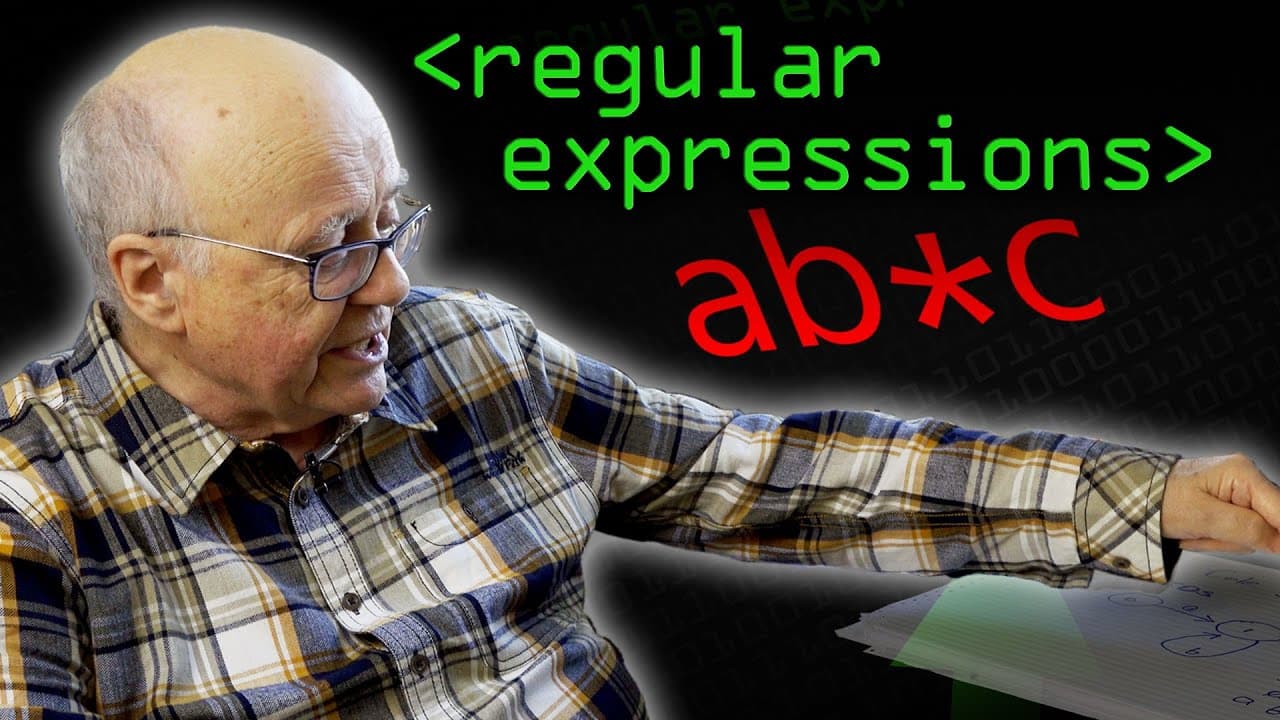
Regular expressions are a powerful tool for pattern matching in strings, created by Stephen Kleene in the 1950s. They offer a compact way to represent automaton diagrams and grammars, all of which are equivalent in functionality. Their ability to handle non-determinism through transformation into deterministic forms is crucial for efficient text processing.
Transcript
today well today as ever we're going to listen to our subscribers and a lot of them keep saying well you haven't really done regular expressions head-on you keep on mentioning them as though we know all about them but we don't it would be nice to have a sort of regular expressions explained as it were so although i'm going to do my best to do regul... Read More
Key Insights
- 😑 Regular expressions were invented in the 1950s as a way to recognize and abbreviate patterns in strings, replacing the need for diagrams.
- 😑 Automaton diagrams, regular expression notation, and grammars are all equivalent representations of regular expressions.
- 🤑 Non-deterministic automaton diagrams can be turned into deterministic ones through factorization, which is essential for efficient pattern recognition.
- 😑 Ken Thompson's approach to regular expressions in Unix ed was to pre-compile assembler code to handle multiple possibilities, creating a flexible and efficient system.
Install to Summarize YouTube Videos and Get Transcripts
Explore YouTube Video Summarizer or Get YouTube Transcript Extractor
Questions & Answers
Q: Who invented regular expressions?
Regular expressions were invented by Stephen Clainey in the mid-1950s. He wanted to find a way to abbreviate and recognize patterns in strings without the need for diagrams.
Q: How do regular expressions represent patterns in strings?
In regular expressions, patterns are represented using automaton diagrams, regular expression notation, or grammars. All three representations are equivalent and can be used to recognize patterns in strings.
Q: What is the advantage of using regular expression notation in programming?
Regular expression notation is compact and easier to handle in programming than drawing automaton diagrams. It provides a concise way to represent patterns in strings, making pattern matching and recognition more efficient.
Q: Is there an alternative to using regular expressions for pattern recognition?
While regular expressions are a popular choice for pattern recognition, grammars can also be used. However, grammars tend to be less compact and not as easy to handle in programming compared to regular expression notation.
Summary & Key Takeaways
-
The content provides an explanation of regular expressions, starting from their invention by Stephen Clainey in the 1950s.
-
Regular expressions were developed as a way to abbreviate and recognize patterns in strings of characters, replacing the need for diagrams.
-
Regular expressions can be represented by automaton diagrams, regular expression notation, or grammars, and all three representations are equivalent.
Read in Other Languages (beta)
Share This Summary 📚
Summarize YouTube Videos and Get Video Transcripts with 1-Click
Try YouTube Summary with ChatGPT & Claude or YouTube Transcript Generator
Explore More Summaries from Computerphile 📚




Summarize YouTube Videos and Get Video Transcripts with 1-Click
Try YouTube Summary with ChatGPT & Claude or YouTube Transcript Generator