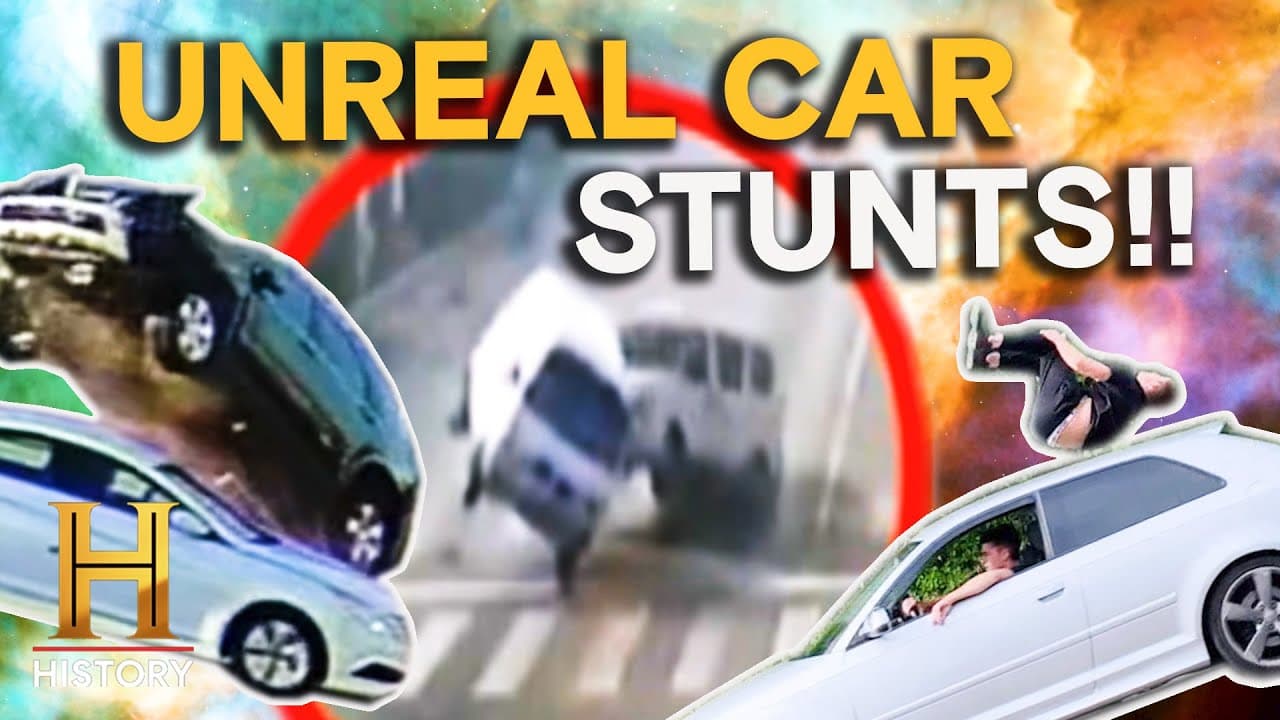
How Can Impossible Car Footage Be Explained?
TL;DR
Seemingly impossible car footage can often be explained through conservation of energy, limited energy transfer, hidden cables, and careful forensic analysis. The examined incidents include a flying SUV narrowly missing a priest, children surviving vehicle impacts, and vans lifted by a cable caught in a street sweeper, with extraordinary timing and good fortune contributing to the outcomes.
Transcript
It's October 2022 in Milford, Ohio. Just after 8:30 in the morning, an 87-year-old, semi-retired priest who asked not to be named is on his way to church to deliver Catholic mass, but he's also on a collision course with near disaster. It happened so fast, I think we should slow it down and take another look. Check out how the SUV, driven by an unn... Read More
Key Insights
- The Milford SUV became airborne after striking two thin poles and a no-left-turn sign, narrowly clearing a white Hyundai driven by an 87-year-old priest before landing bumper-first in a parking lot and crashing into a building.
- The priest was unaware that an SUV had flown over his car, and police discovered the near collision only after reviewing security footage. Police Chief Jamey Mills called it unbelievable that nobody was injured or killed.
- The conservation of energy explains the SUV's flight because its kinetic energy was converted into upward and gravitational energy when it struck the roadside structure. The vehicle then continued along its new path rather than broadsiding the priest's Hyundai.
- The timing encouraged a religious interpretation because the priest was traveling to deliver Catholic mass on the feast day of the guardian angels. Catholic miracle investigator Michael O'Neill considered angelic intervention possible, although he could not definitively identify a guardian angel.
- The teen driver lost control after an epileptic fit, according to Michio Kaku. That circumstance, along with the involvement of an 87-year-old priest, led the investigators to reject the idea that the airborne-SUV incident had been deliberately staged for internet attention.
- The Zhuhai child-survival footage was judged authentic after forensic analyst Michael Primeau compared two camera angles. The vehicle's movement remained consistent as its passenger-side front and rear tires traveled over the child, making fabrication difficult.
- A child's low height can reduce injury in rare vehicle encounters because a rapidly passing car may transfer relatively little energy during the brief impact. Michio Kaku compared the effect to a car passing over a twig rather than a taller log.
- The airborne vans in Xingtai were lifted by a cable that became tangled in a passing street sweeper. The cable was not visible because the recording was low quality, but the vans' jerking and suspended motion indicated that a rope, cable, or chain was involved.
Install to Summarize YouTube Videos and Get Transcripts
Explore YouTube Video Summarizer or Get YouTube Transcript Extractor
Questions & Answers
Q: How did the SUV fly over the priest's car?
The black SUV struck two thin poles and a no-left-turn sign, which redirected some of its kinetic energy upward. According to Michio Kaku, the conservation of energy converted the vehicle's forward motion into the energy associated with being thrust into the air. It cleared the priest's white Hyundai, landed bumper-first in a parking lot, and then crashed into a building.
Q: Was the flying SUV incident considered a miracle?
The program's verdict was that the incident was a possible miracle, while also presenting a scientific explanation. The priest was traveling to deliver Catholic mass on the feast day of the guardian angels, and Michael O'Neill considered those circumstances suggestive of possible angelic intervention. However, he acknowledged that a guardian angel could not be definitively identified, and physics explained the SUV's trajectory.
Q: Why did police initially miss the priest's near collision?
Police knew that the black SUV had crashed into a building, but they did not initially realize it had flown over another vehicle. Security-camera footage later revealed that the SUV had nearly broadsided the priest's Hyundai before clearing it. The priest himself drove away without a scratch and later said that he had not even known an SUV had passed over his car.
Q: Was the airborne SUV crash deliberately staged?
The investigators rejected the idea that the crash was an intentional stunt. The black SUV's teen driver had lost control after an epileptic fit, according to Michio Kaku. Alexis Brooks also argued that recruiting an 87-year-old, semi-retired priest for such a dangerous near collision was implausible. The circumstances therefore supported an accidental crash with extraordinarily precise timing.
Q: How did children survive being driven over by cars?
Michio Kaku proposed that a child's small height and the vehicle's rapid passage can minimize the duration of impact and the amount of energy transferred. He compared a child in this specific physical explanation to a twig beneath a car, while an adult would resemble a taller log that produces greater vertical force and damage. The program stressed that such survival is extremely rare.
Q: How was the Zhuhai child-survival footage authenticated?
Forensic video expert Michael Primeau compared the Zhuhai security recording with footage captured from an overhead angle. He found consistent vehicle movement across both perspectives, particularly as the passenger-side front and rear tires traveled over the child. Primeau said manufacturing that coordinated movement would be difficult, so the program concluded that the footage was real rather than a fabricated sequence.
Q: Why did the two vans in Xingtai jump into the air?
A cable lying in the street became tangled in a passing street sweeper and pulled the vans upward. Analyst Mick West noticed that the vehicles jerked and then appeared suspended, behavior suggesting support from a rope, cable, or chain. He then identified the street sweeper moving through the scene. The recording's low quality prevented viewers from seeing the cable directly.
Q: Did the strange car footage prove reality is a simulation?
The footage prompted discussion of simulation theory, including the idea that an advanced civilization might run programs capable of simulating reality and that strange events could look like computer glitches. However, the investigated van incident had an ordinary physical cause: a hidden cable caught by a street sweeper. The footage therefore did not establish that reality was a simulation.
Summary & Key Takeaways
-
An SUV driven by a teen became airborne after striking poles and a road sign in Milford, Ohio, then cleared an 87-year-old priest's Hyundai before crashing into a building. Although some experts considered possible angelic intervention, conservation of energy explained how forward motion was converted into upward motion.
-
Security footage from China and India appeared to show children surviving encounters with moving cars. Forensic comparison supported the authenticity of the Zhuhai recording, while physics suggested that a child's low height and the brief impact could minimize energy transfer. The program emphasized that most children would not survive such incidents.
-
Footage from Xingtai showed two vans apparently jumping into the air, prompting speculation about gravity, simulations, and glitches in reality. Forensic analysis instead identified a street sweeper as the crucial clue. A cable lying in the road became tangled in the sweeper and lifted the vehicles, but poor video quality concealed it.
Read in Other Languages (beta)
Share This Summary 📚
Summarize YouTube Videos and Get Video Transcripts with 1-Click
Try YouTube Summary with ChatGPT & Claude or YouTube Transcript Generator
Explore More Summaries from HISTORY 📚






Summarize YouTube Videos and Get Video Transcripts with 1-Click
Try YouTube Summary with ChatGPT & Claude or YouTube Transcript Generator