Where Is the Lost Ark of the Covenant Hidden?
TL;DR
The Ark of the Covenant vanishes from the record after the Babylonians destroyed Jerusalem in 587 BC. Babylonian loot lists never mention it, so many historians think it was hidden nearby. Ark hunter Jim Barfield believes priests carried it through an escape tunnel toward Qumran. He says Copper Scroll clues, man-made mortar and metal detector readings point to a sealed cave there.
Transcript
according to the Book of Exodus the story of the Ark dates back to ancient Egypt in the 13th century BCE The Exodus is one of the most famous stories ever told Moses and the Israelites survive a plague that takes the firstborn sons of the land Moses leads the Israelites out of the land of Egypt and they move across the Red Sea where the waters mira... Read More
Key Insights
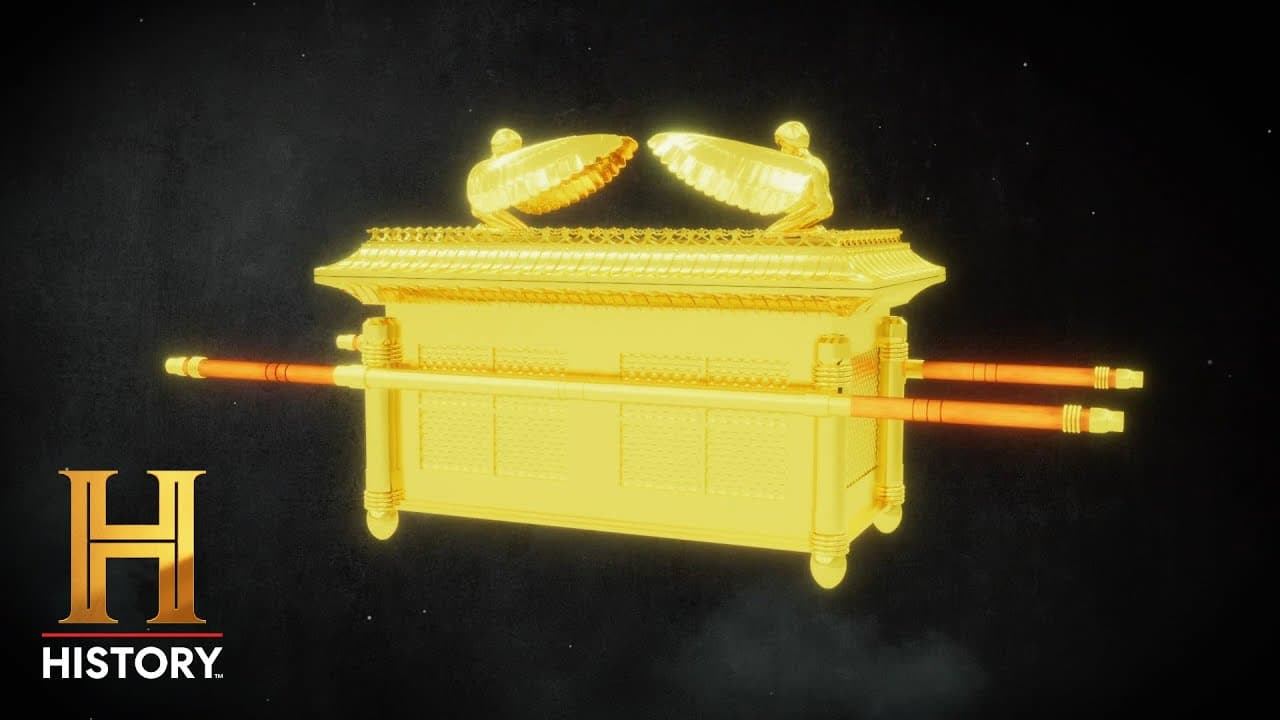
- The Ark of the Covenant is described as an acacia wood chest about 52 inches long, 31 inches wide and 31 inches high. It is covered in gold inside and out, has four gold rings for carrying poles, and a gold lid with two cherubim.
- King Solomon kept the Ark in the Holy of Holies of the first Jewish temple on the Temple Mount in Jerusalem. It was the focal point of religious devotion, the place where God was believed to speak to the world.
- The Babylonian destruction of Jerusalem in 587 BC is supported by archaeological evidence. Records of what Babylon looted never mention the Ark, which leads many historians to believe it was still in Jerusalem until then.
- Historians doubt that the Ark traveled to distant places such as Ethiopia or Ireland. With little time before the Babylonians arrived and the need to carry it on foot, it was most likely hidden somewhere close by.
- A tunnel found in 2007 by archaeologists Ronny Reich and Eli Shukron runs from the Temple Mount to outside the city, under the walls to the Kidron Valley. Its walls are up to 10 feet tall, enough to smuggle out large objects.
- The Copper Scroll, found in 1952 among the Dead Sea Scrolls and dated to the first century, lists 64 places where treasures are hidden. Its vague directions rely on landmarks that probably only locals would have known.
- Jim Barfield, a fire investigator for 23 years who has studied Qumran for 25 years, says three Copper Scroll locations line up in a straight line. The third is a sealed cave at the north end of a hill.
- Barfield's case for the cave rests on a lab result and metal detector readings. A lab in Skokie, Illinois, identified the cave's seal as man-made mortar from that period, and his detector found five times more metal there than at a site he linked to 33 tons of gold.
Install to Summarize YouTube Videos and Get Transcripts
Explore YouTube Video Summarizer or Get YouTube Transcript Extractor
Questions & Answers
Q: What did the Ark of the Covenant look like?
According to the Bible, the Ark of the Covenant was made of acacia wood, two and a half cubits long, one and a half cubits wide and one and a half cubits high, about 52 by 31 by 31 inches. It was covered entirely in gold inside and out and had four gold rings for carrying poles. Its ornate gold lid carried two cherubim sculptures.
Q: What happened to the Ark of the Covenant when Babylon destroyed Jerusalem?
In 587 BC the Babylonians attacked Jerusalem and destroyed it after a 30-month siege. They tore down the temple and set the city on fire, which may have burned the Ark. Babylon looted the city first, and the surviving records of what it took never mention the Ark. Many historians therefore think the Ark was still in Jerusalem until 587 BC and was possibly hidden rather than captured.
Q: Why do historians think the Ark of the Covenant stayed in the Middle East?
Theories place the Ark anywhere from Ethiopia to Ireland, but historians are skeptical that it traveled that far. With the Babylonians closing in, the Jews would have had little time, and the best option would have been to hide it. They would probably have carried it on foot, not taken it on a long voyage. That limits the search to a small radius around Jerusalem.
Q: What is the escape tunnel found under Jerusalem in 2007?
In 2007 archaeologists Ronny Reich and Eli Shukron found what they call an escape hatch: a tunnel running from the Temple Mount to outside the city, under the walls to the Kidron Valley. Its walls are up to 10 feet tall, enough room for priests to smuggle out many objects. This challenges the idea that nothing could leave Jerusalem while the Babylonians surrounded it.
Q: What is the Copper Scroll and how is it linked to the Ark?
The Copper Scroll is one of the Dead Sea Scrolls found at Qumran. It was discovered in 1952 and dates to the first century. Unlike most scrolls, which are papyrus or parchment with stories and scripture, it is made of copper and lists 64 places where items such as gold and silver are hidden. Ark hunter Jim Barfield believes these include treasures from Solomon's temple and the Ark of the Covenant.
Q: How did Jim Barfield identify locations from the Copper Scroll at Qumran?
Barfield matched the scroll's clues to features on the ground. For the first location, steps heading east and 40 cubits long, he found steps at Qumran measuring exactly 40 cubits, about 65 feet. For the second, a dry cistern at a great courtyard, he found a cistern beside a matching courtyard. Using satellite imagery, he then chose a hill for the third location, which sits in a straight line with the first two.
Q: What evidence suggests the sealed cave near Qumran holds treasure?
Barfield sent a stone sample from the sealed cave to a lab in Skokie, Illinois, which found it was man-made mortar of a common mixture from that period. In 2014 he returned with parliamentary delegate Moshe Feiglin and an industrial metal detector, calibrated on 30 pounds of silver buried in his own yard. At the cave it showed five times the metal he associated with the 33 tons of gold at location two.
Q: Has the Ark of the Covenant been found at Qumran?
No. Jim Barfield has not excavated any of his sites because Israeli authorities have not granted permission to dig. They allowed him to return in 2014 with more advanced equipment but did not approve an excavation. He is convinced that the sealed cave holds Israel's greatest treasures, including the Ark, but nothing has been dug up or confirmed.
Summary & Key Takeaways
-
According to Exodus, the Israelites built the Ark of the Covenant to hold the tablets of the Ten Commandments. God gave precise measurements for the gold-covered acacia chest. The Israelites carried it through the desert for 40 years, and King Solomon later placed it in the Holy of Holies of the temple in Jerusalem.
-
In 587 BC the Babylonians destroyed Jerusalem after a 30-month siege, burning the temple. Their records of loot never mention the Ark, so many historians think it was hidden nearby. A 2007 tunnel discovery from the Temple Mount to the Kidron Valley offers a possible escape route, and 2 Maccabees says Jeremiah removed it.
-
Jim Barfield follows the Kidron toward Qumran and uses the Copper Scroll, which lists 64 hidden treasure sites, to locate three of them. He found matching steps, a cistern with a courtyard, and a sealed cave with man-made mortar. His metal detector readings were strong, but he still needs permission to excavate.
Read in Other Languages (beta)
Share This Summary 📚
Summarize YouTube Videos and Get Video Transcripts with 1-Click
Try YouTube Summary with ChatGPT & Claude or YouTube Transcript Generator
Explore More Summaries from HISTORY 📚


Summarize YouTube Videos and Get Video Transcripts with 1-Click
Try YouTube Summary with ChatGPT & Claude or YouTube Transcript Generator