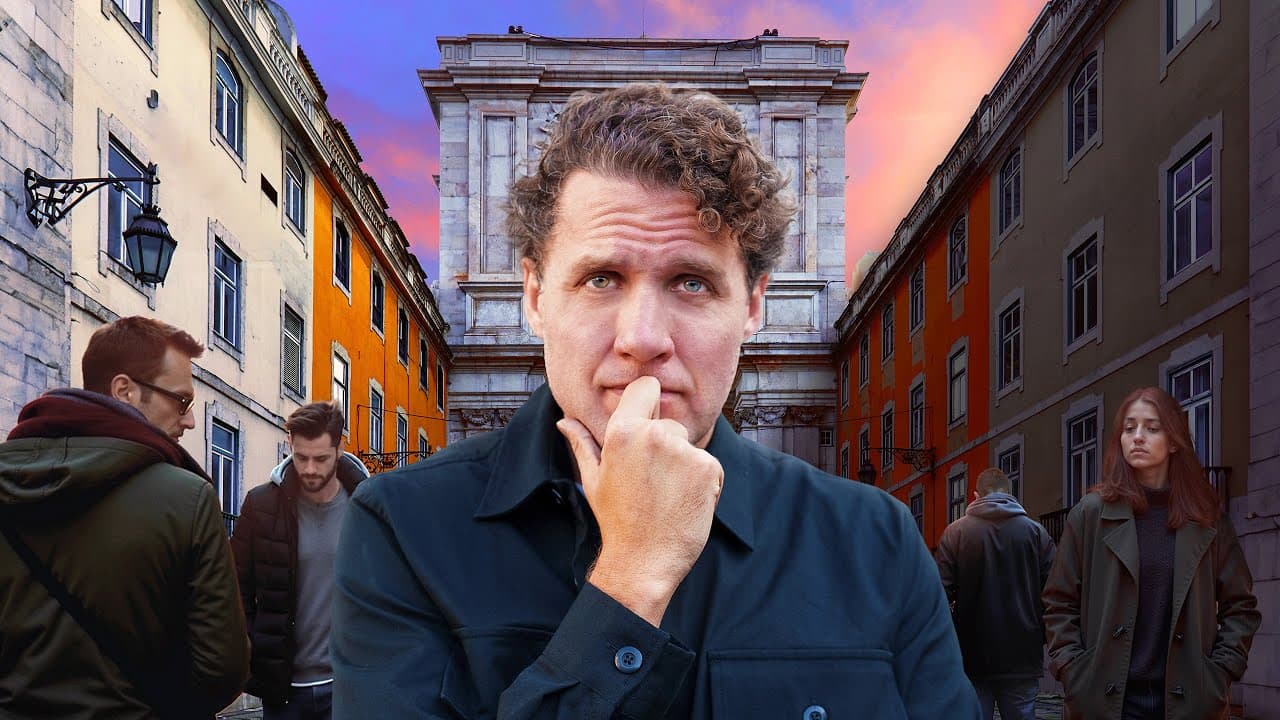
Why Is Anxiety So Widespread in Portugal?
TL;DR
Portugal’s unusually high anxiety rates may be linked less to poverty, religion, war, or isolation than to a culture of uncertainty avoidance, conformity, and fear of external judgment. The account connects these patterns with traditional social expectations and chronic modern stress, while emphasizing that anxiety is a normal protective emotion that becomes harmful when the body faces pressure continuously.
Transcript
- Antonio Salazar is the most successful fascist ever, and you've probably never heard of him. He ruled far longer than this guy, controlled more territory than this guy, and faced way less political opposition than this guy. Now, unlike the other fascist, Salazar came to power reluctantly. He was a boring bureaucrat. He had no romantic visions of ... Read More
Key Insights
- Portugal’s reported anxiety levels are unusually high despite its quiet and peaceful reputation. The transcript says Portugal ranked first in generalized anxiety disorder diagnoses in a large 1990 international survey and cites regular anxiety among 75% of Portuguese college students.
- Economic hardship is presented as an incomplete explanation for Portugal’s anxiety. The country’s unemployment is described as middle of the European Union range, its poverty rate as below average, and its average workweek as 37 hours, while richer countries reportedly tend to show more anxiety.
- Uncertainty avoidance is a cultural tendency to dislike ambiguity and prefer conformity. Geert Hofstede associated cultures high in this trait with persistent anxiety about external judgment or disruption, and Portugal received the highest uncertainty-avoidance score in the dataset discussed.
- Portuguese social expectations can discourage risk-taking and reward following the crowd. Clinical psychologist Sara Crispim describes disproportionate pressure to conform, suggesting that uncertainty, social judgment, and disruption may feel especially threatening within the country’s traditional culture.
- Football illustrates anxious anticipation because goals are scarce and every pass, dribble, or mistake can feel unusually significant. A goal then produces cathartic release, although the transcript explicitly says football fandom itself does not correlate with anxiety.
- Portugal’s football system mirrors broader concerns about inequality and outward migration. Corruption and financial mismanagement reportedly weaken the domestic league, create large gaps between teams, and encourage talented players to leave, with 21 of 26 current men’s national team players competing abroad.
- Religion alone does not explain Portugal’s anxiety in the account presented. The transcript cites research associating religiosity with happiness, stronger relationships, lower stress, and longer life, while Portugal’s communal and family-oriented culture also makes social isolation an unlikely primary explanation.
- Anxiety is a normal emotion with an evolutionary protective function. It increases alertness, worry, and attention to possible threats, but human bodies are described as better prepared for acute stress than for the chronic pressure created by schedules, traffic, appointments, and constant connectivity.
Install to Summarize YouTube Videos and Get Transcripts
Explore YouTube Video Summarizer or Get YouTube Transcript Extractor
Questions & Answers
Q: Why is anxiety so widespread in Portugal?
The transcript proposes that Portugal’s anxiety is connected to high uncertainty avoidance, strong pressure to conform, reluctance to take risks, and concern about external judgment or disruption. Economic stress and traditional expectations may be effects of a deeper cultural tendency rather than complete causes. The account also notes that modern routines expose people to chronic stress, while anxiety evolved primarily to handle acute threats.
Q: How high are reported anxiety levels in Portugal?
The transcript says Portugal placed first worldwide for generalized anxiety disorder diagnoses in the first large international survey of the condition in 1990. It also states that 75% of Portuguese college students report struggling with anxiety regularly. The figures offered for comparison are 44% among college students in the United States and 31% within the European Union.
Q: Does economic insecurity explain Portugal’s anxiety?
Economic insecurity is presented as a popular but insufficient explanation. Journalists mentioned low wage growth, unemployment, and living costs, yet the transcript describes Portugal’s unemployment as middle of the European Union range, its poverty rate as below average, and its average workweek as 37 hours. It also says richer countries generally experience more anxiety, complicating a simple relationship between poverty and anxiety.
Q: What is uncertainty avoidance, and how does it relate to anxiety?
Uncertainty avoidance is one of the six cultural measures associated with social psychologist Geert Hofstede. Cultures scoring highly on it strongly dislike ambiguity and tend to be conformist. Their defining features reportedly include persistent anxiety about outside judgment or disruption. Portugal scored highest on uncertainty avoidance in the dataset discussed, supporting the argument that cultural discomfort with unpredictability may contribute to widespread anxiety.
Q: Did Salazar’s dictatorship cause Portugal’s anxiety?
The transcript does not establish Salazar’s dictatorship as the sole cause. His regime promoted a quiet, traditional life centered on family, church, and the three Fs: fado, Fatima, and futebol. After the regime collapsed and Portugal became democratic in the 1970s, studies found unusually high generalized anxiety. However, the account asks whether Portuguese traditionalism came from the dictatorship or from something deeper, leaving direct causation unresolved.
Q: Does Catholicism explain Portugal’s high anxiety levels?
Catholicism is considered but rejected as a sufficient explanation. The transcript says psychological research connects religiosity with better mental health outcomes, including greater happiness, better relationships, lower stress, and longer life. It also argues that strict religious pressure cannot explain the pattern because most Muslim countries reportedly have relatively low anxiety rates. The focus therefore shifts from religion generally to Portugal’s distinctive response to Fatima.
Q: What does Fatima reveal about Portuguese culture?
Fatima became a pilgrimage destination after three young shepherds reported seeing the Virgin Mary in 1917, followed by a gathering of more than 30,000 people on October 13. The transcript emphasizes that Portuguese believers largely financed the enormous site through pilgrim donations, while church recognition took decades. This response is interpreted as evidence of a distinctive cultural force, although it is not presented as direct proof of anxiety’s cause.
Q: What is the evolutionary purpose of anxiety?
Anxiety is described as a normal emotion that helps people become more alert, preoccupied, and attentive to possible danger. These responses make sense as adaptations to threats experienced across human history. The problem is that the body and brain are portrayed as prepared for acute stress, not continuous pressure. Modern schedules, traffic, appointments, shifting work hours, family demands, and constant connectivity can therefore keep the response activated chronically.
Summary & Key Takeaways
-
Portugal has recorded exceptionally high anxiety levels despite its peaceful image. The transcript cites a major international survey from 1990 that placed Portugal first for generalized anxiety disorder diagnoses, while 75% of Portuguese college students reportedly experience regular anxiety, compared with 44% in the United States and 31% across the European Union.
-
Economic insecurity initially appears to explain Portugal’s anxiety, but the cited comparisons complicate that theory. Portugal’s unemployment is described as average within the European Union, its poverty rate as below average, and its average workweek as 37 hours. Research mentioned in the transcript also associates greater national wealth, not poverty, with higher anxiety.
-
The proposed cultural explanation centers on conformity, risk avoidance, and discomfort with ambiguity. Portugal scored highest for uncertainty avoidance in Geert Hofstede’s dataset, a trait associated with anxiety about judgment or disruption. The discussion ultimately frames anxiety as an evolved response that struggles under continuous pressures, demanding schedules, constant connectivity, and chronic modern stress.
Read in Other Languages (beta)
Share This Summary 📚
Summarize YouTube Videos and Get Video Transcripts with 1-Click
Try YouTube Summary with ChatGPT & Claude or YouTube Transcript Generator
Explore More Summaries from Mark Manson 📚





Summarize YouTube Videos and Get Video Transcripts with 1-Click
Try YouTube Summary with ChatGPT & Claude or YouTube Transcript Generator