Which Books Offer Practical Lessons for Life?

TL;DR
Start creating before fear disappears, focus on what you can control, and turn mistakes into adaptable principles. The featured books also argue that persistence matters when plans collapse, perceived limits may arrive before actual capacity, desire needs some mystery, people-pleasing restricts freedom, and constant self-optimization can produce burnout rather than fulfillment.
Transcript
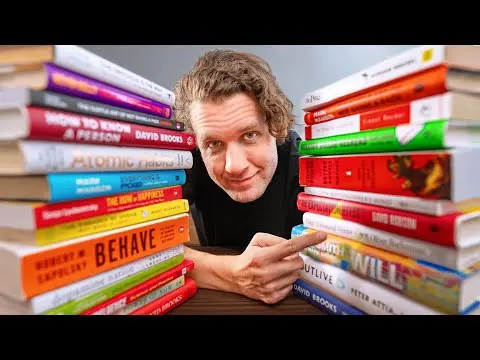
- You're busy, I'm busy, but we all wanna be smart and learn a lot of stuff. So let me save you a little bit of time by summarizing the 22 books that have changed my life, starting with "Big Magic" by Elizabeth Gilbert. It's not that you aren't creative, it's that you're just scared. Scared of sucking, scared of being unoriginal or worse, scared th... Read More
Key Insights
- Creative courage is acting while fear remains, not waiting until uncertainty disappears. Big Magic argues that creators should accept possible failure, unoriginality, or indifference, answer inspiration when it appears, make the best work they can, and leave judgments about its reception to other people.
- Business success is often sustained through disorder rather than produced by a polished plan. Shoe Dog describes Nike growing faster than its available money while Phil Knight pursued loans, handled lawsuits, and taught accounting, illustrating how hard work, teamwork, intelligence, determination, persistence, and luck can all affect outcomes.
- The 40% rule is David Goggins’ claim that the mind may announce exhaustion when only 40% of a person’s capacity has been used. Can’t Hurt Me presents transformation as mental warfare against self-imposed limits and pairs its autobiography with chapter challenges intended to turn reading into action.
- Long-term desire is supported by balancing security with uncertainty. Mating in Captivity argues that love draws strength from safety and stability, while desire feeds on mystery and risk. Couples can preserve passion by remaining curious and treating their partners as people who cannot be completely known.
- The separation of tasks is a way to distinguish living by personal values from managing other people’s responses. The Courage to Be Disliked argues that the past does not define a person as strongly as their interpretation of it, and that universal approval is incompatible with autonomous living.
- Stoic control is the practice of concentrating on one’s attitude, thoughts, and actions while releasing attempts to govern external events. Meditations presents this advice through Marcus Aurelius’s private reflections during invasions, betrayal, and plagues, showing that unpredictability does not require an unpredictable inner response.
- Personal principles are adaptable lessons extracted from both mistakes and successes. Principles recommends identifying a goal, finding the obstacles, designing a plan, executing it, and then reflecting to improve. Its broader message is that people should document their own principles instead of merely adopting Ray Dalio’s.
- Burnout is portrayed as a consequence of self-imposed achievement pressure, not only external discipline. The Burnout Society connects constant busyness, endless self-optimization, and hustle culture with exhaustion and distress, then recommends slowing down, reducing noise, and recovering the capacity to experience boredom.
Install to Summarize YouTube Videos and Get Transcripts
Explore YouTube Video Summarizer or Get YouTube Transcript Extractor
Questions & Answers
Q: How can creative people act despite fear of failure?
Creative people can begin before they feel confident and treat fear as a normal companion to meaningful work. Big Magic advises saying yes when inspiration appears, even when the timing is inconvenient. The creator’s responsibility is to make something as well as possible, while the audience decides whether it likes the result. Separating those responsibilities reduces the urge to wait for permission or a perfect plan.
Q: What does Shoe Dog teach about building a business?
Shoe Dog teaches that building a successful company can involve prolonged instability, scarce cash, legal trouble, and repeated improvisation. Nike reportedly grew faster than its bank account for more than a decade, and Phil Knight scrambled for loans while also teaching accounting. His account emphasizes hard work, a strong team, intelligence, determination, and persistence, while acknowledging that luck may still decide the eventual outcome.
Q: What is the 40% rule in Can’t Hurt Me?
The 40% rule is David Goggins’ assertion that when the mind says a person is finished, that person may have reached only 40% of their actual capacity. The idea is that the mind often quits before the body must stop. Goggins developed this outlook through demanding experiences, including SEAL training and 100-mile races, and the book includes challenges designed to make readers practice transformation rather than merely admire it.
Q: How can couples keep desire alive in a long-term relationship?
Couples can support desire by preserving curiosity, individuality, mystery, and some sense of risk alongside love’s safety and stability. Mating in Captivity argues that greater closeness does not automatically create greater passion and may sometimes weaken the sexual spark. Instead of assuming a partner is fully known, each person can approach the relationship as an unfinished story and remain interested in what has not yet been discovered.
Q: What does the separation of tasks mean?
The separation of tasks means distinguishing your responsibility to act according to your values from another person’s responsibility for their reaction. You are not responsible for guaranteeing parental pride or controlling how a partner responds to honest speech. The Courage to Be Disliked presents this distinction as a way to reduce people-pleasing, accept possible disapproval, and stop organizing life around the impossible goal of satisfying everyone.
Q: How does Meditations recommend handling uncertainty?
Meditations recommends focusing attention on what you can control and releasing concern over what you cannot. External events remain unpredictable, even for a powerful ruler facing invasions, betrayal, and plagues, but personal attitude, thoughts, and actions can still be directed deliberately. Marcus Aurelius wrote these reflections for himself, and their practical lesson is to avoid wasting energy on outcomes that lie beyond personal control.
Q: How can someone create useful personal principles?
Useful personal principles can be created by examining both failures and successes, extracting a lesson, and applying that lesson to later decisions. Principles proposes a cycle: know what you want, identify what blocks it, design a plan, execute the plan, and reflect so the approach can be refined. Because principles are adaptable rather than rigid, the broader objective is to build an operating system suited to your own experience.
Q: Why does constant achievement pressure lead to burnout?
Constant achievement pressure can lead to burnout because people repeatedly demand more from themselves and never experience completion. The Burnout Society contrasts an older culture of discipline with a culture centered on achievement, winning, and endless self-improvement. In that environment, busyness and exhaustion become self-imposed. The proposed response is to slow down, shut out some noise, and regain the ability to be bored instead of continually adding new pursuits.
Summary & Key Takeaways
-
Creative and entrepreneurial work requires action amid fear and uncertainty. Big Magic separates making work from controlling its reception, while Shoe Dog portrays Nike’s early growth as chaotic and financially precarious. Together, they reject the fantasy of a perfect plan and emphasize starting, persevering, building a capable team, and accepting luck’s influence.
-
Several books treat personal agency as a matter of managing interpretations, choices, and effort. Can’t Hurt Me challenges assumed mental limits, The Courage to Be Disliked recommends separating your responsibilities from other people’s reactions, and Meditations advises directing attention toward your own attitude, thoughts, and actions instead of uncontrollable external events.
-
Relationships, work, and achievement require tensions to be managed rather than eliminated. Mating in Captivity contrasts love’s safety with desire’s appetite for mystery, while The Course of Love portrays commitment after early romance. Principles promotes reflection after every result, and The Burnout Society warns that relentless self-improvement can become self-imposed exhaustion.
Read in Other Languages (beta)
Share This Summary 📚
Summarize YouTube Videos and Get Video Transcripts with 1-Click
Try YouTube Summary with ChatGPT & Claude or YouTube Transcript Generator
Explore More Summaries from Mark Manson 📚


Summarize YouTube Videos and Get Video Transcripts with 1-Click
Try YouTube Summary with ChatGPT & Claude or YouTube Transcript Generator