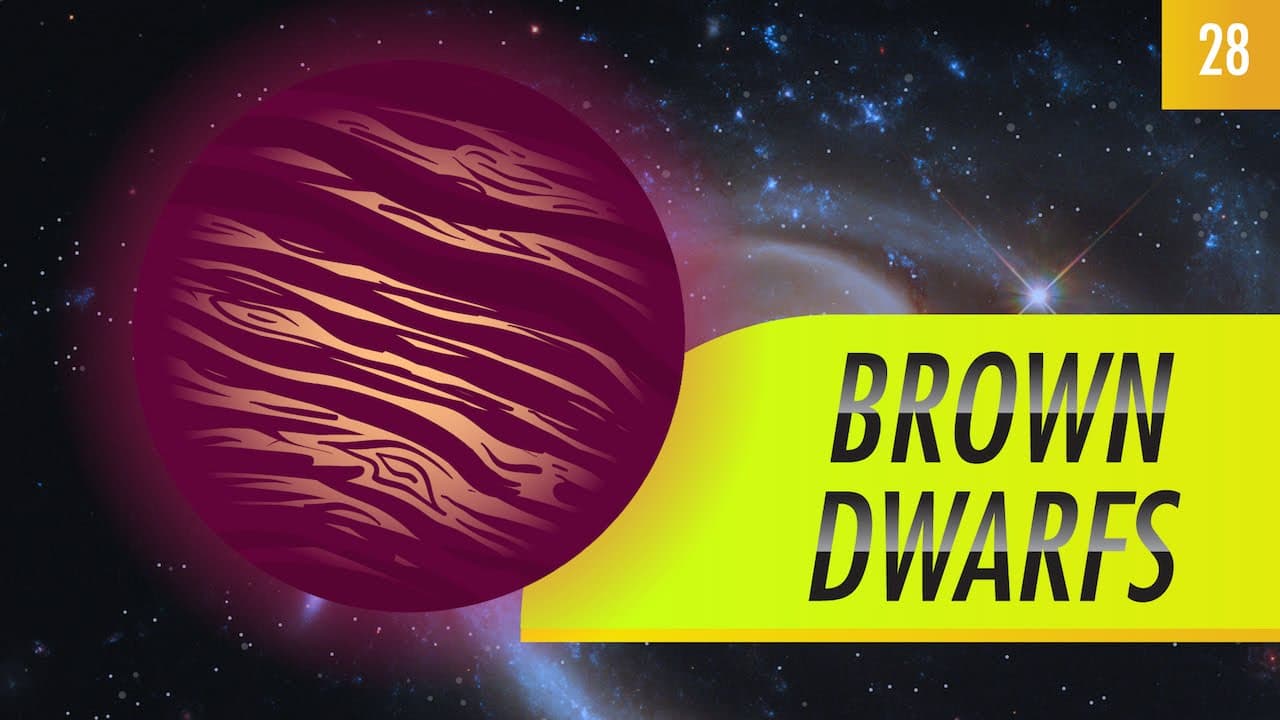
Brown Dwarfs: Crash Course Astronomy #28
TL;DR
Brown dwarfs are objects between planets and stars, lacking hydrogen fusion.
Transcript
The sky, we now know, is full of stars AND planets. Stars are massive enough to fuse hydrogen into helium in their cores, generating energy. The heat created by that process tries to expand them, but their gravity balances that outward force, creating an equilibrium. Planets, even gas giants like Jupiter, are far too small to generate fusion. The s... Read More
Key Insights
- Brown dwarfs are celestial objects that have a mass between that of giant planets and small stars, lacking the mass to initiate hydrogen fusion.
- The concept of brown dwarfs emerged in the 1960s when astronomers realized objects could exist with mass insufficient to sustain hydrogen fusion.
- Brown dwarfs can fuse deuterium and lithium but not hydrogen, distinguishing them from true stars and highlighting their unique characteristics.
- The first brown dwarf, Teide 1, was discovered in 1995, identified by its lithium content, which is absent in regular stars.
- Brown dwarfs exhibit unique spectral characteristics, sometimes appearing magenta due to atmospheric molecules absorbing specific light wavelengths.
- The discovery of Gliese 229b, a brown dwarf with methane in its atmosphere, led to the classification of T dwarfs, expanding the star classification system.
- The physical properties of brown dwarfs are peculiar; they become denser rather than larger as mass increases, unlike most celestial objects.
- The nearest known brown dwarfs, Luhman 16, are only 6.5 light years away, raising questions about potentially undiscovered nearby brown dwarfs.
Install to Summarize YouTube Videos and Get Transcripts
Explore YouTube Video Summarizer or Get YouTube Transcript Extractor
Questions & Answers
Q: What distinguishes brown dwarfs from regular stars?
Brown dwarfs differ from regular stars primarily because they lack the mass needed to sustain hydrogen fusion in their cores. While they can fuse deuterium and lithium, they cannot maintain the hydrogen fusion process that characterizes true stars. This inability to sustain hydrogen fusion is a key factor in distinguishing brown dwarfs from traditional stars.
Q: How was the first brown dwarf discovered?
The first brown dwarf, Teide 1, was discovered in 1995 by astronomers observing the Pleiades star cluster. They identified Teide 1 as a brown dwarf due to its low mass and the presence of lithium in its spectrum, a characteristic absent in regular stars. This discovery confirmed the existence of brown dwarfs and expanded our understanding of celestial objects.
Q: What are the spectral characteristics of brown dwarfs?
Brown dwarfs exhibit unique spectral characteristics due to their atmospheric composition. They often appear magenta because molecules in their atmospheres, such as methane and water vapor, absorb specific wavelengths of light. This absorption alters their color, making them distinct from other celestial objects. Their spectra also show strong infrared emissions, further distinguishing them.
Q: Why are brown dwarfs difficult to classify?
Brown dwarfs are challenging to classify because they share characteristics with both planets and stars. They form from collapsing gas clouds like stars but lack the mass for hydrogen fusion. Their classification is further complicated by their spectral similarities to low-mass stars and their ability to fuse deuterium and lithium, requiring new categories like T and Y dwarfs.
Q: What is the significance of the lithium test in identifying brown dwarfs?
The lithium test is significant in identifying brown dwarfs because it provides a method to distinguish them from regular stars. Brown dwarfs retain lithium in their spectra, as they lack the mass to fuse it, unlike stars that quickly deplete their lithium. This test helps astronomers confirm the sub-stellar nature of brown dwarfs and differentiate them from other celestial objects.
Q: How do brown dwarfs challenge traditional astronomical classifications?
Brown dwarfs challenge traditional astronomical classifications by existing in a mass range between planets and stars, lacking hydrogen fusion. Their discovery necessitated new spectral categories like T and Y dwarfs. Their formation and characteristics blur the lines between planets and stars, prompting astronomers to reconsider definitions and classifications within the celestial hierarchy.
Q: What are the physical characteristics of brown dwarfs?
Brown dwarfs have unique physical characteristics, notably their density. As they gain mass, they become denser rather than larger, unlike most celestial objects. This is due to the high density at their cores, affecting their physical structure. Their atmospheres can contain vaporized metals, leading to phenomena like molten iron rain, illustrating their distinct nature.
Q: Could there be undiscovered brown dwarfs closer to Earth than known stars?
While the nearest known brown dwarfs, Luhman 16, are 6.5 light years away, there is a possibility of undiscovered brown dwarfs closer to Earth. These objects are faint and cool, making them difficult to detect. Advances in infrared astronomy and sky surveys may reveal closer brown dwarfs, potentially altering our understanding of the nearest celestial neighbors.
Summary & Key Takeaways
-
Brown dwarfs are intermediate objects between planets and stars, unable to sustain hydrogen fusion due to their insufficient mass. They can, however, fuse deuterium and lithium, distinguishing them from regular stars. Discovered in the 1990s, thousands are now known, with unique characteristics and spectral properties.
-
The discovery of brown dwarfs challenged existing astronomical classifications, leading to new categories like T and Y dwarfs. These objects exhibit distinct spectral features, sometimes appearing magenta due to atmospheric molecules. Their physical nature is unusual, as they become denser with increased mass rather than larger.
-
Astronomers continue to explore the characteristics and distribution of brown dwarfs, with discoveries like Luhman 16, the third closest star system to Earth. The study of brown dwarfs enhances our understanding of celestial objects, bridging the gap between planets and stars, and expanding our knowledge of the universe.
Read in Other Languages (beta)
Share This Summary 📚
Summarize YouTube Videos and Get Video Transcripts with 1-Click
Try YouTube Summary with ChatGPT & Claude or YouTube Transcript Generator
Explore More Summaries from CrashCourse 📚





Summarize YouTube Videos and Get Video Transcripts with 1-Click
Try YouTube Summary with ChatGPT & Claude or YouTube Transcript Generator