How to Tell If a Molecule Is Polar or Nonpolar
TL;DR
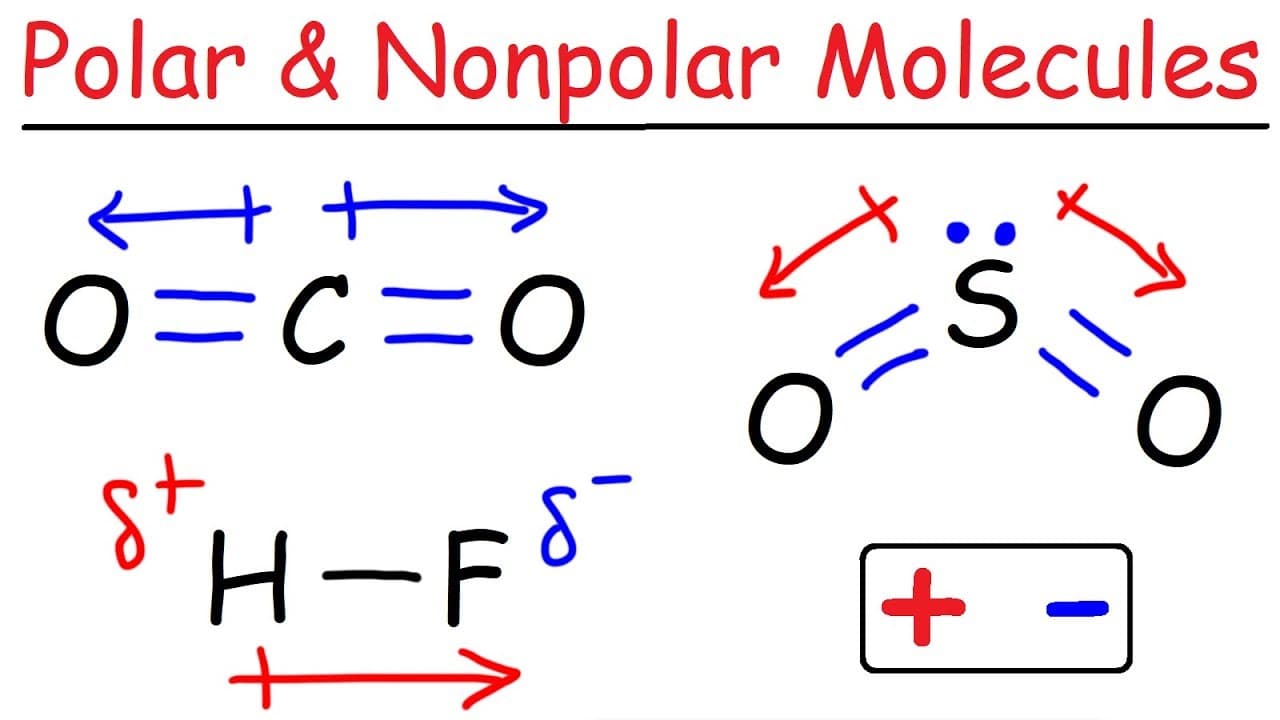
To determine whether a molecule is polar or nonpolar, check its elements and bonds, then use its geometry to see whether the bond dipole moments cancel. A bond is classified as polar when its electronegativity difference is at least 0.5; however, carbon tetrafluoride is nonpolar because its four dipoles cancel, while water is polar because it has a net dipole moment. Read on for rules, calculations, and examples.
Transcript
in this video we're gonna talk about how to tell if a molecule is polar or nonpolar but first we need to understand what it means for something to be pulling and so what I'm gonna do is I'm gonna draw four objects and I want you to determine which of these four objects is polarized so how would you describe these four objects let's start with the o... Read More
Key Insights
- 🐻❄️ Polar molecules have an unequal sharing of electrons, resulting in one side being positive and the other side being negative.
- 🟰 Nonpolar molecules have an equal sharing of electrons and do not have a separation of charge.
- 🅰️ Molecules that contain only one type of element or only carbon and hydrogen are always nonpolar.
- 🐻❄️ The geometry of a molecule can determine its overall polarity, even if it contains polar bonds.
- 🫀 The electronegativity difference between atoms in a bond must be greater than or equal to 0.5 for the bond to be considered polar.
- 🪐 Dipole moments can be used to determine the polarity of a molecule, with a net dipole moment indicating polarity.
- ❓ The Lewis structure of a molecule can be helpful in determining its polarity.
Install to Summarize YouTube Videos and Get Transcripts
Explore YouTube Video Summarizer or Get YouTube Transcript Extractor
Questions & Answers
Q: How can you determine whether a molecule is polar or nonpolar?
First check whether the molecule contains only one element or only carbon and hydrogen, because those molecules are nonpolar. Otherwise, identify polar bonds from electronegativity differences, draw the molecular geometry, and determine whether the bond dipole moments cancel. A net dipole moment makes the molecule polar.
Q: What is the difference between polar and nonpolar molecules?
A polar molecule has unequal electron sharing, producing a partial positive region and a partial negative region. A nonpolar molecule shares electrons relatively equally or has bond dipoles that cancel, so it has no overall separation of charge.
Q: What electronegativity difference makes a bond polar?
The transcript classifies a bond as polar when the electronegativity difference between its atoms is greater than or equal to 0.5. A smaller difference is treated as nonpolar.
Q: Why is hydrofluoric acid polar?
Fluorine has an electronegativity of 4.0, while hydrogen has a value of 2.1. Fluorine pulls the shared electrons toward itself, giving it a partial negative charge and leaving hydrogen with a partial positive charge. This separation of charge makes the molecule polar.
Q: Why are molecules made from only one element nonpolar?
When a molecule contains identical atoms, the atoms share electrons equally. Therefore, molecules such as H2, N2, O2, F2, Br2, Cl2, and I2 are nonpolar.
Q: Why are hydrocarbons nonpolar?
Hydrocarbons contain only carbon and hydrogen. Carbon has an electronegativity of about 2.5 and hydrogen has a value of 2.1, giving a difference of 0.4. Because that is below 0.5, the carbon-hydrogen bond is classified as nonpolar.
Q: Can a molecule with polar bonds be nonpolar overall?
Yes. Carbon tetrafluoride has polar carbon-fluorine bonds with an electronegativity difference of 1.5, but its tetrahedral geometry arranges the four dipoles so they cancel. Its net dipole moment is zero, making the molecule nonpolar overall.
Q: Why is water a polar molecule?
The oxygen-hydrogen bond is polar because oxygen has an electronegativity of 3.5 and hydrogen has a value of 2.1, a difference of 1.4. Water's oxygen also has two lone pairs, and its dipole arrows point toward oxygen without canceling. The resulting net dipole moment makes water polar.
Summary & Key Takeaways
-
Polar molecules have an unequal sharing of electrons, resulting in one side being positive and the other side being negative.
-
Nonpolar molecules have an equal sharing of electrons and do not have a separation of charge.
-
To determine if a molecule is polar or nonpolar, consider if it contains only one type of element, if it is a hydrocarbon, and the geometry of the molecule.
Read in Other Languages (beta)
Share This Summary 📚
Summarize YouTube Videos and Get Video Transcripts with 1-Click
Try YouTube Summary with ChatGPT & Claude or YouTube Transcript Generator
Explore More Summaries from The Organic Chemistry Tutor 📚




Summarize YouTube Videos and Get Video Transcripts with 1-Click
Try YouTube Summary with ChatGPT & Claude or YouTube Transcript Generator