How Does AI Change Cybersecurity Governance?
TL;DR
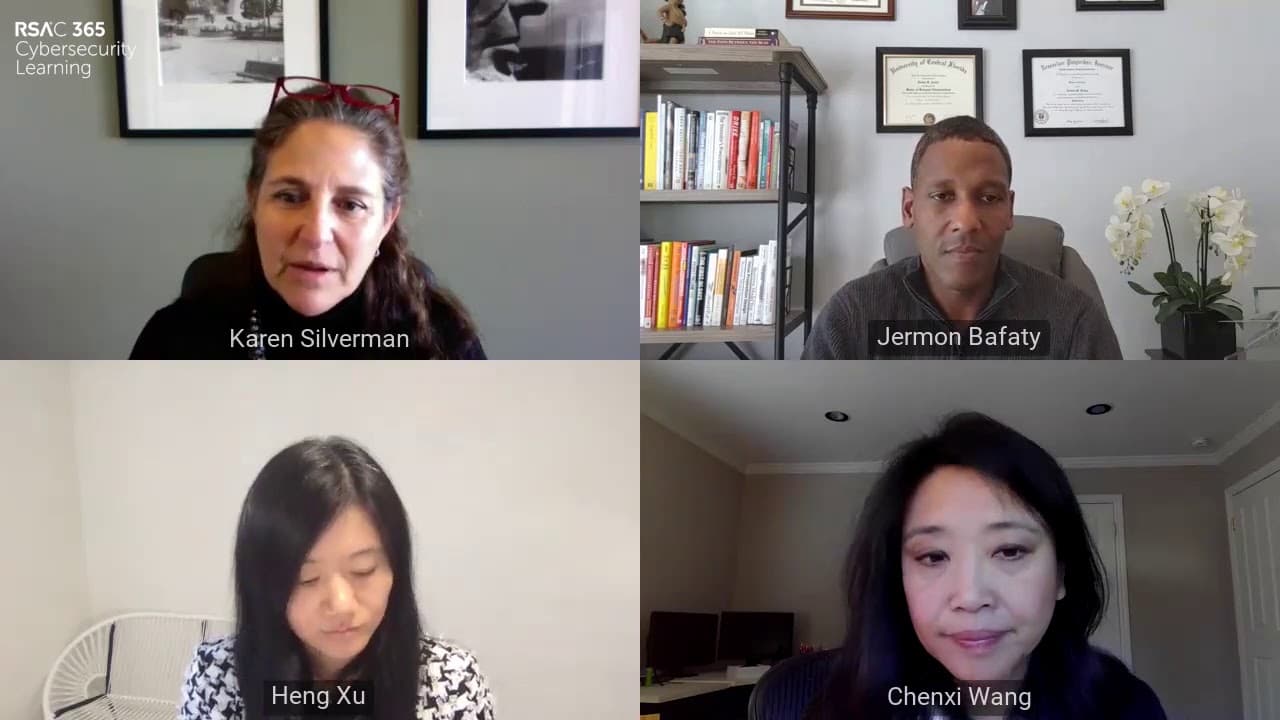
AI strengthens cybersecurity through large-scale pattern analysis, prediction, and threat detection, but it also gives malicious actors accessible tools for finding vulnerabilities and spreading attacks quickly. Effective governance must address this dual use, examine unintended consequences, and coordinate decisions across business, government, and academia while accounting for privacy, fairness, and ambiguous boundaries between espionage and conflict.
Transcript
Hello. Thank you, um, Casey. Delighted to be here and, and gathered with everybody. Um, I am a, uh, lapsed lawyer, um, by training, and, and now really spending most of my time working in and around artificial intelligence and other frontier technologies, particularly as, um, they are implemented, and working specifically with leadership in governm... Read More
Key Insights
- AI is both a cybersecurity defense capability and a threat multiplier. Its processing and pattern-detection strengths can support prediction and detection, while its availability can also equip malicious actors to identify weaknesses, scale errors, and spread harmful activity rapidly.
- Cybersecurity defense is structurally asymmetric because defenders must anticipate many possible compromises, while an attacker needs to find only one exploitable weakness. AI and accessible open-source technologies can strengthen the attacker’s ability to search repeatedly for that single vulnerability.
- Communication platforms are sufficiently interconnected for vulnerabilities to spread quickly. A weakness in a commonly used platform can affect organizations across industry and government, especially when information and attack techniques move rapidly through broadly accessible channels.
- AI governance is necessary because technological development may advance faster than understanding of its societal effects. The panel identifies rapid deployment, limited assessment, and emerging algorithms not yet applied to cybersecurity as simultaneous sources of concern and opportunity.
- Unintended consequences can arise from technologies designed for beneficial purposes. Evaluating an AI or privacy mechanism requires examining not only its original goal, but also its effects on fairness, business decisions, research quality, security, and affected communities.
- Data anonymization can protect consumer privacy while reducing analytical value. In health-related datasets, removing identifying indicators may prevent practitioners or researchers from detecting disparities, creating tension between privacy protection and the preservation of socially valuable information.
- Cyber activity can occur below the threshold of traditional conflict. Governments and economies must assess whether particular behavior represents surveillance, digital espionage, or an act of war, even when established definitions and response boundaries remain uncertain.
- Cross-sector collaboration is central to responsible AI security strategy. Academia, government, and industry contribute different perspectives to governance frameworks, real-world applications, investment decisions, operations, privacy research, and responses to threats from state and non-state actors.
Install to Summarize YouTube Videos and Get Transcripts
Explore YouTube Video Summarizer or Get YouTube Transcript Extractor
Questions & Answers
Q: How does AI improve cybersecurity threat detection?
AI can improve cybersecurity by processing large amounts of information, identifying patterns, and supporting the prediction and detection of risks. These capabilities can help security teams recognize suspicious behavior and develop ways to neutralize threats. The same analytical strengths require governance, however, because AI can also scale mistakes or be used by malicious actors to search for vulnerabilities.
Q: Why can AI increase cybersecurity risks?
AI can increase cybersecurity risks by placing powerful and accessible tools in the hands of malicious actors. Attackers can experiment with open-source technologies until they discover a weakness in an application, including one developed over several years. Because communication platforms are highly interconnected, knowledge of a vulnerability can spread quickly and affect commonly used systems across business and government.
Q: Why do attackers have an advantage over cybersecurity defenders?
Attackers can have an advantage because a defending organization must consider many possible ways its systems could be compromised, while a malicious actor needs to find only one exploitable flaw. Access to open-source technology reduces the required level of sophistication and supports repeated experimentation. This imbalance becomes more serious when the targeted platform is widely used across multiple organizations or sectors.
Q: What unintended consequences can AI governance address?
AI governance can address effects that differ from a technology’s intended purpose, including impacts on privacy, fairness, research, business strategy, and society. A well-intended mechanism may solve one problem while creating another. The panel therefore emphasizes examining technologies after deployment and considering how design choices influence different objectives, users, institutions, and affected groups rather than focusing on technical performance alone.
Q: How can data anonymization interfere with health disparity research?
Data anonymization is intended to protect consumer privacy, but it can remove valuable information and indicators from a dataset. When health practitioners or researchers need to detect health disparities, those missing details may weaken or prevent the analysis. The example shows that privacy-enhancing technology can produce unintended consequences when protection methods conflict with the dataset’s socially valuable research purpose.
Q: How should business leaders approach cybersecurity governance?
Business leaders should incorporate cybersecurity into daily strategy and evaluate emerging technologies from governance as well as technical perspectives. Their decisions should consider threat detection, privacy protection, fairness, analytical usefulness, and unintended consequences. They should also work with expertise from academia, government, finance, operations, law, and cybersecurity because AI-related risks and benefits cross traditional organizational and disciplinary boundaries.
Q: Why is cyber conflict difficult for governments to classify?
Cyber activity often occurs just below the threshold of traditional conflict, which makes classification and response difficult. Governments, economies, and organizations may need to distinguish voyeuristic surveillance, digital espionage, and an act of war without settled boundaries. Competition among state and non-state actors adds further complexity because positioning and hostile behavior can take place continuously within cyberspace without becoming conventional conflict.
Q: Why is collaboration important for AI cybersecurity frameworks?
Collaboration brings together the different expertise needed to govern AI and apply it to real security problems. Academia can study privacy, fairness, and unintended consequences. Government can examine national threats and conflict boundaries. Industry can contribute operational, investment, scaling, and implementation experience. Coordinating these perspectives can support frameworks that reflect both AI’s defensive value and its capacity to amplify cybersecurity risks.
Summary & Key Takeaways
-
AI and cybersecurity have a dual relationship. Artificial intelligence can improve prediction, pattern detection, risk analysis, and threat neutralization, yet the same capabilities can help malicious actors discover vulnerabilities. Widely available open-source technology and lower technical barriers can intensify this imbalance and allow weaknesses to spread across commonly used platforms.
-
Cybersecurity governance must consider unintended consequences rather than evaluating a technology only by its intended purpose. Data anonymization illustrates the problem: protecting consumer privacy can remove information needed by health practitioners or researchers to detect disparities. Privacy, security, fairness, and analytical usefulness therefore require careful consideration together.
-
Cyber threats also create strategic uncertainty for governments and businesses. Activity in cyberspace can remain below the threshold of traditional conflict, making it difficult to distinguish surveillance, digital espionage, and acts of war. Collaboration among academia, government, and industry can help develop frameworks and apply AI to practical security problems.
Read in Other Languages (beta)
Share This Summary 📚
Summarize YouTube Videos and Get Video Transcripts with 1-Click
Try YouTube Summary with ChatGPT & Claude or YouTube Transcript Generator
Explore More Summaries from RSAC Cybersecurity 📚




Summarize YouTube Videos and Get Video Transcripts with 1-Click
Try YouTube Summary with ChatGPT & Claude or YouTube Transcript Generator