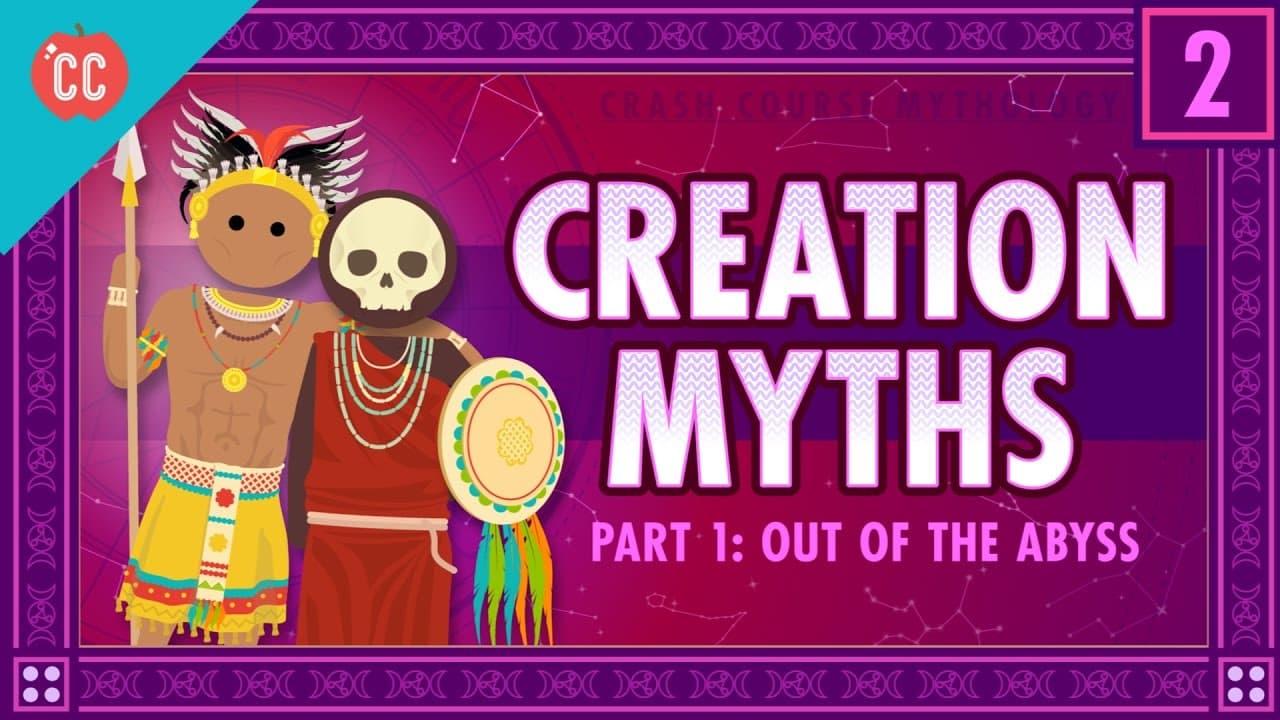
Creation from the Void: Crash Course World Mythology #2
TL;DR
Explores various creation myths and their significance.
Transcript
Hi, I'm Mike Rugnetta, this is Crash Course Mythology, and today, we're going to talk about a small, easy topic: The creation of the Universe. This is the first of several episodes on creation stories, and this one will center on myths that imagine a universe created out of nothing. Or possibly something. Sometimes out of water– Probably water, but... Read More
Key Insights
- Ex nihilo creation myths describe the universe emerging from nothing, often invoking existential questions about the void and chaos.
- The Genesis story in the Bible is a well-known ex nihilo myth, portraying God creating the world from a void and darkness.
- Egyptian creation myths also depict the universe arising from a primordial void, with the sun emerging from primeval waters.
- The Kono people of Guinea have a creation myth involving Death and a god named Alatangana, who transforms mud into Earth.
- The Maya's Popul Vuh describes creation occurring multiple times, emphasizing the power of words and thought in shaping reality.
- The Big Bang theory is likened to a modern creation myth, with structural similarities to ancient stories of light emerging from darkness.
- Creation myths often involve water as a symbol of the unknown and eternal, reflecting humanity's fascination with the vastness of the sea.
- These myths highlight the human need to impose order on chaos, using narrative to make sense of the universe's origins.
Install to Summarize YouTube Videos and Get Transcripts
Explore YouTube Video Summarizer or Get YouTube Transcript Extractor
Questions & Answers
Q: What is the significance of ex nihilo creation myths?
Ex nihilo creation myths are significant because they address fundamental existential questions about the origins of the universe. They often involve a deity or divine figure creating the world from a void or chaos, highlighting humanity's attempt to understand and impose order on the cosmos. These myths reflect cultural beliefs and values, offering insight into how different societies perceive the nature of existence and the divine.
Q: How does the Genesis creation story compare to other ex nihilo myths?
The Genesis creation story is similar to other ex nihilo myths in that it describes the universe emerging from a void and darkness, with a divine figure, God, bringing order and light. Like other myths, it emphasizes the power of a deity in shaping the world. However, it is distinct in its monotheistic perspective and its influence on Judeo-Christian religious traditions. Other myths, like those from Egypt or the Kono people, may involve multiple deities or different symbolic elements, such as water or mud.
Q: What role does water play in creation myths?
Water often plays a symbolic role in creation myths, representing the unknown, the eternal, and the primordial state before creation. It is frequently depicted as a vast, chaotic sea from which the universe emerges, reflecting ancient societies' awe and reverence for the sea's vastness and mystery. Water is also associated with life, as many myths suggest that life originated from the sea, aligning with scientific theories of evolution. This symbolism underscores humanity's connection to nature and the cosmos.
Q: How does the Kono creation myth differ from others?
The Kono creation myth from Guinea differs from other ex nihilo myths in its portrayal of Death as a constant presence in the universe. It involves the god Alatangana transforming a mud sea into Earth, emphasizing the theme of transformation and improvement. Unlike other myths that focus on a single deity, the Kono myth involves interactions between divine figures, highlighting cultural perspectives on the relationship between life, death, and creation. It also uniquely personifies Earth as needing companionship, adding a layer of emotional depth.
Q: What challenges do creation myths address?
Creation myths address challenges related to understanding the origins of the universe and humanity's place within it. They explore themes of chaos, order, existence, and the divine, providing narrative frameworks for societies to make sense of the cosmos. These myths often grapple with existential questions about nothingness, the nature of time, and the role of deities or divine forces in shaping reality. By addressing these challenges, creation myths offer cultural insights and moral lessons that resonate across generations.
Q: How does the Maya creation myth emphasize the power of words?
The Maya creation myth, as described in the Popul Vuh, emphasizes the power of words and thought in shaping reality. The myth portrays the maker and the feathered serpent bringing the world into existence through their words and thoughts, highlighting the creative and transformative power of language. This concept underscores the importance of communication, storytelling, and naming in establishing order and meaning. It reflects the cultural belief in the potency of speech and its ability to manifest and influence the physical world.
Q: What similarities exist between the Big Bang theory and creation myths?
The Big Bang theory shares structural similarities with creation myths, particularly in its narrative of the universe emerging from a primordial state. Like ex nihilo myths, it describes an origin event where light and matter are conjured from a void or chaos. While the Big Bang lacks a deity, it provides a scientific framework for understanding the cosmos' beginnings, resonating with mythical themes of creation, transformation, and the emergence of order from disorder. These parallels highlight humanity's enduring quest to explain the universe's origins.
Q: Why are creation myths important in understanding cultural beliefs?
Creation myths are important in understanding cultural beliefs because they encapsulate foundational narratives that reflect a society's worldview, values, and understanding of the cosmos. They offer insights into how different cultures perceive the divine, the nature of existence, and humanity's role in the universe. By studying these myths, we gain a deeper appreciation for the diversity of human thought and the common themes that unite us across time and space. Creation myths also serve as cultural touchstones, shaping religious practices, moral codes, and artistic expressions.
Summary & Key Takeaways
-
Ex nihilo creation myths are explored, highlighting their existential implications and the common theme of a universe emerging from nothingness. These myths often involve a deity bringing order to chaos, with water frequently symbolizing the unknown.
-
The Genesis story, Egyptian creation myths, and the Kono myth from Guinea illustrate different cultural perspectives on creation, emphasizing the role of a divine figure in shaping the world from a primordial void.
-
The Maya's Popul Vuh and the Big Bang theory are discussed as modern and ancient creation narratives, both emphasizing the power of words and thought in manifesting reality and highlighting the structural similarities between scientific and mythical explanations.
Read in Other Languages (beta)
Share This Summary 📚
Summarize YouTube Videos and Get Video Transcripts with 1-Click
Try YouTube Summary with ChatGPT & Claude or YouTube Transcript Generator
Explore More Summaries from CrashCourse 📚
Summarize YouTube Videos and Get Video Transcripts with 1-Click
Try YouTube Summary with ChatGPT & Claude or YouTube Transcript Generator