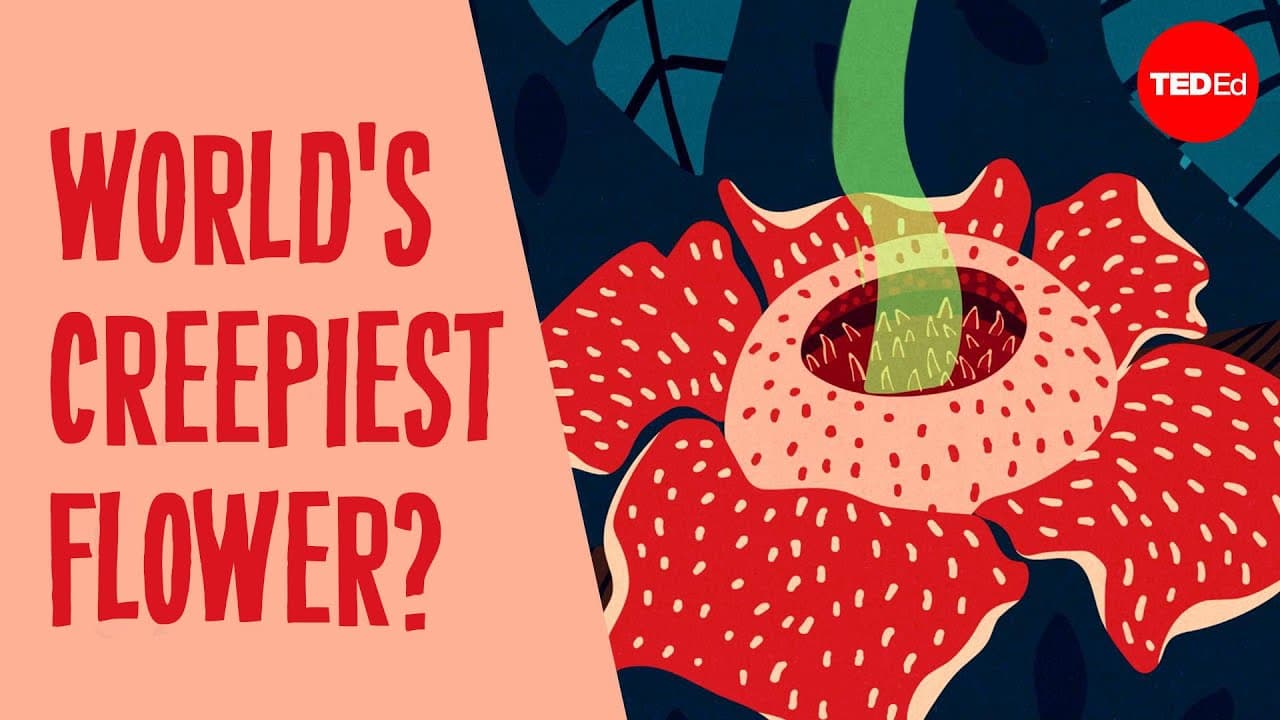
Why does this flower smell like a dead body? - Daniel Nickrent
TL;DR
Rafflesia arnoldii smells like a dead body because its sulfur-containing compounds attract carrion flies that pollinate the flower. This Southeast Asian parasite can weigh seven kilograms and span over a meter, yet it has no roots and cannot photosynthesize, so it siphons water and nutrients from Tetrastigma vines. Its unusual reproduction, genetic theft, and uncertain seed development offer compelling reasons to read on.
Transcript
Deep inside the Sumatran rainforest, a carrion fly descends, guided by the scent of its favorite place to lay eggs: dead and rotting animal carcasses. But when it lands, it isn’t on liquefying flesh, but instead on the world’s biggest, and perhaps strangest, flower— Rafflesia arnoldii. Rafflesia is a genus of over 30 species found across the tropic... Read More
Key Insights
- 🌱 The Rafflesia plant is a parasitic plant found in the Sumatran rainforest with unique characteristics, including being the world's largest flower and relying on other plants for its survival.
- 🖤 Rafflesia's lack of DNA in its plastids and its ability to undergo horizontal gene transfer showcase remarkable adaptations for a parasitic plant.
- 😵 The putrid smell emitted by Rafflesia serves as a clever strategy to attract pollinators and facilitate cross-pollination.
- 🌱 The cultivation of Rafflesia outside its natural habitat remains a challenge, jeopardizing our understanding and preservation of this fascinating plant species.
Install to Summarize YouTube Videos and Get Transcripts
Explore YouTube Video Summarizer or Get YouTube Transcript Extractor
Questions & Answers
Q: Why does Rafflesia arnoldii smell like a dead body?
Its fleshy maroon petals emit foul-smelling, sulfur-containing compounds that mimic the scent of rotting flesh. This odor attracts carrion flies, which can carry pollen from male flowers to female flowers and complete cross-pollination.
Q: How large can Rafflesia arnoldii grow?
The biggest Rafflesia flower weighs seven kilograms and spans more than a meter across. By contrast, the smallest representative of the genus has a flower only a few centimeters wide.
Q: How does Rafflesia survive without roots or photosynthesis?
Rafflesia lives as a parasite inside Tetrastigma vines and siphons water and nutrients from its host. Its plastids appear to have lost their DNA and the ability to photosynthesize, leaving the plant completely dependent on the vine.
Q: What does Rafflesia look like for most of its life?
For most of its life, Rafflesia exists beneath its host’s bark as a single thin strand of almost uniform cells. After living inside the vine, it emerges as one bud that may take several months or even a year to reach full size.
Q: How does Rafflesia use horizontal gene transfer?
Through horizontal gene transfer, Rafflesia has acquired genetic material from its host and other plants in its habitat. It uses several transferred sequences like its own DNA, transcribing them into RNA and translating them into proteins used in key cellular processes, though scientists still do not know exactly how the transfer occurs.
Q: How do carrion flies pollinate Rafflesia flowers?
A fly exploring a male flower may collect liquid pollen on its back, where the pollen dries. If it later visits a female flower, the pollen rehydrates against the damp stigma and completes cross-pollination.
Q: How are Rafflesia seeds dispersed?
A pollinated flower gradually withers and turns black while a fruit containing thousands of tiny seeds forms over several months. Scientists debate whether elephants, rodents, or ants disperse them; ants have been observed carrying the seeds, which have oily appendages called elaiosomes.
Q: Why is Rafflesia difficult to cultivate outside its natural habitat?
Nobody has observed its seeds germinating or attaching to and infecting a host root, so a crucial stage of development remains unclear. Despite many attempts, botanists around the globe have been largely unsuccessful at growing Rafflesia from seeds outside its natural habitat.
Summary & Key Takeaways
-
Rafflesia arnoldii is a genus of parasitic plants found in the tropical forests of Southeast Asia, known for their large size and foul odor.
-
Rafflesia survives as an endophyte, relying on its host plant, Tetrastigma, for water and nutrients.
-
The plant has stolen genetic material through horizontal gene transfer, incorporating it into its own cellular processes.
Read in Other Languages (beta)
Share This Summary 📚
Summarize YouTube Videos and Get Video Transcripts with 1-Click
Try YouTube Summary with ChatGPT & Claude or YouTube Transcript Generator
Explore More Summaries from TED-Ed 📚





Summarize YouTube Videos and Get Video Transcripts with 1-Click
Try YouTube Summary with ChatGPT & Claude or YouTube Transcript Generator