How to Generate Training Data Using Natural Language Explanations
TL;DR
You can generate training data more efficiently by using natural language explanations instead of traditional labels with the Babel framework. This approach allows you to produce high-quality training sets with far fewer user inputs, maintaining classifier quality while leveraging unlabeled data effectively.
Transcript
great that's great to be here um as a wrapping up Stanford PhD right now myself it's a it's fun that I've watched a number of these colloquia from my own laptop and to be giving one now here is a great honor opportunity so I'm at Braden here on caucus I said I guess I'm a fourth year PhD student I'm finishing up work my research in general has been... Read More
Key Insights
- 😫 The Babel Babel framework enables the generation of large training sets using natural language explanations instead of traditional labels.
- 👻 The framework consists of a semantic parser, a filter bank, and an aggregation process, allowing for efficient and high-quality data generation.
- 😫 The generated training sets from the framework require fewer user inputs while achieving the same classifier quality.
- 👻 The framework is applicable to various domains, allowing users to leverage their domain expertise to generate training data.
- 🍵 The Babel Babel framework can handle noisy labeling functions and utilize unlabeled data to improve classifier accuracy.
Install to Summarize YouTube Videos and Get Transcripts
Explore YouTube Video Summarizer or Get YouTube Transcript Extractor
Questions & Answers
Q: How does the Babel Babel framework address the bottleneck of obtaining specific training data for new applications?
The Babel Babel framework allows users to provide natural language explanations instead of traditional labels to generate training data. This eliminates the need for manually labeling large amounts of data, making the process more efficient.
Q: How does the semantic parser in the framework convert explanations into labeling functions?
The semantic parser uses substitution rules to map tokens in the explanations to higher-level tokens. It then generates multiple potential parse trees, each representing a valid labeling function. These functions are structured as Python functions that output labels based on specified conditions.
Q: What is the purpose of the filter bank in the Babel Babel framework?
The filter bank is responsible for removing unnecessary labeling functions. It includes semantic and pragmatic filters that identify functions that do not accurately capture the user's intent or provide valuable information. This helps improve the quality of the generated training data.
Q: How does the aggregation process in the framework work?
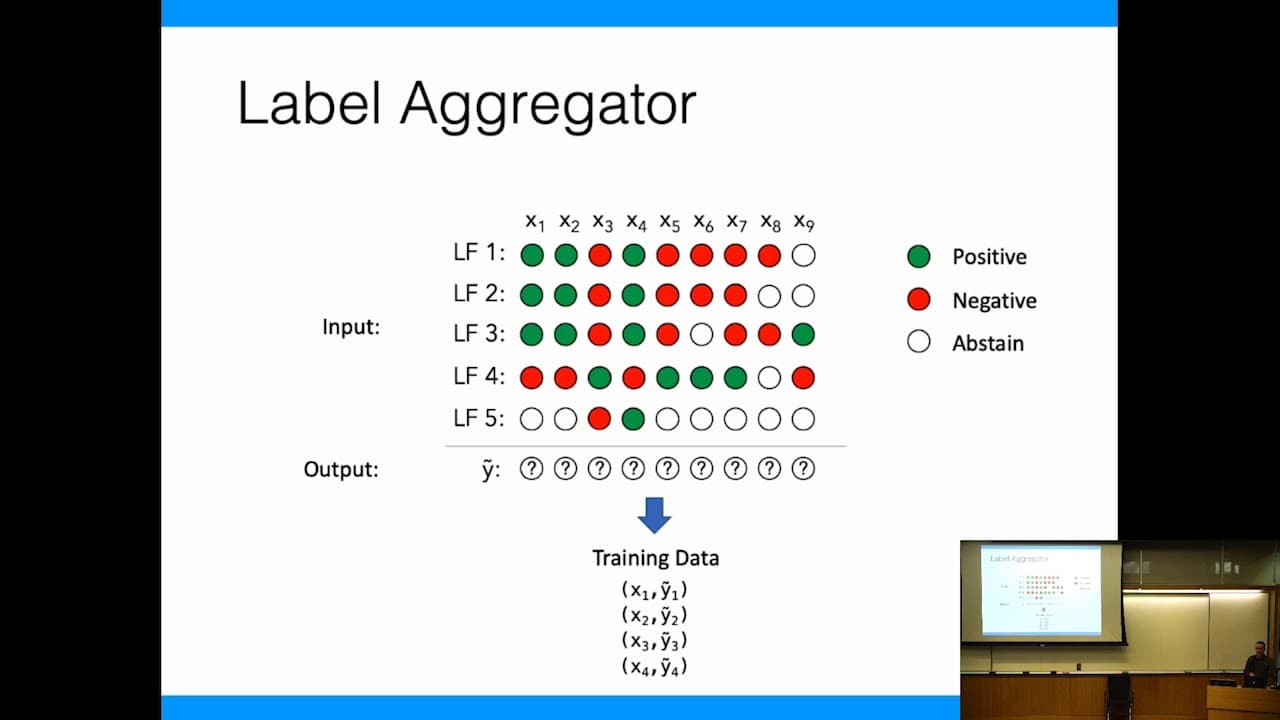
The aggregation process combines the output of the labeling functions into a label matrix. It aggregates the votes from each function for each example and determines the final label. This process takes into account the accuracy and correlation of the labeling functions to generate high-quality labels.
Summary & Key Takeaways
-
Traditional machine learning models have easy access to pre-trained models and hardware, but the bottleneck is often getting specific training data for a new application.
-
The Babel Babel framework allows users to provide natural language explanations instead of labels, which are used to automatically generate large training sets.
-
The framework includes a semantic parser to convert explanations into labeling functions, a filter bank to remove unnecessary functions, and an aggregation process to combine the functions and generate labels.
Read in Other Languages (beta)
Share This Summary 📚
Summarize YouTube Videos and Get Video Transcripts with 1-Click
Try YouTube Summary with ChatGPT & Claude or YouTube Transcript Generator
Explore More Summaries from Stanford Online 📚
Summarize YouTube Videos and Get Video Transcripts with 1-Click
Try YouTube Summary with ChatGPT & Claude or YouTube Transcript Generator