Testing different Peltier coolers by cooling/freezing water - Part 1 - Introduction
TL;DR
A detailed experiment measuring cooling efficiency of various planetary coolers using a water freezing test.
Transcript
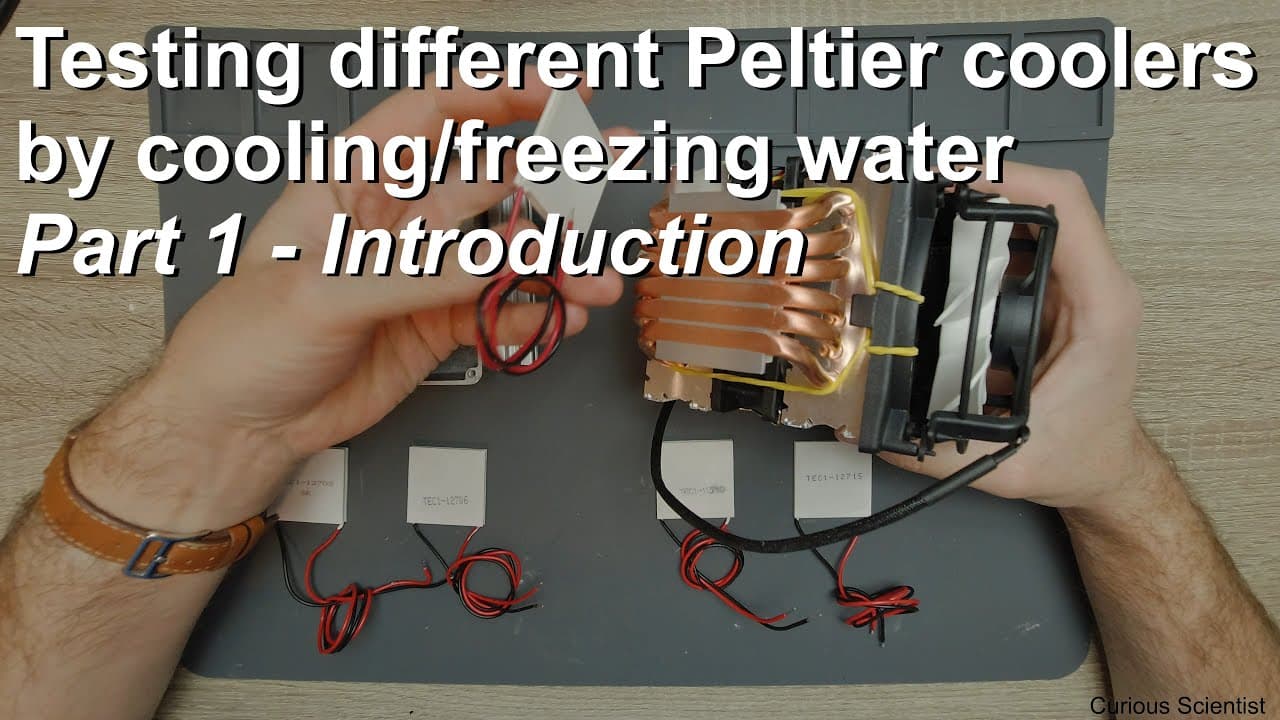
welcome everyone in this video I'm going to continue to work with the five different planetary coolers so as you can see I have a 3 6 8 10 and 15 amperes unit so quite wide spectrum of different units and what I'm going to do now is a bit different from the other experiments that I've been doing in the past so let me explain so what you can see her... Read More
Key Insights
- 😎 The experiment utilizes a unique assembly that combines a CPU cooler with planetary coolers to analyze cooling efficiency in a controlled manner.
- 🥵 An aluminum box was chosen for water containment due to its favorable thermal properties, allowing for effective heat transfer during the cooling process.
- 😎 Temperature measurements are taken at multiple points to provide a comprehensive overview of the cooling system's performance, facilitating better analysis.
- 🥵 The design incorporates insulation techniques to minimize external heat interference, keeping the experiment relevant and focused on the cooler performance itself.
- 💦 Using 100 grams of water enables easily manageable quantities for observation, while also presenting a meaningful challenge for freezing within the allotted time.
- 😎 Multiple test units of different amperage settings allow for comparative analysis of cooling performance across a spectrum of cooling capacities.
- 👣 The integration of 3D printed components exhibits modern approaches to experimental design, showcasing adaptability and innovation in creating custom fits for assembly.
Install to Summarize YouTube Videos and Get Transcripts
Explore YouTube Video Summarizer or Get YouTube Transcript Extractor
Questions & Answers
Q: What are the key components involved in this cooling experiment?
The experiment primarily involves five planetary cooler units of varying amperage, a CPU cooler utilized for effectively cooling the hot side, and an aluminum box to house 100 grams of water to measure freezing time. The design is essential as the cold side of the cooler interacts closely with the water to assess performance.
Q: How is the experimental setup designed to minimize heat gain from the environment?
The experimental setup utilizes a sealed aluminum box filled with water, where insulation is provided by a polystyrene container. The bottom is sealed with foam specific to patio coolers, hindering heat transfer. A transparent cover is also used to restrict convection while allowing visibility of the cooling process.
Q: Why is it important to measure the temperature at multiple locations during the experiment?
Measuring temperatures at various points enables comprehensive data collection, allowing for a clearer understanding of heat transfer efficiency. By evaluating the temperature of the water, the output from the cooler, and the heatsink's hot side, one can gain insights into the cooler's performance across different scenarios.
Q: What specific role does thermal grease play in the setup?
Thermal grease enhances the thermal contact between surfaces, filling microscopic gaps and allowing for better heat transfer between the cooler and the aluminum box. Applying thermal grease ensures that the cold side can effectively cool the heat generated by the water, thus improving the overall efficiency of the cooling system.
Summary & Key Takeaways
-
The content outlines an experiment using five different planetary cooler units, specifically focusing on how quickly they can freeze water using a setup with a CPU cooler and aluminum box.
-
The experiment design includes temperature monitoring and an insulated environment to evaluate the performance of each cooler under consistent conditions, utilizing precise measurements and materials.
-
Data gathered from the trial will help compare the cooling efficiency of the different units, ultimately leading to conclusions about their effectiveness for cooling applications.
Read in Other Languages (beta)
Share This Summary 📚
Summarize YouTube Videos and Get Video Transcripts with 1-Click
Try YouTube Summary with ChatGPT & Claude or YouTube Transcript Generator
Explore More Summaries from Curious Scientist 📚


![Building a Peltier cooler-based cooling box - First iteration, improvements [Part 2/6] thumbnail](/_next/image?url=https%3A%2F%2Fi.ytimg.com%2Fvi%2F0YlNw0EGnzI%2Fhqdefault.jpg&w=750&q=75)


Summarize YouTube Videos and Get Video Transcripts with 1-Click
Try YouTube Summary with ChatGPT & Claude or YouTube Transcript Generator