How Did the Term Artificial General Intelligence Begin?
TL;DR
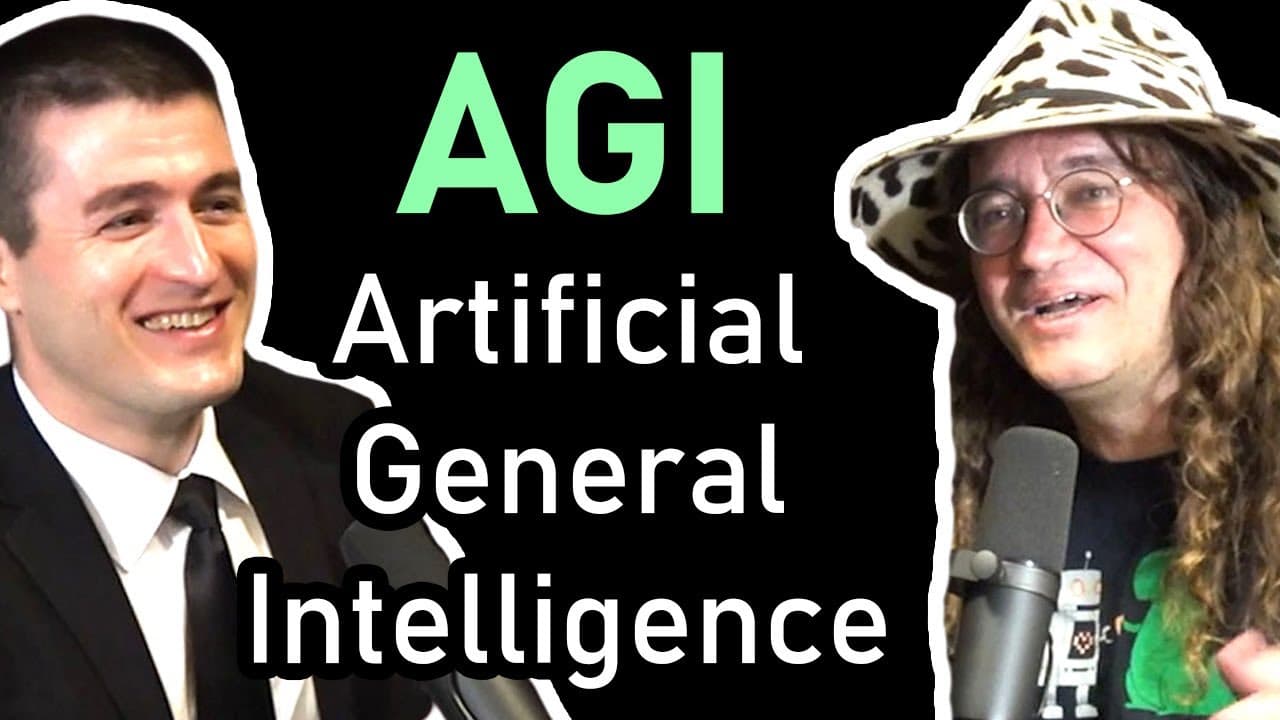
The term AGI gained traction when Ben Goertzel and collaborators needed a title for an academic book about machines capable of broadly humanlike thinking. Artificial general intelligence was chosen after email discussions involving alternatives such as real AI, broad AI, and GAI, although Goertzel says every word in the phrase is imperfect and earlier published uses may exist.
Transcript
Maybe it's good to step back a little bit. I mean, we've been using the term AGI. Uh, people often cite you as the creator or at least the popularizer of the term AGI, artificial general intelligence. Can you tell the origin story of the term maybe? For sure. So yeah, I would say I, I launched the term AGI upon the world for, for, for what, what it... Read More
Key Insights
- The term AGI was launched into wider use through a book project that Ben Goertzel began editing around 2001 or 2002 and published in 2005. The collection focused on serious academic work toward machines able to think like humans or more broadly.
- The provisional title Real AI was rejected because specialized machine-learning work is also real artificial intelligence. Goertzel cited applications involving genomics data and sentiment analysis as examples of narrow systems whose legitimacy made the original contrast misleading.
- The label strong AI was unsuitable because narrow and strong are not opposites, and cognitive science already used strong AI for the hypothesis that digital computer systems could possess genuine consciousness comparable to human consciousness.
- The acronym AGI emerged from a private email discussion involving possible terms such as narrow AI, broad AI, wide AI, general AI, and GAI. Goertzel recalls that either Shane Legg or Peter Voss proposed artificial general intelligence.
- The phrase general intelligence had an established psychological association through the G factor and IQ. Peter Voss and Shane Legg viewed AGI as artificial general intelligence built upon that recognizable meaning of general intelligence.
- The exact first inventor of AGI remains uncertain within the account. Goertzel popularized the term through the book, while Mark Gubrud later told him that he had published an essay using AGI around 1997.
- The word artificial is imperfect because future general intelligences may become agents rather than tools, while both humans and machines can be viewed as parts of nature. Goertzel suggests evolved versus engineered may describe the relevant distinction more precisely.
- A perfectly general computational intelligence is theoretically possible in Marcus Hutter's framework but would require infinite computing power. Goertzel therefore argues that general, like artificial and intelligence, is technically problematic even though the combined acronym serves a useful social function.
Install to Summarize YouTube Videos and Get Transcripts
Explore YouTube Video Summarizer or Get YouTube Transcript Extractor
Questions & Answers
Q: How did the term AGI become widely used?
AGI became widely used through an academic book project led by Ben Goertzel. He began organizing the collection around 2001 or 2002, and it was eventually published in 2005. After discussing several possible labels with contributors by email, the group used artificial general intelligence in the book title, helping establish the acronym within the technical community.
Q: Who proposed the acronym AGI during the book discussion?
Ben Goertzel recalls that either Shane Legg or Peter Voss proposed artificial general intelligence during a private email discussion about the book's title. He does not assign definitive credit to one person. Goertzel describes himself as the person who launched the term more broadly through the book, while acknowledging uncertainty about who first coined it.
Q: Was Ben Goertzel the first person ever to use AGI?
The conversation does not establish Ben Goertzel as the first person ever to use the acronym. After the book appeared, Mark Gubrud told Goertzel that he had published an essay containing AGI around 1997. Goertzel therefore presents his role as launching or popularizing the term, not conclusively inventing a completely unprecedented expression.
Q: Why was the provisional title Real AI abandoned?
Real AI was abandoned because it implied that narrower artificial intelligence was somehow unreal. Goertzel was also working on machine-learning applications involving genomics data and sentiment analysis, and he considered that work genuinely artificial intelligence. He needed a label that distinguished broadly capable thinking machines from narrow systems without denying the validity of specialized AI research.
Q: Why did Ben Goertzel reject the term strong AI?
Goertzel rejected strong AI for two reasons. First, strong is not the opposite of narrow, so the contrast between narrow AI and strong AI is linguistically awkward. Second, cognitive science already used strong AI to describe the hypothesis that digital computer systems could have genuine consciousness comparable to that of human beings, creating a different but related meaning.
Q: Why was artificial general intelligence chosen instead of GAI?
Pei Wang preferred GAI, meaning general artificial intelligence, because that ordering matched Chinese usage. The group instead selected AGI, partly because GA would not work well in the United States cultural context at that time. The chosen order also connected naturally with the established psychological concept of general intelligence and its association with the G factor and IQ.
Q: Why does Ben Goertzel consider the phrase AGI imperfect?
Goertzel considers all three words imperfect. Artificial can imply a mere tool and an unnecessary opposition between machines and nature. Fully general intelligence is not physically achievable under the computational framework discussed because it would require infinite computing power. Intelligence itself also lacks a clear definition, especially when reduced to maximizing expected future reward.
Q: What alternative view of intelligence does the conversation present?
The conversation presents David Weinbaum's view of open-ended intelligence as an alternative to defining intelligence through a single reward function. An intelligent system can be understood as a complex, self-organizing system that revises, grows, and improves itself together with its environment. During limited intervals, it may behave as though it is optimizing an objective without having one permanent objective.
Summary & Key Takeaways
-
Ben Goertzel began editing a book around 2001 or 2002 that collected serious, academically oriented papers about machines capable of thinking like people or even more broadly. The provisional title, Real AI, became unsatisfactory because narrow applications such as genomics analysis and sentiment analysis were also legitimate forms of artificial intelligence.
-
Contributors and correspondents included Peter Voss, Shane Legg, Marcus Hutter, Pei Wang, and several Russian researchers. During a private email discussion, the group considered labels including broad AI, wide AI, general AI, and GAI. They ultimately selected artificial general intelligence, partly because general intelligence already had meaning in psychology.
-
Goertzel says the label succeeded because technically informed people can understand it immediately, even though he dislikes each component. Artificial can misleadingly imply a tool or separation from nature, perfect generality would require infinite computing power, and intelligence lacks a settled definition. Nevertheless, AGI has become socially established and difficult to replace.
Read in Other Languages (beta)
Share This Summary 📚
Summarize YouTube Videos and Get Video Transcripts with 1-Click
Try YouTube Summary with ChatGPT & Claude or YouTube Transcript Generator
Explore More Summaries from Lex Fridman 📚




Summarize YouTube Videos and Get Video Transcripts with 1-Click
Try YouTube Summary with ChatGPT & Claude or YouTube Transcript Generator