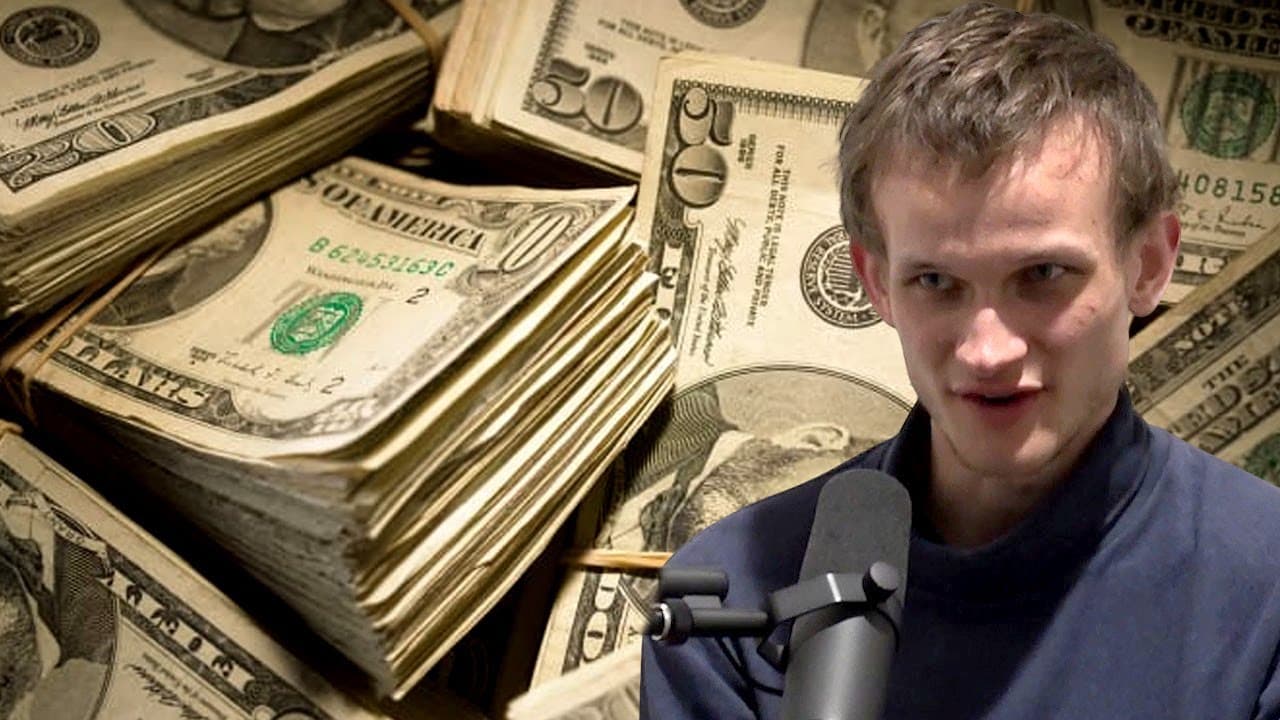
What is Money? (Vitalik Buterin) | AI Podcast Clips
TL;DR
Money acts as a game involving points, facilitating exchange and wealth storage while evolving from gold-backed systems to free-floating currencies. In the 21st century, value is often derived from network effects rather than physical backing, significantly affecting how we understand wealth and incentivize behavior.
Transcript
so let's ask the hi philosophically just about money yeah what at the highest level is money what is money it's a kind of game and it's a game where we have points and like if you have points there's this one move where you can reduce your points by a number and increase someone else's voice by the same number and these it's a fair game hopefully w... Read More
Key Insights
- 😚 Money serves as a game with points that can be gained or lost, making it a fair method of exchange and wealth storage.
- 🤑 The mechanisms of money have evolved over time, with increased intermediation and a shift away from physical backing.
- 😮 The 21st century sees the rise of valuable things not backed by anything physical, relying on network effects and coordination problems.
- 🤑 Money is a significant motivator, but there are other factors such as power, social status, and personal goals at play.
- ✊ Money equals power, and decentralized currencies aim to challenge existing power structures.
- ❓ Utopia from an economic perspective would involve aligning incentives to eliminate conflicts and encourage collective benefits.
- 🤑 Economic philosophies deviate from this utopia, and public goods are not effectively incentivized by traditional money systems.
- 🎙️ More videos with Vitalik Buterin:
Install to Summarize YouTube Videos and Get Transcripts
Explore YouTube Video Summarizer or Get YouTube Transcript Extractor
Questions & Answers
Q: What is the fundamental nature of money?
Money is a game where points can be gained or lost, serving as a fair method of exchange and storage of wealth.
Q: How has the role of money changed over time?
In the 20th century, there was increased intermediation, the shift from gold-backed currencies to free-floating currencies, and the rise of electronic banking.
Q: How is it possible for money to exist without physical backing?
In the 21st century, many valuable things, like tech companies, are not backed by anything physical but rely on network effects and coordination problems to maintain value.
Q: What is the interplay between money and human motivation?
Money is a significant motivator, although not the only one, as other factors such as social status and personal goals also come into play.
Key Insights:
- Money serves as a game with points that can be gained or lost, making it a fair method of exchange and wealth storage.
- The mechanisms of money have evolved over time, with increased intermediation and a shift away from physical backing.
- The 21st century sees the rise of valuable things not backed by anything physical, relying on network effects and coordination problems.
- Money is a significant motivator, but there are other factors such as power, social status, and personal goals at play.
- Money equals power, and decentralized currencies aim to challenge existing power structures.
- Utopia from an economic perspective would involve aligning incentives to eliminate conflicts and encourage collective benefits.
- Economic philosophies deviate from this utopia, and public goods are not effectively incentivized by traditional money systems.
- Quadratic funding is a mechanism that compensates for the tragedy of the commons in supporting public goods.
Summary
In this video, the speaker discusses the concept of money as a game and its evolution throughout history. They explore the idea of money not being backed by anything physical and its role in human motivation. They also touch on the interplay of money and power, as well as different economic philosophies. The speaker introduces the concept of quadratic funding as a mechanism for supporting public goods and discusses its potential applications within the Ethereum ecosystem.
Questions & Answers
Q: What is money at the highest level?
Money can be seen as a game where points are exchanged. It serves as a fair system for redistributing points, where one can reduce their points and increase someone else's by the same number. Money has survived for thousands of years due to its usefulness in wealth storage, value exchange, and future payment nominations.
Q: How has the role and mechanisms of money changed over time, especially in the 20th century?
In the 20th century, we saw increased intermediation and a shift from money being backed by gold to becoming a system of free-floating currencies. This transition involved the emergence of banking systems, electronic payments, and payment processors. The evolution of money reflects changing societal needs and technological advancements.
Q: What makes the idea of money existing without being backed by something physical fascinating?
Money's detachment from physical assets challenges traditional notions of value and security. In the 21st century, many valuable things, such as tech companies, are not backed by anything physical. The value of such entities lies in network effects and coordination problems, making money a subjective construct with societal agreement as its foundation.
Q: Is money the ultimate motivator for human beings?
While money is a significant motivator, it is not the only one. It is one of the closest things we have to a universal motivator, as most people are more inclined to do something when money is involved. However, various factors influence human motivation, and money is often intertwined with power, social status, and self-worth.
Q: Does money equal power? How do they interplay?
Money is a form of power, and some individuals seek money as a means to gain power. Furthermore, money is often associated with social status, making it a measure of success in society. While money and power are interconnected, they are not synonymous, and different individuals may prioritize different motivators.
Q: What does utopia look like from an economic perspective?
In the economist's utopia, all incentives would align, minimizing conflicts between personal goals and societal well-being. Existing economic philosophies deviate from this utopia, and issues such as income inequality and suboptimal allocation of resources persist. Different economic philosophies, such as Marxism and Objectivism, reflect various interpretations of what utopia could entail.
Q: What role do public goods play, and how do they interact with the concept of money?
Public goods, which benefit many people simultaneously, pose challenges for traditional monetary systems. On the internet, actions can have distributed benefits without fine-grained control over their distribution. Money's design as a point system is effective for incentivizing private goods but falls short in encouraging actions that provide widespread benefits. New mechanisms like quadratic funding have been proposed to address this gap.
Q: How does quadratic funding work, and in which contexts is it useful?
Quadratic funding is a mechanism that incentivizes the support of public goods by multiplying the contributions of multiple individuals. The summing of square roots compensates for the tragedy of the commons, where individuals hesitate to contribute to goods with distributed benefits. Quadratic funding has been implemented in the Ethereum ecosystem to support initiatives such as user interfaces, documentation, privacy tools, and open-source implementations of protocols.
Takeaways
Money functions as a game where points are exchanged, and its utility determines its survival over time. While money is a significant motivator, it is not the sole driving factor for human behavior. Money represents power and often correlates with social status and self-worth. Existing economic philosophies deviate from the economist's utopia, and alternative mechanisms like quadratic funding have been proposed to address the challenges posed by public goods. Understanding the complexities of money and its interplay with societal dynamics is crucial in shaping our economic systems.
Summary & Key Takeaways
-
Money is a game where points can be gained or lost, serving as a fair method of exchange and storage of wealth.
-
The mechanisms of money have changed over time, with increased intermediation and a move away from a gold-backed system to free-floating currencies.
-
In the 21st century, valuable things like tech companies rely on network effects and coordination problems, rather than physical backing.
Read in Other Languages (beta)
Share This Summary 📚
Summarize YouTube Videos and Get Video Transcripts with 1-Click
Try YouTube Summary with ChatGPT & Claude or YouTube Transcript Generator
Explore More Summaries from Lex Fridman 📚



Summarize YouTube Videos and Get Video Transcripts with 1-Click
Try YouTube Summary with ChatGPT & Claude or YouTube Transcript Generator