How to Convert PPM to Molarity Step-by-Step
TL;DR
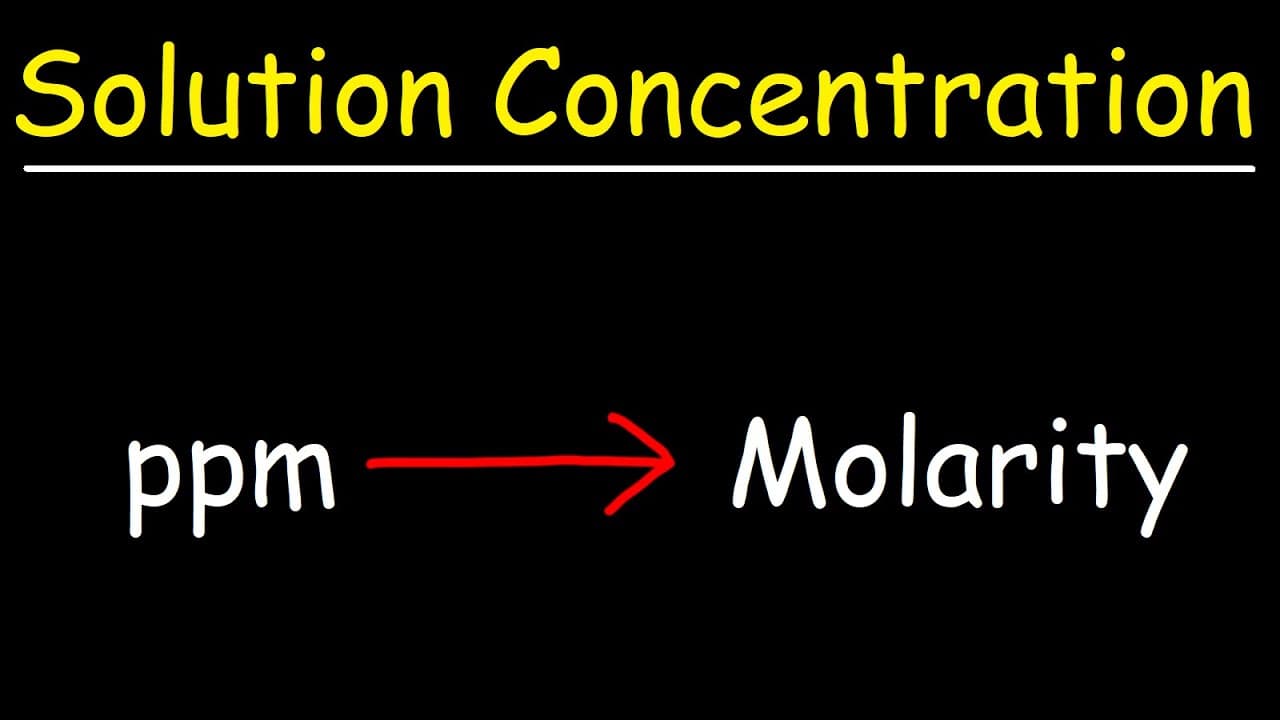
To convert ppm to molarity, rewrite the ppm value as grams of solute per 1,000,000 grams of solution, convert grams of solute to moles using the molar mass, and convert grams of solution to liters using the density. In the worked example, an 840 ppm sodium hydroxide solution (molar mass 40 g/mol, density 1.05 g/mL) works out to 0.022 M. Read on for the reverse molarity-to-ppm conversion and the exact formula.
Transcript
in this video we're going to talk about how to convert from one type of concentration into another type of concentration more specifically how to convert from parts per million to molarity so let's begin first we need to understand what this type of concentration represents parts per million is to represent solutions with very low concentrations an... Read More
Key Insights
- 😘 Parts per million (ppm) is a concentration unit used for solutions with very low concentrations.
- 🪡 To convert from ppm to molarity, you need to convert grams of solute to moles of solute and grams of solution to liters of solution.
- 💆 The molar mass of the solute and the density of the solution are necessary for the conversion process.
- 🗂️ Molarity is calculated as moles of solute divided by liters of solution.
- ❓ The density of a solution can be used to convert grams of solution to liters of solution.
- 🫀 The molar mass of the solute can be obtained from the periodic table by summing the atomic weights of its elements.
- 🧑🏭 Converting from ppm to molarity involves multiple conversion steps using conversion factors.
Install to Summarize YouTube Videos and Get Transcripts
Explore YouTube Video Summarizer or Get YouTube Transcript Extractor
Questions & Answers
Q: How do you convert parts per million (ppm) to molarity?
Start by writing the ppm value as grams of solute per 1,000,000 grams of solution. Convert grams of solute to moles using the solute's molar mass, then convert grams of solution to liters using the solution's density (grams to milliliters, then milliliters to liters). Dividing moles of solute by liters of solution gives molarity.
Q: How do you convert molarity to ppm?
Write the molarity as moles of solute per 1 liter of solution, then convert moles of solute to grams using the molar mass. Convert liters of solution to milliliters and then to grams using the density. Once you have grams of solute divided by grams of solution, multiply the result by 10^6 to get ppm.
Q: What is the 840 ppm to molarity example answer?
For an 840 ppm sodium hydroxide solution with a molar mass of 40 g/mol and a density of 1.05 g/mL, the calculation is 840 divided by 10^6, then divided by 40, then multiplied by 1.05 and by 1000. The result is 0.022 M, or 0.022 moles of solute per liter of solution.
Q: What information do you need to convert between ppm and molarity?
You need the molar mass of the solute to convert between grams and moles of solute, and the density of the solution to convert between grams and liters of solution. The molar mass is found by summing the atomic weights of the solute's elements from the periodic table.
Q: What is the formula for parts per million (ppm)?
Parts per million equals the grams of solute divided by the mass in grams of solution, multiplied by 10 to the sixth. For example, 840 ppm means 840 grams of solute per 1,000,000 grams of solution.
Q: How do you find the molar mass of sodium hydroxide (NaOH)?
Add the atomic weights of each element from the periodic table: sodium is 22.99, oxygen is 16, and hydrogen is 1.008. The sum is 39.998 grams per mole, which rounds to about 40 grams per mole, meaning one mole of NaOH has a mass of roughly 40 grams.
Q: What is parts per million (ppm) used for?
Parts per million is a concentration unit used to represent solutions with very low concentrations. It expresses how many grams of solute are present per one million grams of solution.
Q: How is molarity defined?
Molarity is equal to the moles of solute divided by the liters of solution. This is why converting from ppm requires changing grams of solute into moles and grams of solution into liters before dividing.
Summary & Key Takeaways
-
Parts per million (ppm) is a concentration unit used for solutions with very low concentrations.
-
To convert from ppm to molarity, you need to convert grams of solute to moles of solute and grams of solution to liters of solution.
-
The molar mass of the solute and the density of the solution are necessary for the conversion process.
Read in Other Languages (beta)
Share This Summary 📚
Summarize YouTube Videos and Get Video Transcripts with 1-Click
Try YouTube Summary with ChatGPT & Claude or YouTube Transcript Generator
Explore More Summaries from The Organic Chemistry Tutor 📚


Summarize YouTube Videos and Get Video Transcripts with 1-Click
Try YouTube Summary with ChatGPT & Claude or YouTube Transcript Generator