Intermediate Value Theorem
TL;DR
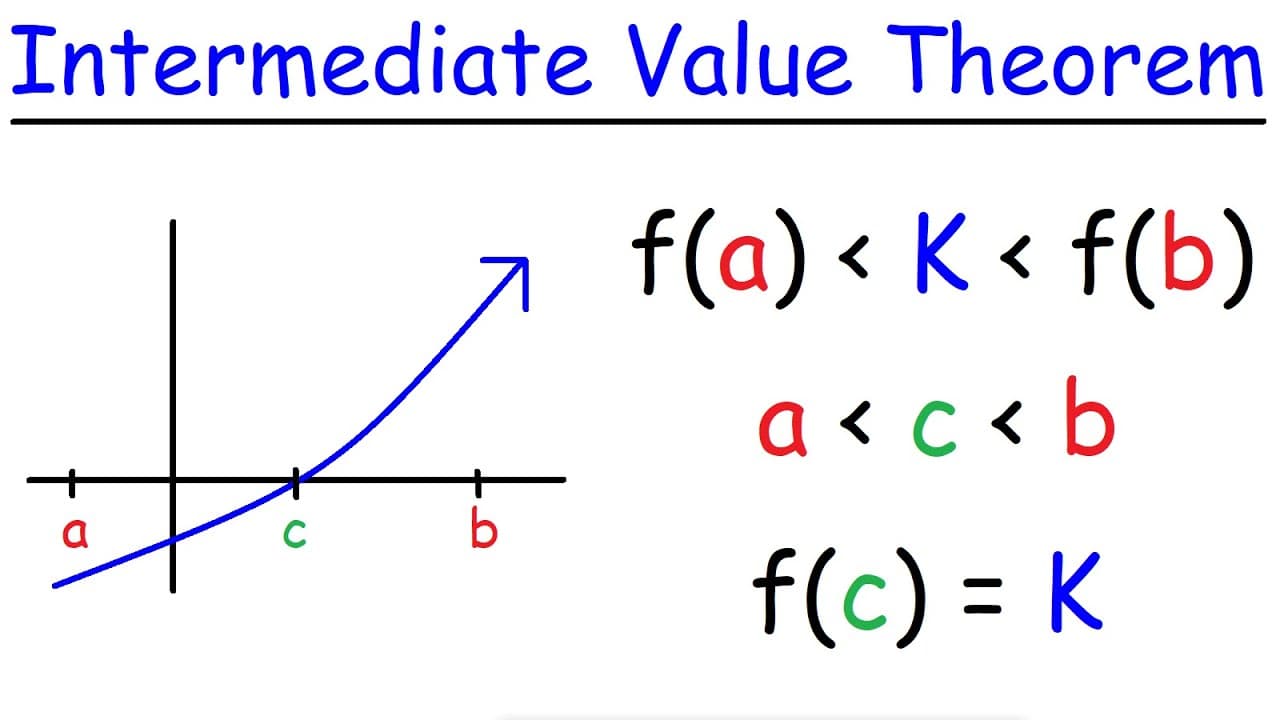
The Intermediate Value Theorem states that if a function is continuous on a closed interval and takes different values at the endpoints, then there exists at least one number within the interval where the function equals any value in between.
Transcript
now let's talk about ivt the intermediate value theorem the intermediate value theorem states that if f is continuous on a closed interval a to b and f of a does not equal f of b and k is any number that's between f of a and f b then there's at least one number c on the interval a to b such that f c is equal to k now let's go ahead and apply this i... Read More
Key Insights
- 👍 The Intermediate Value Theorem is a powerful tool in mathematics for proving the existence of solutions or roots in a function within a specified interval.
- 🥡 The theorem relies on the continuity of the function and the different values taken at the endpoints of the interval.
- 👍 The IVT can be used to prove the existence of roots or solutions in a variety of functions, from linear to polynomial, as long as they satisfy the conditions of the theorem.
- 😫 Finding the specific value of c, where the function equals a given value, requires setting the function equal to that value and solving for x.
- 🫚 The IVT provides a rigorous mathematical proof for the existence of solutions and roots, ensuring that they are not mere approximations or estimations.
- 🏑 The Intermediate Value Theorem has applications in various fields, including physics, economics, and engineering, where the existence of solutions within specific intervals is crucial.
- ❓ The theorem provides a foundational concept for understanding the behavior of continuous functions and their relationships with the values they take on within intervals.
Install to Summarize YouTube Videos and Get Transcripts
Explore YouTube Video Summarizer or Get YouTube Transcript Extractor
Questions & Answers
Q: What is the Intermediate Value Theorem?
The Intermediate Value Theorem states that for a continuous function on a closed interval, if the function values at the endpoints of the interval are different, there exists at least one number within the interval where the function takes any value in between.
Q: How can the IVT be used to prove the existence of a root in a function?
To prove the existence of a root, we first find the function values at the endpoints of the interval. If the values have opposite signs or one is zero, then the IVT guarantees that there exists a number within the interval where the function equals zero, thus proving the existence of a root.
Q: How do we find the specific value of c using the IVT?
To find the specific value of c, we set the function equal to the given value and solve for x. The obtained x value will be the value of c, which satisfies the Intermediate Value Theorem.
Q: Can the Intermediate Value Theorem be applied to all continuous functions?
Yes, the Intermediate Value Theorem applies to all continuous functions on a closed interval. As long as the function is continuous and takes different values at the endpoints, the theorem holds.
Summary & Key Takeaways
-
The Intermediate Value Theorem (IVT) states that for a continuous function on a closed interval, if the function values at the endpoints of the interval are different, then there exists a number within the interval where the function takes any value between the endpoints.
-
To use the IVT to prove the existence of a root in a function, we first find the function values at the endpoints of the interval. If the values are on opposite sides of zero, it guarantees the existence of a root within the interval.
-
To find the specific value of c where the function equals a given value, we set the function equal to that value and solve for x. The obtained x value will be the value of c.
Read in Other Languages (beta)
Share This Summary 📚
Summarize YouTube Videos and Get Video Transcripts with 1-Click
Try YouTube Summary with ChatGPT & Claude or YouTube Transcript Generator
Explore More Summaries from The Organic Chemistry Tutor 📚


Summarize YouTube Videos and Get Video Transcripts with 1-Click
Try YouTube Summary with ChatGPT & Claude or YouTube Transcript Generator