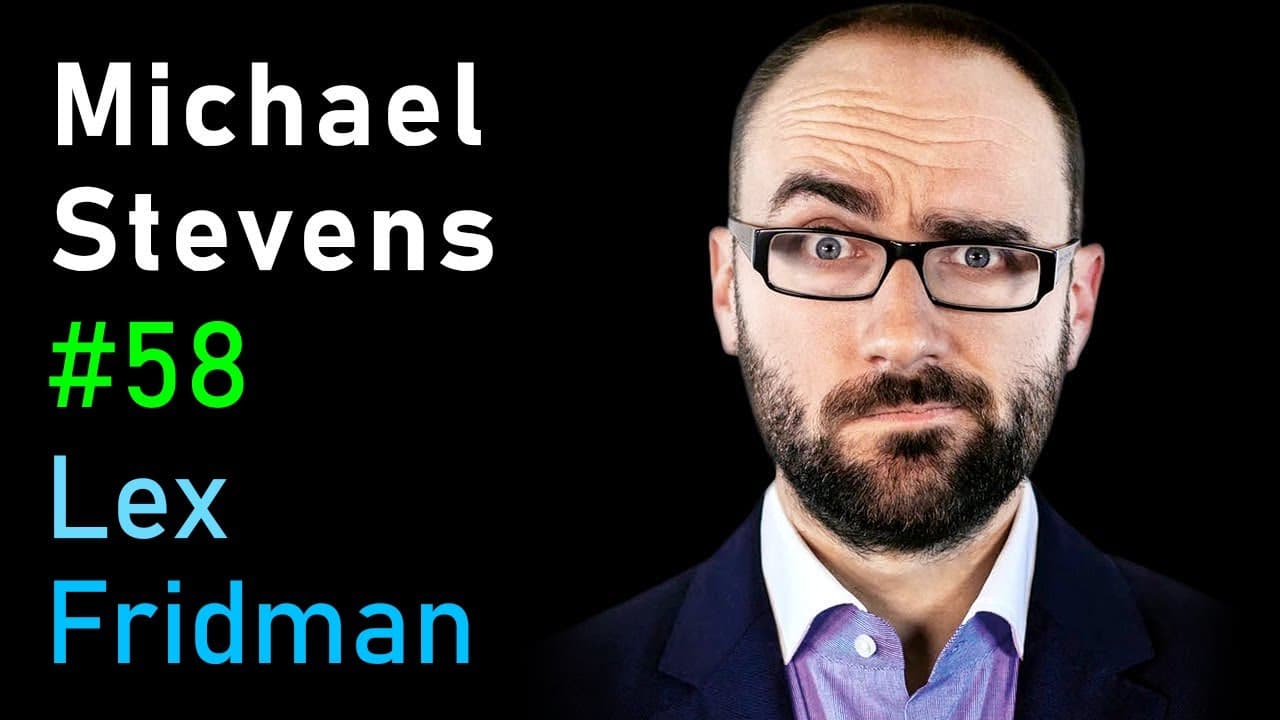
Michael Stevens: Vsauce | Lex Fridman Podcast #58
TL;DR
Michael Stevens argues that consciousness can probably be explained within the laws of physics, potentially emerging from states of the universe that contain memories of other states. In Lex Fridman Podcast #58, the Vsauce creator also discusses psychology’s lack of precision, AI’s risks and benefits, simulation theory, curiosity, and the YouTube algorithm. Read on for his speculative framework and its wider implications.
Transcript
the following is a conversation with Michael Stevens the creator of Vsauce one of the most popular educational YouTube channels in the world with over 15 million subscribers and over 1.7 billion views his videos often ask and answer questions that are both profound and entertaining spanning topics from physics to psychology popular questions includ... Read More
Key Insights
- Michael Stevens believes that consciousness can be fully explained within the laws of physics, but it remains a complex and mysterious phenomenon.
- Stevens suggests that the study of human behavior is challenging due to its complexity and lack of precise scientific rigor compared to fields like physics.
- He emphasizes the importance of curiosity and questioning as fundamental aspects of scientific inquiry and personal growth.
- The potential risks of artificial intelligence are acknowledged, but Stevens argues that fear should not hinder technological progress.
- Stevens discusses the concept of living in a simulation as a useful thought experiment to explore philosophical and scientific questions.
- He reflects on the responsibility that comes with having a large audience and the importance of humility in sharing scientific knowledge.
- Stevens notes that the YouTube algorithm reflects human behavior and preferences, highlighting the balance between educational content and entertainment.
- He expresses the idea that humans and their technology form a single organism, with advancements in AI and other technologies being inevitable.
Install to Summarize YouTube Videos and Get Transcripts
Explore YouTube Video Summarizer or Get YouTube Transcript Extractor
Questions & Answers
Q: How does Michael Stevens explain consciousness through physics?
Michael Stevens thinks consciousness can probably be fully explained within the laws of physics, although he identifies his view as speculation rather than expertise. He suggests that consciousness may emerge when a state of the universe contains fragments or memories of other states, creating an experience of time and self-awareness.
Q: What makes human psychology difficult to study precisely?
Stevens says human behavior is messy and lacks the precision associated with theoretical physics. Although emotions, moods, and behaviors may result from the mechanical behavior of atoms and molecules in the brain, chaos and the uncertainty principle make their physical foundations difficult to determine.
Q: What are “time capsule states” in Michael Stevens’s account of consciousness?
Stevens describes Julian Barbour’s “time capsule states” as configurations of the universe that contain memories of other states. A present state might include both a scratch and a memory of being scratched by a cat three days earlier, producing the sense that events happened in the past.
Q: Does Michael Stevens consider consciousness a fundamental part of reality?
Stevens discusses the idea that consciousness might be fundamental to reality, but his own guess is that it can be explained within existing physical laws. He argues that bodies, brains, the universe, and the quantum level are sufficiently rich and complex to leave room for consciousness.
Q: Why does Michael Stevens think curiosity matters?
Stevens treats curiosity and good questions as central to scientific exploration and personal growth. His work on Vsauce uses questions spanning physics and psychology to encourage deeper inquiry into the universe and human behavior.
Q: What does Michael Stevens say about the risks and benefits of artificial intelligence?
Stevens acknowledges that artificial intelligence can produce both positive and negative outcomes and that safeguards matter. However, he argues that fear should not prevent technological progress, viewing AI as part of the broader relationship between humans and technology.
Q: Why does Michael Stevens find simulation theory useful?
Stevens treats simulation theory as a useful thought experiment for examining reality, perception, consciousness, and the limits of knowledge. Its value lies in prompting philosophical and scientific questions rather than providing a settled answer.
Q: How does Michael Stevens view the YouTube algorithm?
Stevens views the YouTube algorithm as a reflection of human behavior and preferences. It exposes the tension between educational material and entertainment by prioritizing content people are likely to click on and engage with.
Summary
Michael Stevens, the creator of Vsauce, discusses a range of topics in this conversation. He addresses questions about the future of psychology, the nature of consciousness, determinism, the gap between perception and reality, the simulation hypothesis, artificial intelligence, and the responsibility that comes with scientific progress. He also shares his thoughts on the Flat Earth theory, the role of technology in human lives, and the potential dangers of AI and other technologies. Stevens emphasizes the importance of curiosity, humility, and embracing doubt in the pursuit of knowledge.
Questions & Answers
Q: How can psychology become more precise and rigorous like physics?
One approach could be finding the physical foundations of psychology and understanding the mechanical behaviors of atoms and molecules in the brain. However, the complexity of chaos theory and the uncertainty principle make this difficult. Nevertheless, by studying the physical and mathematical aspects of consciousness, we can gain deeper insights into self-reference and other cognitive processes.
Q: In your view, is consciousness a fundamental part of reality or a human construct?
While consciousness remains a speculative topic, I believe it can be fully explained within the laws of physics. The rich complexity of our bodies, brains, and the universe at the quantum level provide ample room for consciousness to arise. The question of why we are aware of ourselves and the significance of self-reference is intriguing but may require more time and faith to find definitive answers.
Q: What are your thoughts on determinism and free will?
I do not hold a strong belief in determinism, but I also do not place much importance on the question. While the concept of determinism has yielded great scientific progress, I find it more productive to focus on living life and making choices based on personal responsibility, rather than being constrained by theories about the predetermined nature of the universe.
Q: How big is the gap between our perception of the world and reality?
The subjective nature of perception and the limitations of the human mind make it impossible to completely bridge the gap between perception and reality. All our experiences are interpretations within our brains, and we cannot prove the existence of external objects. However, it is useful and essential to infer the existence of the external world to function and make sense of our surroundings.
Q: Do you find the thought experiment of living in a simulation useful?
Yes, the thought experiment about living in a simulation is valuable in sparking curiosity and exploring deeper questions about the nature of reality, consciousness, and perception. While it is unlikely that we live in a simulated reality, the discussion can provoke interest in various fields such as physics, psychology, consciousness, and philosophy.
Q: What is your view on Elon Musk's endeavors in space exploration, electric vehicles, autonomous vehicles, and neural interfaces?
I find Elon Musk's achievements inspiring and recognize the responsibility that comes with such influence. The ability to amass a large following raises questions about the psychological impact and ethical considerations. It would be intriguing to understand how he handles this responsibility and his thoughts on the power he holds.
Summary & Key Takeaways
-
Michael Stevens discusses consciousness and suggests it can be explained through physics, though it remains complex. He highlights the challenges of studying human behavior due to its complexity and lack of precision compared to physics. Curiosity and questioning are emphasized as key components of scientific inquiry.
-
Stevens acknowledges potential AI risks but argues against letting fear hinder progress. He finds the simulation theory a valuable thought experiment for exploring philosophical questions. He reflects on the responsibility of having a large audience and the importance of humility in sharing scientific knowledge.
-
The YouTube algorithm is seen as a reflection of human behavior, balancing educational content and entertainment. Stevens views humans and technology as a single organism, with AI advancements being inevitable. He emphasizes the importance of curiosity in understanding the universe and our place within it.
Read in Other Languages (beta)
Share This Summary 📚
Summarize YouTube Videos and Get Video Transcripts with 1-Click
Try YouTube Summary with ChatGPT & Claude or YouTube Transcript Generator
Explore More Summaries from Lex Fridman Podcast 📚


Summarize YouTube Videos and Get Video Transcripts with 1-Click
Try YouTube Summary with ChatGPT & Claude or YouTube Transcript Generator