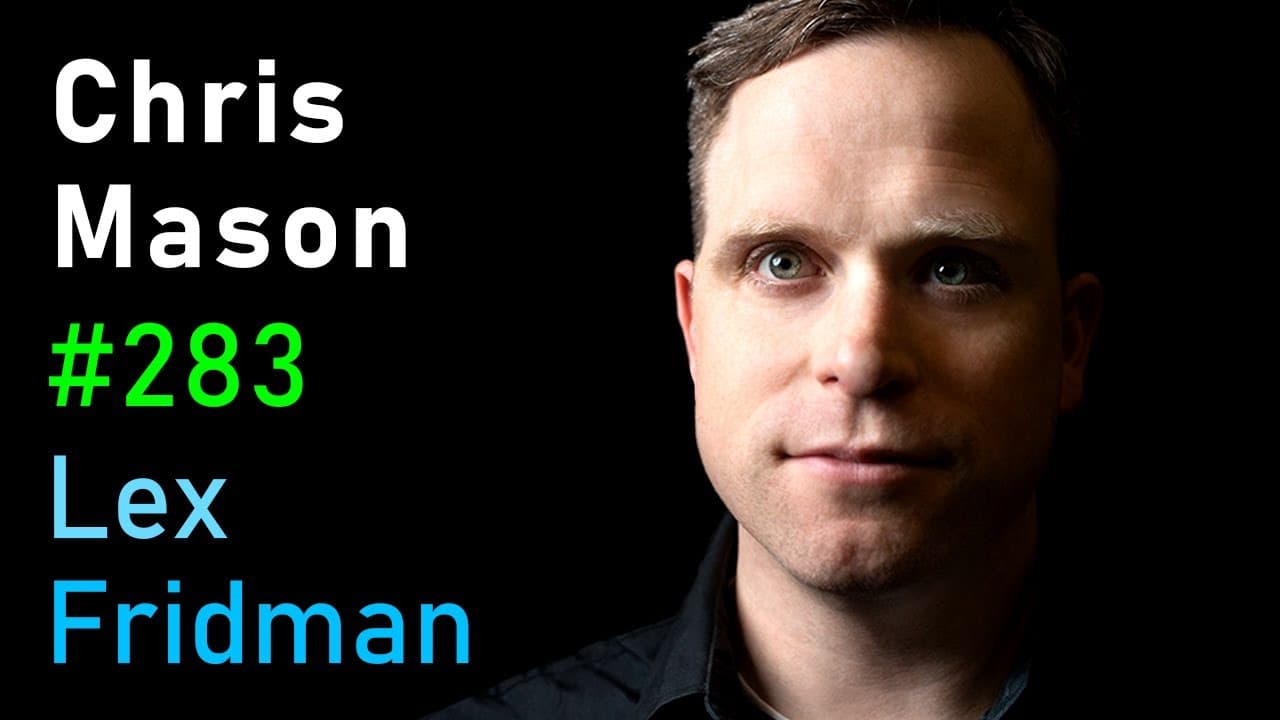
Chris Mason: Space Travel, Colonization, and Long-Term Survival in Space | Lex Fridman Podcast #283
TL;DR
Chris Mason, a professor of genomics, discusses the importance of awareness of death and extinction, the human-specific trait, in the context of colonizing space and expanding beyond our planet's boundaries.
Transcript
would that make you sad to die in mars looking back at the planet you were born on no i think it would be actually in some ways it may be the best way to die knowing that you're in the first wave of people expanding the reach into the stars it'd be an honor the following is a conversation with chris mason professor of genomics physiology and biophy... Read More
Key Insights
- 🚀 The awareness of death and extinction is a unique human trait that gives us a moral duty to protect and preserve life, including our own species.
- 💡 Contemplating our own mortality can be a creative force, inspiring us to make the most of our lives and strive for legacy.
- 🌍 Humans have a responsibility to expand beyond Earth and colonize other planets as a backup solution for the survival of our species.
- ⚙️ Engineering life is a key aspect of reaching new worlds and colonizing space, and we have a duty to use this knowledge to protect and enhance life.
- 😱 Viruses are both terrifying and exciting, as they can be harmful but also carry the potential for groundbreaking scientific advancements.
- 🌟 Humans possess a unique perspective and the ability to create beauty, innovation, and hierarchy, setting us apart from other species.
- 🔬 DNA, RNA, and genes play crucial roles in the recipe for life, carrying instructions for the development and functioning of the human body.
- 🚀 The impact of space on the human body includes inflammation, changes in gene expression, and adaptation to the effects of radiation. Understanding these effects is crucial in preparing for long-term space missions.
Install to Summarize YouTube Videos and Get Transcripts
Explore YouTube Video Summarizer or Get YouTube Transcript Extractor
Questions & Answers
Q: Does awareness of death and extinction contribute to human-driven innovations and advancements?
Yes, awareness of death and extinction serves as a motivational force for humans to push the boundaries of scientific knowledge and pursue advancements that can extend life and prevent extinction. This awareness enables individuals, as well as the human species as a whole, to strive for progress, innovations in space travel, and the preservation of life beyond Earth.
Q: How does the concept of duty play a role in the efforts to colonize space and explore other planets?
The concept of duty drives humans to expand beyond Earth and establish colonies on other planets as a means of preserving life and ensuring the survival of the human species. By viewing it as a duty, humans recognize their unique capability to carry this awareness of death and extinction and actively work towards expanding into the universe, thereby fulfilling their responsibility to future generations.
Q: How does the book "The Next 500 Years" address the long-term challenges of colonizing space?
The book explores the challenges and opportunities involved in colonizing space, focusing on the engineering of life to adapt to the conditions of other planets and ensure the survival of future generations. It delves into the potential for genetic modifications, technological advancements, and the interplay between biology and artificial intelligence in creating sustainable colonies in space.
Q: What are the main insights gained from analyzing the effects of space travel on the human body, particularly from the study of Scott Kelly's prolonged mission?
The study of Scott Kelly's mission revealed the body's remarkable adaptability to the challenges of space travel, such as inflammation and radiation exposure. It also highlighted unexpected findings, such as telomeres (chromosome ends associated with aging) increasing in length in space. These insights contribute to our understanding of the human body's response to prolonged space travel and inform strategies to protect and sustain astronauts during future missions.
Summary
In this video, Lex Friedman interviews Chris Mason, a professor of genomics physiology and biophysics at Cornell. They discuss topics related to space exploration, the human condition, consciousness, and the future of humanity. Chris also talks about his book titled "The Next 500 Years: Engineering Life to Reach New Worlds," which explores the colonization of space and the potential for human expansion beyond Earth.
Questions & Answers
Q: How fundamental is awareness of death and extinction to the human condition?
Awareness of death and extinction is a unique and exemplary human trait. While many people don't like to think about their own mortality, the awareness of the loss of not just one's own life, but the lives of everyone like us, gives humans a sense of duty to protect and preserve life.
Q: Is contemplating the extinction of the whole species a creative force?
Yes, contemplating the extinction of the whole species can be a creative force. At an individual level, contemplating death can create a sense of urgency and drive to accomplish things before our time is up. At a species-wide level, contemplating extinction can inspire humans to create solutions and innovations that could extend our presence in the universe.
Q: Why is duty an important word when discussing humanity's expansion beyond Earth?
Duty is an important word because it implies a responsibility and a sense of purpose. While duty can often be associated with mundane tasks, having a duty to protect and preserve life at a species-wide level is a morally grounded and powerful motivator. It creates a sense of love, compassion, and a fight for the rarity and preciousness of life.
Q: Can humans prevent the heat death of the universe?
While the heat death of the universe seems like an inevitable eventuality, humans have the capacity to resist entropy and prolong our existence. With a deep understanding of physics and space-time, humans could potentially restructure the shape of the universe to prevent or delay the heat death. The desire to survive and the ability to engineer systems that can withstand the challenges of the universe make humans well-suited to confront this existential threat.
Q: Are humans alone in the universe?
As far as we know, humans are the only sentient beings in the universe. There may be bacterial life elsewhere, but sentient life seems to be unique to Earth. However, considering the vastness of the universe and the relatively short time it has existed, it's possible that humans are just the first or one of the early attendees to the party of life. The question should be more about when other life forms will appear, rather than where they are.
Q: Should humans focus on making contact with aliens or on engineering life on their own?
Humans can walk and chew gum at the same time. While there are ongoing efforts to explore and make contact with aliens, it doesn't hinder our ability to focus on engineering life, improving genetics, or addressing immediate challenges on Earth. Both pursuits can coexist and, in some cases, intersect to create a better future for humanity.
Q: Are viruses exciting or terrifying?
Viruses can be both exciting and terrifying. As a geneticist, Chris Mason finds viruses fascinating and acknowledges their significant impact on human civilization. While some viruses can be harmful and cause diseases, the majority of viruses are not inherently dangerous. Understanding viruses and their potential uses, such as in gene therapy or genetic engineering, can be both inspiring and beneficial.
Q: How can the concept of entropy goggles shape our perspective?
Entropy goggles are a thought experiment that allows us to envision the transience and decay of everything around us. By imagining the future state of objects and environments in various time frames, we become aware of the impermanence of things. This awareness can be both terrifying and liberating, as it emphasizes our ability to impact and shape the world.
Q: Why did Chris Mason choose a 500-year timeline?
Chris Mason chose a 500-year timeline because it allows for the exploration of significant developments in technology and biology. Within this timeframe, he envisions the possibility of missions to Mars and the moon, as well as the potential for interstellar travel using generation ships. A 500-year timeline provides enough space for advancements while still being reasonably foreseeable.
Summary & Key Takeaways
-
Chris Mason emphasizes the significance of humans' awareness of death and extinction, which drives the duty to preserve life and expand into space.
-
He explores the concept of humans being the first sentient beings with this awareness, emphasizing the need for a sense of duty towards both current and future generations.
-
Mason discusses the role of contemplating the extinction of the whole species and the potential for humans to prevent and even resurrect extinct life forms.
Read in Other Languages (beta)
Share This Summary 📚
Summarize YouTube Videos and Get Video Transcripts with 1-Click
Try YouTube Summary with ChatGPT & Claude or YouTube Transcript Generator
Explore More Summaries from Lex Fridman 📚




Summarize YouTube Videos and Get Video Transcripts with 1-Click
Try YouTube Summary with ChatGPT & Claude or YouTube Transcript Generator