Consciousness is Not a Computation (Roger Penrose) | AI Podcast Clips
TL;DR
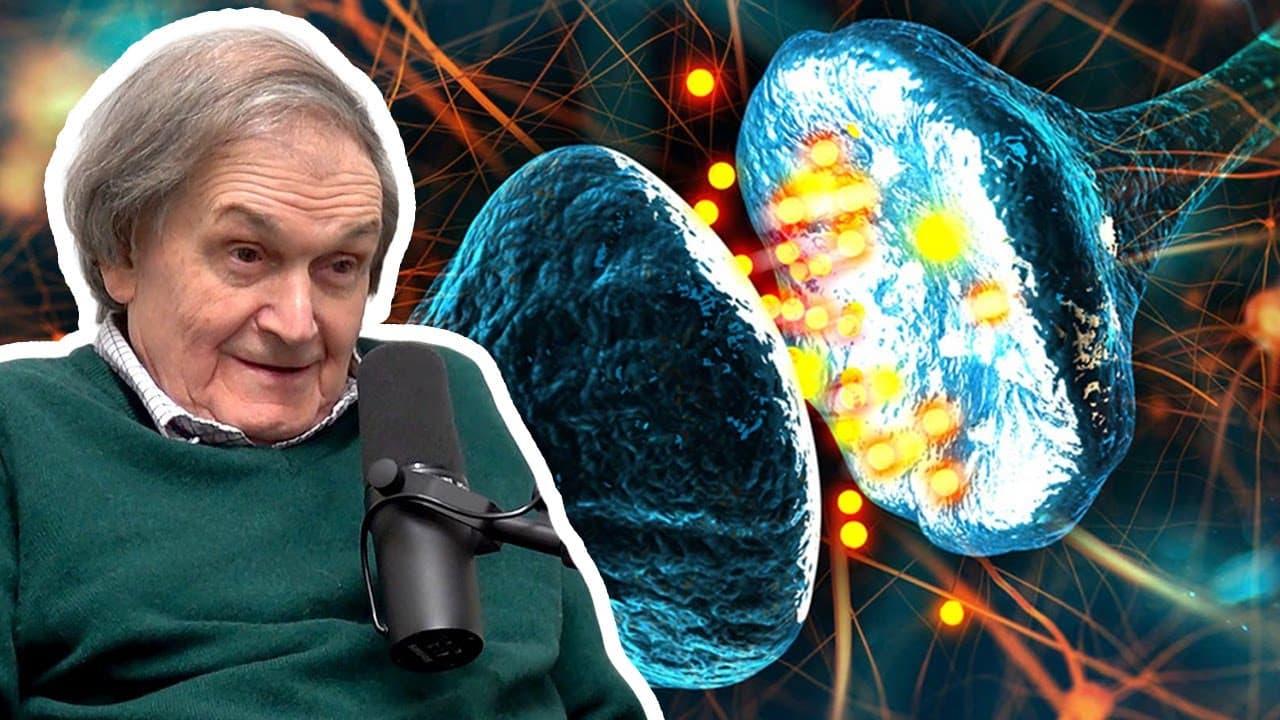
Consciousness is posited to arise from quantum processes within the brain, rather than being mere computations. Microtubules play a significant role in preserving quantum coherence, potentially influencing consciousness, especially in light of research on how general anesthetics affect these structures.
Transcript
I'm trying to say that whatever consciousness is it's not a computation yes it's not a physical process which can be described by computation but it nevertheless could be so one of the interesting models that you've proposed as the orchestrated objective reduction yeah that's going from there you say so I say I have no idea so I wrote this book thr... Read More
Key Insights
- ❓ Consciousness may not be fully explainable through computational processes.
- 🛟 Microtubules, with their symmetrical structures, are potential candidates for preserving quantum coherence and contributing to consciousness.
- 🥺 General anesthetics may directly affect microtubules, leading to a temporary loss of consciousness.
- 🎙️ More videos with Roger Penrose:
Install to Summarize YouTube Videos and Get Transcripts
Explore YouTube Video Summarizer or Get YouTube Transcript Extractor
Questions & Answers
Q: What led the author to write a book on consciousness?
The author was inspired by a radio discussion between Edward Fredkin and Marvin Minsky, which made him realize that there was something missing in the idea that computers could fully emulate human consciousness.
Q: What role do microtubules play in consciousness?
Microtubules are believed to preserve quantum coherence and may play a role in consciousness. They are of particular interest due to their symmetrical structures, which could better preserve quantum states.
Q: How do general anesthetics affect consciousness?
Stuart Hameroff and others believe that general anesthetics directly affect microtubules, potentially leading to a temporary loss of consciousness. This is a promising area for further research.
Q: Is there experimental evidence to support the role of microtubules in consciousness?
While there is some evidence pointing in that direction, further experiments are needed to confirm the direct effects of microtubules on consciousness.
Key Insights:
- Consciousness may not be fully explainable through computational processes.
- Microtubules, with their symmetrical structures, are potential candidates for preserving quantum coherence and contributing to consciousness.
- General anesthetics may directly affect microtubules, leading to a temporary loss of consciousness.
- The understanding of consciousness and its relationship to quantum mechanics and gravity is still in the early stages of development.
Summary
In this video, Roger Penrose discusses his ideas on consciousness and the role of quantum mechanics in understanding it. He explains how he came to write his book on the topic and the influence of colleagues like Stuart Hameroff. Penrose introduces the concept of microtubules and their potential role in preserving quantum coherence and influencing consciousness. He also talks about the need for a new theory that goes beyond conventional quantum mechanics and explains the collapse of wave functions. Penrose discusses the different viewpoints and ongoing experiments in the field, particularly relating to general anesthetics and their effects on microtubules.
Questions & Answers
Q: What led Roger Penrose to write his book on the relationship between consciousness and computation?
Penrose initially thought of writing a book on his ideas about consciousness when he retired. However, he was motivated to start writing earlier after listening to a radio discussion between Edward Fredkin and Marvin Minsky claiming that computers could emulate the entire human race in terms of concepts and ideas. Penrose disagreed with this perspective and decided to express his own ideas in a book.
Q: How did Stuart Hameroff influence Penrose's thinking on consciousness?
Stuart Hameroff reached out to Penrose and introduced him to the idea of microtubules, which Penrose hadn't previously considered. Hameroff suggested that microtubules could be relevant to the study of consciousness and argued that general anesthetics directly affect microtubules. This perspective significantly impacted Penrose's thinking and led him to incorporate microtubules into his theory.
Q: What are microtubules?
Microtubules are small tubular structures found in various cells, including neurons. Penrose became interested in them because of their symmetrical structure and the potential for preserving quantum coherence. Different types of microtubules exist within the body, and Penrose was particularly intrigued by the highly symmetrical ones. He believed they could better preserve quantum states necessary for consciousness.
Q: What is the Orchestrated Objective Reduction theory proposed by Penrose and Hameroff?
The Orchestrated Objective Reduction (Orch OR) theory posits that consciousness arises from quantum processes occurring inside neurons. It challenges the idea that consciousness is solely a result of computational processes performed by synapses. According to Orch OR, microtubules play a crucial role in preserving quantum coherence necessary for consciousness.
Q: Penrose mentions the need for a theory that goes beyond conventional quantum mechanics. What does he mean by that?
Penrose argues that conventional quantum mechanics, based on the Schrödinger equation, is not sufficient to explain consciousness. He believes there is something missing, specifically related to the measurement process and the collapse of wave functions. Penrose suggests that an entirely new theory is needed to understand the non-computable aspects of consciousness.
Q: Can the Orchestrated Objective Reduction theory be experimentally tested?
While there are no definitive experiments yet, there have been efforts to investigate the influence of microtubules and general anesthetics on consciousness. Jeremy Stowe and other researchers are working on experiments that could potentially demonstrate the need to modify quantum mechanics when gravitational effects are involved. Additionally, ongoing experiments are examining the direct effects of anesthetics on microtubules.
Q: How does Penrose categorize current physics theories regarding consciousness?
Penrose divides physics theories into three categories: superb, useful, and tentative. He claims that we are still far from even the tentative stage when it comes to understanding consciousness. While some computational views are commonly accepted, there isn't a clear consensus, and physics itself lacks a proper theory to explain the collapse of wave functions and the non-computable nature of consciousness.
Q: What is the relationship between intelligence, understanding, and awareness?
Penrose believes that understanding is a vital component of intelligence and that awareness is necessary for understanding. He sees a connection between these three concepts, although he admits that he doesn't know how to define them precisely. Understanding is the central focus for Penrose since it is an area where he can provide insight through mathematical frameworks like the kernel theorem.
Q: How does Penrose explain the choice made by nature in collapsing superpositions of quantum states?
Penrose presents two contrasting perspectives on the topic. Traditionally, some physicists believed that conscious observation collapses superpositions. In Penrose's view, the state reduces itself rather than being influenced by consciousness. He suggests that the choice made by nature in favor of one state over another is a fundamental aspect of consciousness and may involve proto-conscious elements.
Q: Is there a consensus among physicists regarding the study of consciousness and its relationship to quantum mechanics?
Penrose states that there is no clear consensus among physicists when it comes to understanding consciousness. Many views are computational in nature, but these perspectives don't fully explain consciousness. Neurophysiologists and quantum physicists have different approaches, and there are multiple possible lines of thinking. However, the study of consciousness is still a controversial and uncertain field.
Takeaways
Roger Penrose's exploration of consciousness challenges the perspective that it arises solely from computation performed by synapses. His Orchestrated Objective Reduction theory proposes a quantum foundation for consciousness, involving microtubules and the collapse of wave functions. Penrose emphasizes the need for a new theory that goes beyond conventional quantum mechanics to fully account for consciousness. Ongoing experiments in both quantum effects and the effects of anesthetics on microtubules shed light on the potential connections between quantum processes and consciousness. However, the study of consciousness is in its early stages, lacking a clear consensus among physicists, and a superb theory remains distant.
Summary & Key Takeaways
-
The content discusses the author's book on consciousness, inspired by a radio discussion between Edward Fredkin and Marvin Minsky, which made the author realize there was something missing in the idea that computers could fully emulate human consciousness.
-
The author explores the concept of microtubules, which are believed to play a role in preserving quantum coherence and potentially contributing to consciousness.
-
Stuart Hameroff's work on the effects of general anesthetics on microtubules is highlighted as a potential avenue for understanding the relationship between microtubules and consciousness.
Read in Other Languages (beta)
Share This Summary 📚
Summarize YouTube Videos and Get Video Transcripts with 1-Click
Try YouTube Summary with ChatGPT & Claude or YouTube Transcript Generator
Explore More Summaries from Lex Fridman 📚






Summarize YouTube Videos and Get Video Transcripts with 1-Click
Try YouTube Summary with ChatGPT & Claude or YouTube Transcript Generator