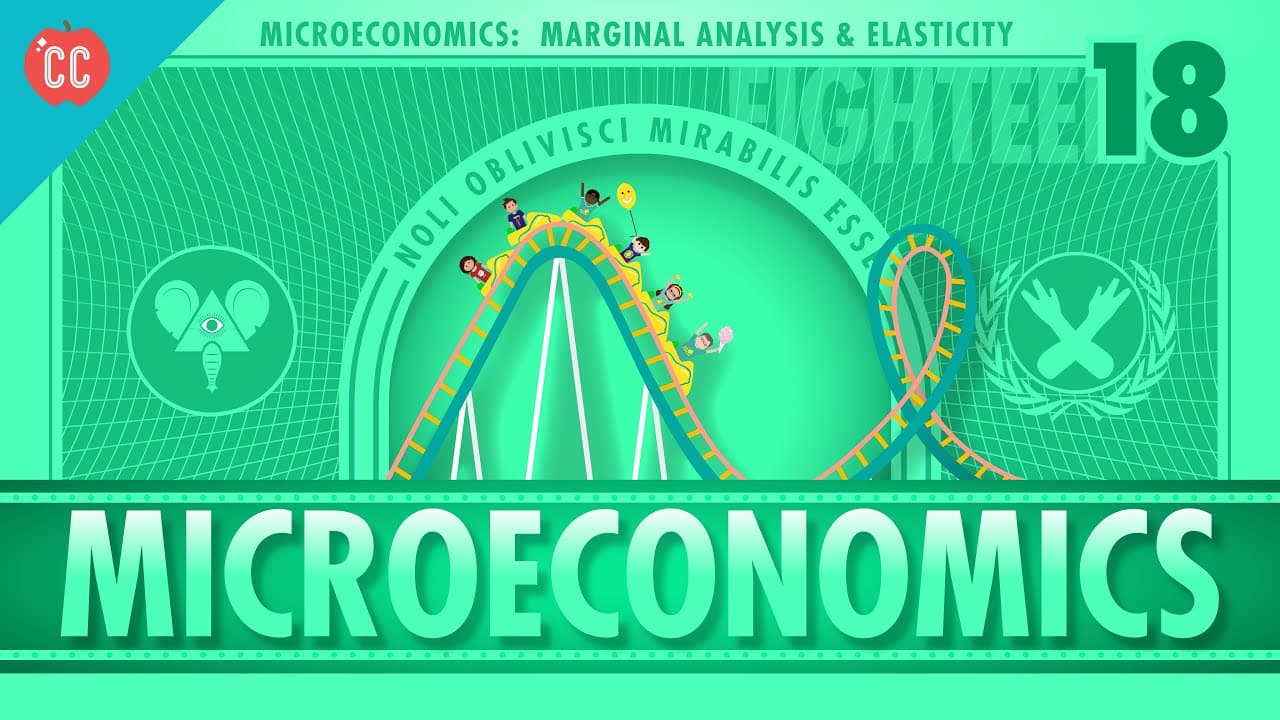
Marginal Analysis, Roller Coasters, Elasticity, and Van Gogh: Crash Course Economics #18
TL;DR
Microeconomics explores decision-making through marginal analysis and elasticity.
Transcript
Welcome to Crash Course Economics, I'm Jacob Clifford. And I'm Adriene Hill. We've been talking a lot about macroeconomics: GDP, unemployment, fiscal and monetary policy. That kind of thing. Now we're going to start talking about microeconomics. Microeconomics looks at individual markets and the decision-making of consumers, businesses, and governm... Read More
Key Insights
- Microeconomics focuses on individual markets and decision-making by consumers, businesses, and governments, contrasting with macroeconomics which looks at the economy as a whole.
- Marginal analysis is crucial in economics, assessing additional benefits and costs to guide decision-making for individuals, businesses, and governments.
- The Law of Diminishing Marginal Utility explains how additional consumption leads to less satisfaction, influencing consumer choices and demand curves.
- Supply and demand curves illustrate market efficiency, with equilibrium achieved when marginal benefit equals marginal cost.
- The Diamond-Water Paradox highlights how scarcity and marginal utility affect value, explaining why diamonds are priced higher than water.
- Elasticity of demand and supply affects how sensitive quantity demanded or supplied is to price changes, impacting pricing strategies and market behavior.
- Products with inelastic demand, like gasoline and insulin, see little change in quantity demanded despite price fluctuations, due to few substitutes.
- Microeconomics provides tools like marginal analysis and elasticity to improve decision-making, helping individuals and organizations optimize resource use.
Install to Summarize YouTube Videos and Get Transcripts
Explore YouTube Video Summarizer or Get YouTube Transcript Extractor
Questions & Answers
Q: What is the main focus of microeconomics?
Microeconomics focuses on individual markets and the decision-making processes of consumers, businesses, and governments. It contrasts with macroeconomics, which examines the economy as a whole. Microeconomics looks at factors like supply and demand, pricing strategies, and resource allocation to understand how these entities make choices.
Q: How does marginal analysis influence decision-making?
Marginal analysis influences decision-making by assessing the additional benefits and costs associated with an action. It helps individuals, businesses, and governments determine the optimal level of production or consumption. By comparing marginal benefits to marginal costs, decision-makers can maximize utility and efficiency, ensuring resources are used effectively.
Q: What is the Law of Diminishing Marginal Utility?
The Law of Diminishing Marginal Utility states that as a person consumes more units of a good or service, the additional satisfaction (utility) gained from each subsequent unit decreases. This concept explains why demand curves slope downward and why consumers are less willing to pay for additional units, affecting pricing and consumption patterns.
Q: How do supply and demand curves achieve market efficiency?
Supply and demand curves achieve market efficiency by aligning the quantity supplied with the quantity demanded at equilibrium. At this point, the marginal benefit of the last unit consumed equals the marginal cost of production. This balance ensures that resources are used optimally, with no excess supply or unmet demand, reflecting efficient market operations.
Q: What is the Diamond-Water Paradox?
The Diamond-Water Paradox highlights the discrepancy between the high price of diamonds and the low price of water, despite water's essential role in sustaining life. This paradox is explained by marginal analysis and scarcity. While water is abundant, its marginal utility is low, whereas diamonds are scarce, giving them high marginal utility and value.
Q: How does elasticity affect consumer behavior?
Elasticity affects consumer behavior by determining how sensitive the quantity demanded is to price changes. For products with inelastic demand, like gasoline, consumers continue purchasing despite price increases due to limited substitutes. Conversely, products with elastic demand, like pizza, see significant changes in quantity demanded with price fluctuations.
Q: Why is demand for gasoline considered inelastic?
Demand for gasoline is considered inelastic because consumers have few substitutes available. Even with price increases, consumers still need gasoline for transportation, leading to minimal changes in quantity demanded. This inelasticity is represented by a steep demand curve, indicating that price changes have a limited impact on consumer behavior.
Q: What role does microeconomics play in decision-making?
Microeconomics plays a crucial role in decision-making by providing tools like marginal analysis and elasticity to evaluate choices. It helps individuals and organizations optimize resource allocation, pricing strategies, and consumption patterns. Understanding these concepts enables better decision-making, improving efficiency and maximizing utility in various economic contexts.
Summary & Key Takeaways
-
Microeconomics examines individual markets, focusing on decision-making by consumers, businesses, and governments. Marginal analysis, a key concept, evaluates additional benefits and costs to guide these decisions. This approach helps understand consumer behavior and business pricing strategies, emphasizing the importance of both micro and macroeconomic perspectives.
-
Marginal analysis reveals how additional consumption affects satisfaction, explaining the Law of Diminishing Marginal Utility. This principle shapes demand curves, showing why consumers are less willing to pay for additional units. Supply and demand curves illustrate market efficiency, with equilibrium where marginal benefit equals marginal cost.
-
Elasticity in economics shows how sensitive demand and supply are to price changes. Inelastic demand, seen in products like gasoline, results in minimal quantity change despite price shifts. Microeconomics equips individuals with tools like marginal analysis and elasticity for better decision-making, optimizing resource allocation.
Read in Other Languages (beta)
Share This Summary 📚
Summarize YouTube Videos and Get Video Transcripts with 1-Click
Try YouTube Summary with ChatGPT & Claude or YouTube Transcript Generator
Explore More Summaries from CrashCourse 📚





Summarize YouTube Videos and Get Video Transcripts with 1-Click
Try YouTube Summary with ChatGPT & Claude or YouTube Transcript Generator