How Can Cloud Providers Build and Preserve Trust?
TL;DR
Trust depends on securing customer information, recognizing customer ownership of data, protecting privacy, following the law, and operating transparently. Cloud providers should combine strong encryption with a holistic security approach covering identity, devices, applications, infrastructure, and data, while governments and industry work together to preserve enduring values amid cyberattacks, terrorism, surveillance debates, and geopolitical conflict.
Transcript
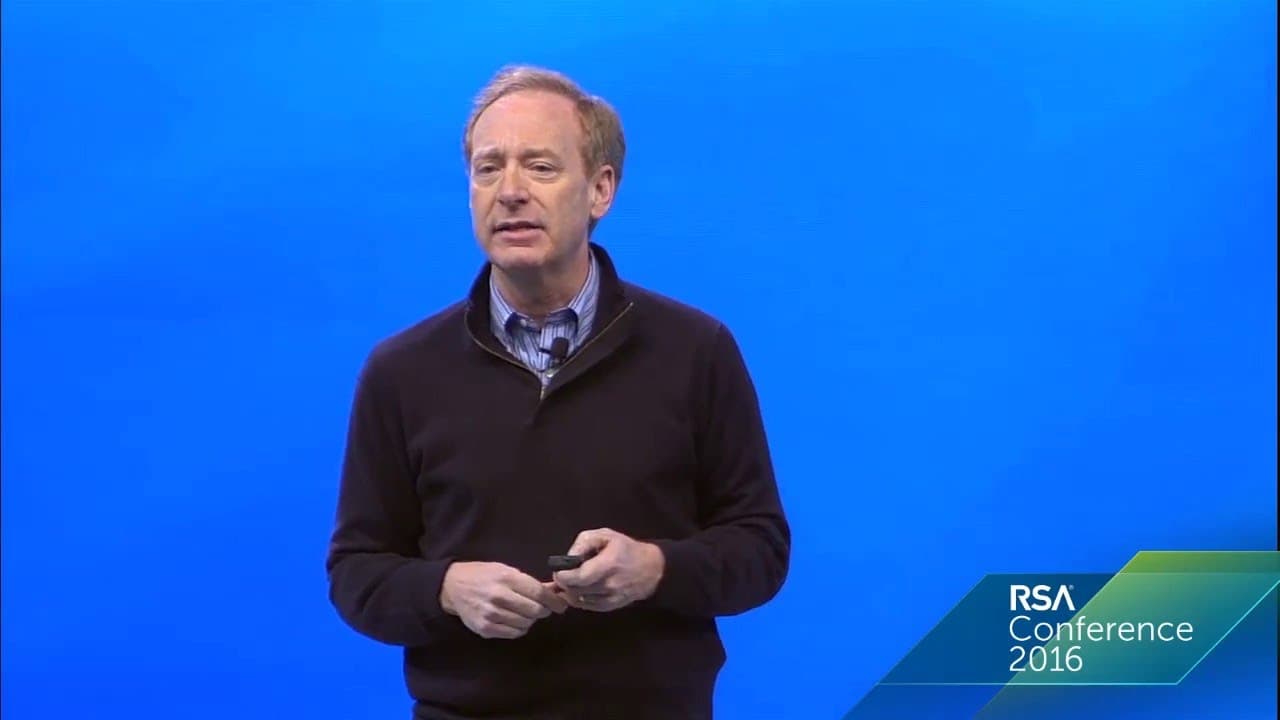
Ladies and gentlemen, please welcome President and Chief Legal Officer, Microsoft, Brad Smith. Good morning. I w- I wanna begin by saying that it's a pleasure and a privilege for me, not only to represent Microsoft here at this twenty-fifth conference, but in particular to follow Art Coviello onto the stage. Art, I think the most important thing to... Read More
Key Insights
- Trust is the foundation of the technology industry because people will not use systems they consider untrustworthy. Maintaining that trust requires cloud providers to translate stated values into consistent security, privacy, legal compliance, customer control, and transparency practices.
- Cybersecurity is inseparable from national security because activity intended to influence the physical world increasingly begins online. Governments examining the Sony attack recognized that protecting institutions and society now requires effective defenses for networks, devices, services, and digital information.
- Customer data remains the property of the customer even when entrusted to a technology provider. Microsoft identifies this ownership principle as a central obligation alongside information security, privacy protection, legal management of data, and transparency about company practices.
- Encryption is the most important technology for maintaining security in the framework Brad Smith presents. He argues that well-intentioned demands for backdoors can create dangerous weaknesses, so the technology industry must thoughtfully and publicly defend strong encryption.
- A holistic security strategy begins with identity and extends across devices, applications, infrastructure, and data. This broader model builds upon the established practices of protecting against threats, detecting attacks, and responding when security incidents occur.
- The Target breach exposed information affecting more than forty million customers before the reported number rose above one hundred million. The global investigation demonstrated how attacks on ordinary commercial systems can rapidly become large, international security events.
- The Sony Pictures attack became both an information technology crisis and a geopolitical dispute connected to North Korea. Its consequences showed that corporate administrators and private-company decisions can attract direct scrutiny from national leaders and become matters of public policy.
- Timeless values should endure even as technology advances. Microsoft uses this idea to frame difficult choices involving security, privacy, data ownership, legal obligations, and transparency during periods when attacks and public fear can push policy debates in sharply different directions.
Install to Summarize YouTube Videos and Get Transcripts
Explore YouTube Video Summarizer or Get YouTube Transcript Extractor
Questions & Answers
Q: Why is trust essential for cloud computing?
Trust is essential because people will not use technology they believe cannot protect them or their information. Computing devices contain what the transcript calls the privacies of life, so providers must demonstrate that customer data is secure, privately handled, legally managed, and transparently governed. Trust therefore depends on both effective technical defenses and clear principles that guide company behavior.
Q: How should cloud providers protect customer data?
Cloud providers should use a holistic security approach that begins with identity and covers devices, applications, infrastructure, and the data itself. They should continue the established work of protecting systems, detecting threats, and responding to attacks. They must also preserve strong encryption, respect customer ownership of entrusted data, protect privacy, comply with law, and explain their practices transparently.
Q: What principles guide Microsoft's approach to cloud trust?
Microsoft identifies four guiding principles. Security is paramount, so customer information must be kept secure. Customers continue to own the data they entrust to Microsoft. Their privacy must be protected, and their information must be managed according to law. Finally, Microsoft says transparency is essential because people need to understand what the company is doing with their data.
Q: Why does Brad Smith oppose encryption backdoors?
Brad Smith argues that no security technology is more important than encryption and that it must remain strong. He warns that even well-intentioned efforts to create backdoors can open a dangerous path by weakening protection. His position is that the industry should be thoughtful and vocal in defending encryption because secure information is necessary for safety and public trust.
Q: How did the Target breach change cybersecurity awareness?
Target announced on December 19, 2013, that more than forty million customers had been affected after store systems were penetrated. Within less than a month, the reported number exceeded one hundred million, and the investigation extended around the world. The incident opened public attention to the scale of technology security risks and the international reach of major commercial breaches.
Q: Why was the Sony Pictures attack a geopolitical event?
The Sony Pictures attack began as employees encountered computers that did not operate as expected, but the investigation reached North Korea and expanded beyond ordinary information technology security. It became a geopolitical issue discussed by President Obama at a press conference. The episode showed that attacks against private companies can raise national policy questions and place corporate responses under presidential scrutiny.
Q: How are cybersecurity and national security connected?
Cybersecurity and national security are connected because the Internet is no longer separate from events in the physical world. People use online systems to recruit, advocate, investigate crimes, learn, and influence real-world activity. After studying the Sony case, governments recognized that national security now requires cybersecurity, while the technology industry recognized that physical safety increasingly depends on online safety.
Q: How should governments and technology companies balance security and privacy?
Governments and technology companies should begin with enduring values while recognizing that no individual or organization has every answer. The transcript calls for conversation among industry, government, and the wider world. Decisions should keep information secure, preserve privacy and customer ownership, follow the law, provide transparency, and maintain strong encryption even when attacks create pressure for expanded surveillance or technological backdoors.
Summary & Key Takeaways
-
Cloud computing connects digital systems with events in the physical world, making cybersecurity essential to national security and personal safety. The Target and Sony breaches demonstrated the scale and geopolitical reach of modern attacks, while terrorism intensified public arguments about surveillance, privacy, encryption, and the responsibilities of governments and technology companies.
-
Trust is the foundation of technology adoption because computing devices contain deeply private information. Microsoft organizes its decisions around four principles: keeping data secure, recognizing that customers retain ownership of entrusted data, protecting privacy and managing information according to law, and providing transparency so people understand how their information is handled.
-
Security requires more than principles written on paper. Microsoft advocates evolving the established protect, detect, and respond model through a holistic strategy covering identity, devices, applications, infrastructure, and data. The company also argues that encryption must remain strong because deliberately created backdoors can weaken the security on which customers and society depend.
Read in Other Languages (beta)
Share This Summary 📚
Summarize YouTube Videos and Get Video Transcripts with 1-Click
Try YouTube Summary with ChatGPT & Claude or YouTube Transcript Generator
Explore More Summaries from RSAC Cybersecurity 📚



Summarize YouTube Videos and Get Video Transcripts with 1-Click
Try YouTube Summary with ChatGPT & Claude or YouTube Transcript Generator