How Did Cleopatra Rise to Power in Egypt?
TL;DR
Cleopatra regained Egypt’s throne by combining education, political skill, personal confidence, and an alliance with Julius Caesar. Her command of several languages, respect for Egyptian traditions, and determination helped her survive exile, defeat her rivals, strengthen Egypt, and continue ruling after Caesar’s assassination placed her and her son in danger.
Transcript
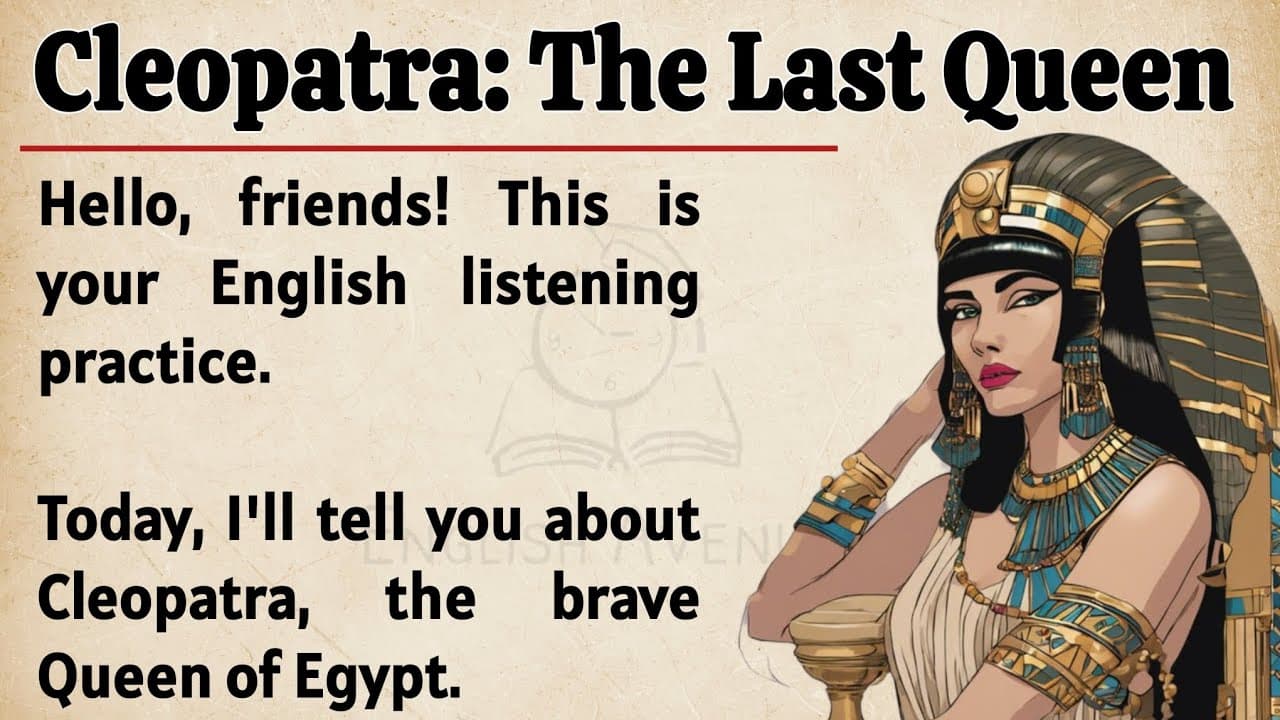
hello my friends today I want to tell you the incredible story of Cleopatra the last queen of ancient Egypt this is not just a history lesson it's a journey back in time filled with drama power love and ambition Cleopatra was one of the most famous women in history and her life is like an exciting movie so sit back relax and enjoy this amazing stor... Read More
Key Insights
- Cleopatra VII was born in Alexandria in 69 BCE and belonged to the Ptolemaic dynasty, a royal family of Greek origin that had governed Egypt since her ancestor Ptolemy I became king after the death of Alexander the Great.
- Cleopatra’s education was a major source of political power because she studied languages, science, mathematics, literature, and politics. The story says she spoke at least seven languages fluently and was the first Ptolemaic ruler to learn the Egyptian language.
- Cleopatra’s identification with Egypt distinguished her from earlier members of her dynasty. Although her family came from Greece, she respected Egyptian traditions, spoke the local language, and presented herself as Isis, a powerful goddess in Egyptian mythology.
- Cleopatra became queen at 18 after her father, Ptolemy XII, died, but his will required her to rule with her 10-year-old brother, Ptolemy XIII. Their unequal experience and competing claims quickly created a dangerous struggle for control.
- Ptolemy XIII’s advisers forced Cleopatra from the palace because they preferred a young ruler they could control. Exile left her without a throne, army, or secure home, but she retained loyal followers and began planning her return instead of surrendering.
- Cleopatra secured Julius Caesar’s attention through a bold secret meeting in which a servant reportedly carried her into Caesar’s quarters wrapped in a large carpet. She then used intelligence, confidence, and political persuasion to win his support for restoring her throne.
- Cleopatra’s alliance with Caesar combined strategic interests and a personal relationship. Caesar helped defeat Ptolemy XIII, while Cleopatra strengthened ties between Egypt and Rome, pursued new policies, improved trade, and hoped their son Caesarion could unite both powers.
- Caesar’s assassination in 44 BCE removed Cleopatra’s strongest Roman ally and placed her in danger. She escaped Rome with Caesarion and her treasures, returned to Egypt, strengthened the army and economy, educated her son in leadership, and sought another protective alliance.
Install to Summarize YouTube Videos and Get Transcripts
Explore YouTube Video Summarizer or Get YouTube Transcript Extractor
Questions & Answers
Q: How did Cleopatra become queen of Egypt?
Cleopatra became queen after her father, King Ptolemy XII, died and left instructions that she should rule with her younger brother, Ptolemy XIII. She was 18, while he was only 10. His advisers later forced her into exile, but she gained Julius Caesar’s support, defeated her rivals, and was restored to Egypt’s throne.
Q: Why was Cleopatra forced into exile?
Cleopatra was forced into exile because Ptolemy XIII’s advisers opposed her independent rule. They preferred her younger brother because he lacked experience and was easier for them to control. Their plotting made the palace unsafe for Cleopatra, so she fled into the desert with a small group of loyal followers and began planning how to recover her throne.
Q: How did Cleopatra persuade Julius Caesar to help her?
Cleopatra arranged a dramatic secret meeting because her enemies could have prevented her from entering the palace openly. According to the story, a loyal servant wrapped her inside a large carpet and carried it into Caesar’s quarters as a gift. Once revealed, she described her struggle, devotion to Egypt, and ambitions, impressing Caesar with her confidence and intelligence.
Q: What languages and subjects did Cleopatra study?
Cleopatra studied Greek, Latin, Egyptian, Hebrew, and several other languages, and the story says she could speak at least seven languages fluently. Her education also covered science, mathematics, literature, history, and politics. This broad learning gave her communication skills and political understanding that were unusual for women of her period and useful in diplomacy and government.
Q: Why did Cleopatra identify herself with Egyptian traditions?
Cleopatra came from the Greek Ptolemaic dynasty, but she developed a strong attachment to the country she ruled. She learned Egyptian, respected local traditions, and presented herself as the goddess Isis. These choices distinguished her from previous Ptolemaic rulers and demonstrated that she wanted to be regarded as more than a foreign monarch wearing Egypt’s crown.
Q: What was the relationship between Cleopatra and Julius Caesar?
Cleopatra and Julius Caesar formed both a political alliance and a personal relationship after he helped restore her throne. They spent time in Alexandria, sailed on the Nile, and discussed future plans. Their relationship produced a son in 47 BCE named Ptolemy Caesar, commonly called Caesarion. Cleopatra hoped he could eventually connect Egypt and Rome.
Q: Why did Cleopatra travel to Rome with Caesarion?
Caesar invited Cleopatra to Rome after returning from Egypt, and she accepted, traveling with Caesarion and an impressive entourage. She lived in a luxurious villa provided by Caesar, attended banquets, met Roman leaders, and displayed Egyptian wealth and culture. Her presence also caused suspicion among Romans who feared she might influence Caesar and Roman affairs.
Q: What did Cleopatra do after Julius Caesar was assassinated?
After Caesar was assassinated by Roman senators in 44 BCE, Cleopatra recognized that she had lost her most important ally and was no longer safe in Rome. She gathered Caesarion, her servants, and her treasures and returned to Egypt. There she strengthened the army, improved the economy, protected and educated her son, and sought another alliance for Egypt.
Summary & Key Takeaways
-
Cleopatra VII was born in Alexandria in 69 BCE into the Greek Ptolemaic dynasty. Raised amid royal luxury and danger, she studied languages, science, mathematics, literature, and politics. Her education, confidence, and respect for Egyptian traditions prepared her to pursue power in a family where relatives regularly competed for the throne.
-
After her father died, the 18-year-old Cleopatra was required to share Egypt’s throne with her 10-year-old brother, Ptolemy XIII. His advisers plotted against her and forced her into exile. Cleopatra responded by seeking Julius Caesar’s support, reportedly entering his quarters concealed inside a carpet to present her case personally.
-
Caesar helped Cleopatra defeat Ptolemy XIII and return to power. Their political and personal relationship produced a son, Ptolemy Caesar, commonly called Caesarion. After Caesar was assassinated in 44 BCE, Cleopatra fled Rome, protected her son, strengthened Egypt’s army and economy, and searched for another alliance against future dangers.
Read in Other Languages (beta)
Share This Summary 📚
Summarize YouTube Videos and Get Video Transcripts with 1-Click
Try YouTube Summary with ChatGPT & Claude or YouTube Transcript Generator
Explore More Summaries from English Avenue 📚






Summarize YouTube Videos and Get Video Transcripts with 1-Click
Try YouTube Summary with ChatGPT & Claude or YouTube Transcript Generator