How Do Trademarks Prevent Consumer Confusion?
TL;DR
Trademarks are crucial for distinguishing goods and preventing consumer confusion. They serve as a form of consumer protection by ensuring that products are identifiable by their source, thus maintaining quality and brand reputation. Trademarks can be words, symbols, sounds, or even smells, and their legal protection helps companies safeguard their investments in product development and marketing.
Transcript
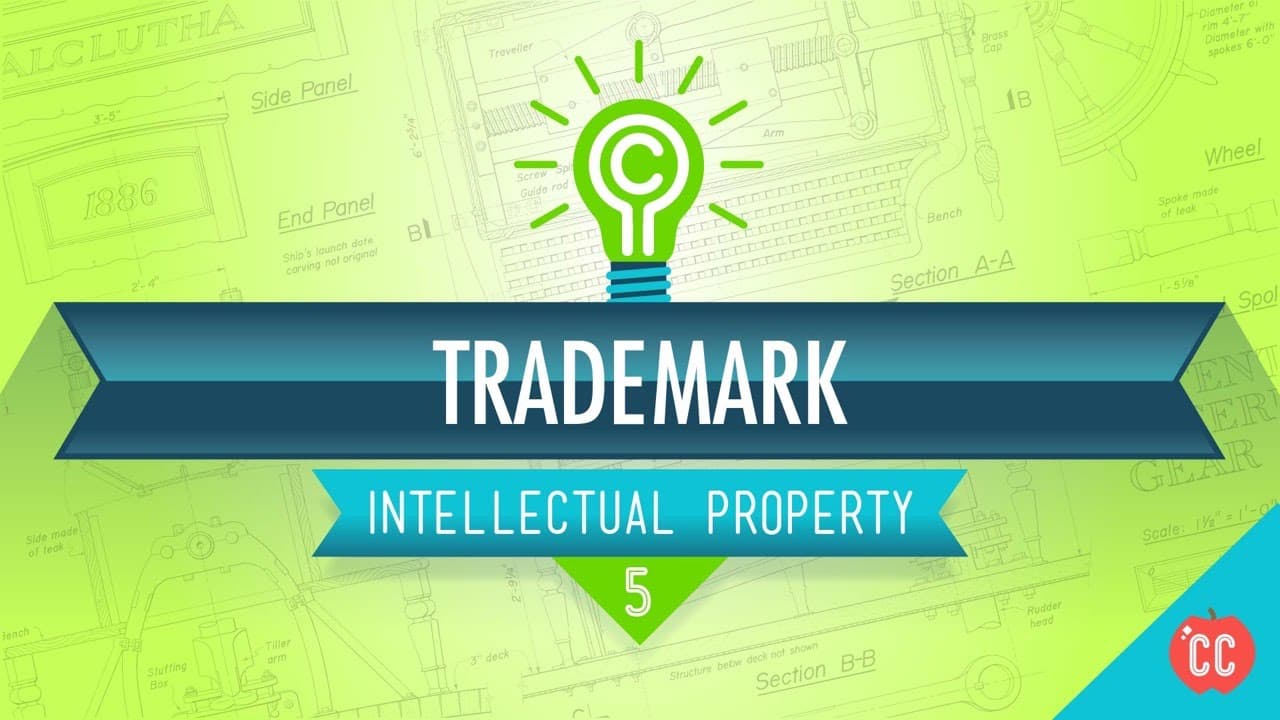
Hi! I'm Stan Muller, this is Crash Course Intellectual Property, and today we're talking about trademarks. Trademarks are everywhere, and they can often be confusing, so today we're gonna talk about why just about everything seems to be trademarked, and why trademarks are good for business. Mr. Muler! Trademarks don't intersect with my life, so I r... Read More
Key Insights
- Trademarks are symbols or devices used to identify and distinguish goods from those manufactured or sold by others.
- Trademarks serve as a consumer protection measure by preventing confusion and making it easier for consumers to select desired goods.
- The U.S. Supreme Court ruled that trademarks cannot be protected under the intellectual property clause but can be regulated under the commerce clause.
- Service marks are similar to trademarks but distinguish services rather than goods, like the MGM roaring lion for movies.
- Trademarks can include words, logos, designs, sounds, and even scents, provided they distinguish the product's source.
- Three requirements for trademarks include being a qualifying symbol, used in interstate commerce, and identifying the owner's goods distinctly.
- Trademarks are ranked by distinctiveness from generic to fanciful, with fanciful marks receiving automatic protection.
- Trademark disputes often center on the likelihood of confusion, with courts using various criteria to assess cases.
Install to Summarize YouTube Videos and Get Transcripts
Explore YouTube Video Summarizer or Get YouTube Transcript Extractor
Questions & Answers
Q: How do trademarks protect consumers?
Trademarks protect consumers by ensuring that goods and services are easily identifiable by their source, thus preventing confusion. This allows consumers to make informed purchasing decisions based on brand reputation and past experiences. By distinguishing products, trademarks also safeguard consumers from counterfeit goods and ensure consistent quality.
Q: What are the requirements for a valid trademark?
A valid trademark must meet three requirements: it must be a symbol or device that qualifies as a trademark, it must be used in interstate commerce, and it must identify the owner's goods and distinguish them from others. Additionally, the trademark must be distinctive to be eligible for legal protection.
Q: What types of symbols can be registered as trademarks?
Trademarks can include a wide range of symbols, such as words, logos, designs, sounds, and even scents. For example, the Nike swoosh, the sound of the NBC chimes, and the scent of a particular brand of motor oil are all registered trademarks. The key is that the symbol must distinguish the product's source.
Q: How does trademark distinctiveness affect protection?
Trademark distinctiveness affects protection by determining the level of legal protection a trademark receives. Trademarks are ranked from generic to fanciful. Fanciful, arbitrary, and suggestive marks are inherently distinctive and receive automatic protection. Descriptive marks require proof of acquired distinctiveness, while generic terms are not protectable.
Q: What is trademark dilution?
Trademark dilution refers to the weakening of a famous trademark's distinctive quality. It occurs in two forms: dilution by blurring, which erodes the distinctiveness of the mark, and dilution by tarnishment, which harms the mark's reputation. Famous trademarks, like Apple or Google, are protected against dilution even without consumer confusion.
Q: What role does consumer confusion play in trademark disputes?
Consumer confusion is central to trademark disputes, as the primary goal of trademark law is to prevent such confusion. Courts assess the likelihood of confusion by examining factors like the similarity of the marks, the defendant's intent, and any evidence of actual confusion. These factors help determine whether a trademark has been infringed.
Q: How are service marks different from trademarks?
Service marks are similar to trademarks but specifically distinguish services rather than goods. While trademarks apply to products, service marks apply to service providers, such as the MGM roaring lion for motion picture production. Both serve the same purpose of identifying the source and ensuring quality and reputation.
Q: What is the process for registering a trademark?
The process for registering a trademark involves filing an application with the U.S. Patent and Trademark Office (USPTO). The application is reviewed to ensure it meets all requirements. If accepted, the trademark is published for opposition, allowing others to contest it. If unopposed, the trademark is registered, and the owner must file affidavits of continuous use every five years to maintain registration.
Summary & Key Takeaways
-
Trademarks are essential tools for distinguishing goods and ensuring consumers can identify the source of products. They prevent consumer confusion and protect businesses' investments in branding. Trademarks can be almost anything that signifies the source of goods, including words, symbols, sounds, and even scents. They are legally protected to maintain brand integrity and consumer trust.
-
The U.S. Supreme Court has ruled that trademarks cannot be protected under the intellectual property clause but can be regulated under the commerce clause. Service marks and trade dress are similar concepts, with service marks distinguishing services and trade dress protecting distinctive product packaging.
-
Trademark disputes often revolve around the likelihood of consumer confusion. Courts use various criteria to assess these cases, including the similarity of marks, the intent of the defendant, and evidence of actual confusion. Famous trademarks may also receive protection against dilution, which can occur through blurring or tarnishment.
Read in Other Languages (beta)
Share This Summary 📚
Summarize YouTube Videos and Get Video Transcripts with 1-Click
Try YouTube Summary with ChatGPT & Claude or YouTube Transcript Generator
Explore More Summaries from CrashCourse 📚

Summarize YouTube Videos and Get Video Transcripts with 1-Click
Try YouTube Summary with ChatGPT & Claude or YouTube Transcript Generator