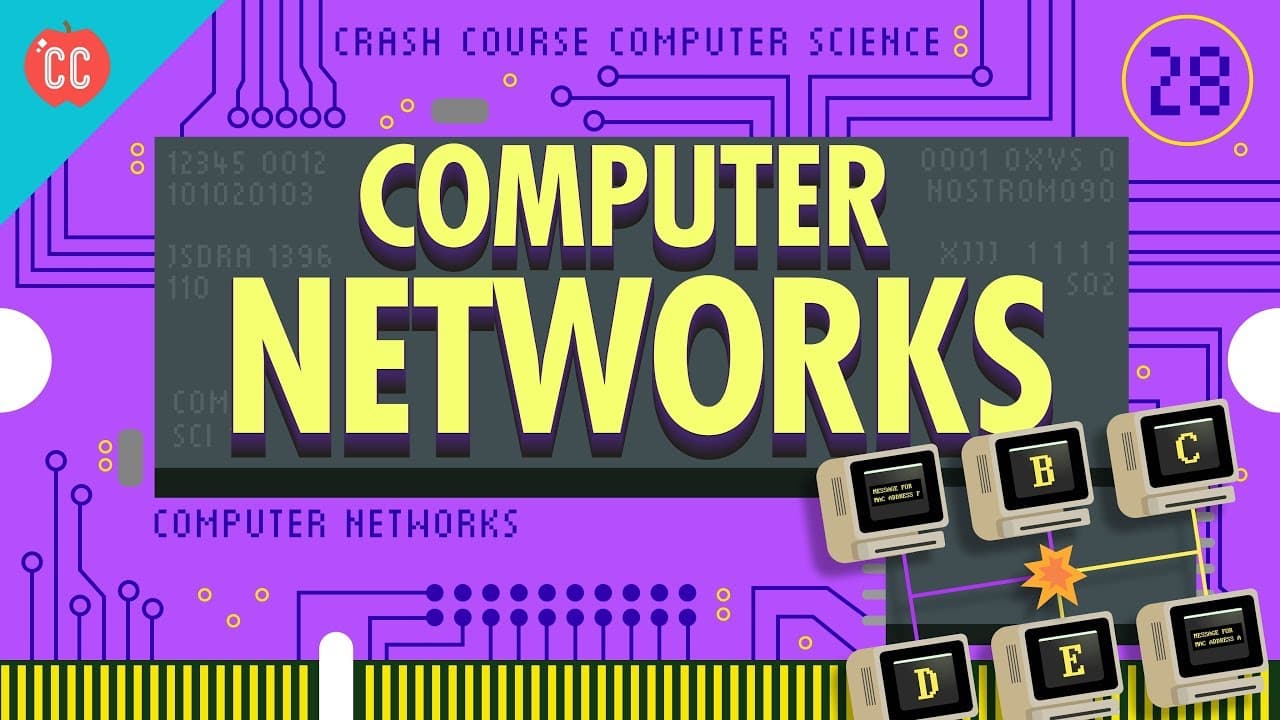
What Are Computer Networks and How Do They Work?
TL;DR
Computer networks are systems that allow computers to communicate and share resources efficiently. They evolved from early Local Area Networks (LANs) to the global Internet, utilizing technologies like Ethernet and packet switching to ensure reliable data transmission. Key principles include managing collisions, routing data effectively, and the decentralized nature of communication.
Transcript
Hi, I’m Carrie Anne, and welcome to CrashCourse Computer Science! The internet is amazing. In just a few keystrokes, we can stream videos on Youtube -- Hello! -- read articles on Wikipedia, order supplies on amazon, video chat with friends, and tweet about the weather. Without a doubt, the ability for computers, and their users, to send and receive... Read More
Key Insights
- The internet has revolutionized global communication, drastically reducing the time taken to send information across the world.
- Early computer networks emerged in the 1950s and 60s, primarily within organizations to facilitate data exchange and resource sharing.
- Local Area Networks (LANs) allowed multiple computers to share resources like printers and storage, with Ethernet being a prominent technology.
- Ethernet uses a shared medium and unique MAC addresses to manage data transmission and prevent collisions between devices.
- Network switches help reduce collisions by segmenting networks into smaller collision domains, allowing multiple transmissions simultaneously.
- Routing is essential for connecting distant networks, with techniques like circuit switching, message switching, and packet switching.
- Packet switching, used by the internet, divides data into packets for efficient routing, allowing flexible and fault-tolerant communication.
- ARPANET, the precursor to the modern internet, used packet switching and laid the foundation for the global network we have today.
Install to Summarize YouTube Videos and Get Transcripts
Explore YouTube Video Summarizer or Get YouTube Transcript Extractor
Questions & Answers
Q: What is the significance of MAC addresses in Ethernet networks?
MAC addresses are unique identifiers assigned to devices on a network, crucial for managing data transmission in Ethernet networks. They allow devices to recognize if incoming data is intended for them, preventing data collisions and ensuring efficient communication. Each device listens for data with its MAC address in the header, processing only relevant data.
Q: How do network switches improve network efficiency?
Network switches improve efficiency by reducing the likelihood of data collisions. They segment a network into smaller collision domains, allowing multiple simultaneous transmissions. Switches keep track of MAC addresses and only pass data between segments when necessary, optimizing network performance and minimizing traffic congestion.
Q: What is packet switching and why is it important?
Packet switching is a method of data transmission where large messages are divided into smaller packets. Each packet is routed independently, allowing for flexible and efficient use of network resources. This approach is crucial for the internet, enabling decentralized communication, fault tolerance, and efficient congestion control, adapting to varying network conditions.
Q: How does exponential backoff help manage data collisions?
Exponential backoff is a technique used to manage data collisions in networks. When a collision is detected, devices wait for a random time before retrying transmission. If collisions persist, the wait time increases exponentially. This method reduces the likelihood of repeated collisions, helping to stabilize network traffic and improve data flow.
Q: What role did ARPANET play in the development of the internet?
ARPANET was the first packet-switched network and a precursor to the modern internet. Funded by the US Advanced Research Projects Agency, it demonstrated the feasibility of networked communication between distant computers. ARPANET's development of packet switching laid the groundwork for the internet's decentralized architecture, supporting global connectivity and data exchange.
Q: Why is packet switching preferred over circuit switching for internet communication?
Packet switching is preferred because it allows for more efficient use of network resources. Unlike circuit switching, which dedicates a line for the duration of a communication session, packet switching divides data into packets that can take multiple routes. This flexibility enhances fault tolerance, reduces congestion, and optimizes bandwidth usage, making it ideal for the dynamic nature of internet traffic.
Q: What challenges do routers face in managing network traffic?
Routers face challenges such as congestion control, load balancing, and ensuring reliable data delivery. They must dynamically adjust routing paths based on network conditions, handle varying traffic loads, and manage packet reordering. Protocols like TCP/IP assist in maintaining efficient communication, adapting to changing network demands to provide consistent performance.
Q: How does the internet's decentralized nature contribute to its reliability?
The internet's decentralized nature enhances reliability by eliminating single points of failure. Multiple routing paths allow data to circumvent network issues, ensuring continued communication even if parts of the network are compromised. This architecture supports robust fault tolerance, enabling the internet to adapt to disruptions and maintain connectivity across diverse global networks.
Summary & Key Takeaways
-
The video discusses the evolution of computer networks, starting from early LANs within organizations to the development of global networks like the internet. Key technologies such as Ethernet, MAC addresses, and network switches are explained, highlighting their roles in efficient data transmission.
-
Ethernet technology and MAC addresses are crucial in managing data transmission over shared mediums, preventing collisions, and ensuring efficient communication within networks. The concept of collision domains and network switches further enhances network efficiency by segmenting networks.
-
Routing techniques, including circuit switching, message switching, and packet switching, are explored. Packet switching, the backbone of the internet, allows data to be divided into packets for flexible and reliable routing, supporting the decentralized nature of global communication networks.
Read in Other Languages (beta)
Share This Summary 📚
Summarize YouTube Videos and Get Video Transcripts with 1-Click
Try YouTube Summary with ChatGPT & Claude or YouTube Transcript Generator
Explore More Summaries from CrashCourse 📚





Summarize YouTube Videos and Get Video Transcripts with 1-Click
Try YouTube Summary with ChatGPT & Claude or YouTube Transcript Generator