Finding The Probability of a Binomial Distribution Plus Mean & Standard Deviation
TL;DR
Learn how to calculate the probability of a specific event occurring in a binomial distribution using a formula.
Transcript
in this video we're gonna talk about how to calculate the probability of a binomial distribution so here we have a problem where a six-sided die is rolled 12 times what is the probability of getting a four five times so here's the formula that we need the probability of getting X so sexist is equal to the combination formula NC X which can be writt... Read More
Key Insights
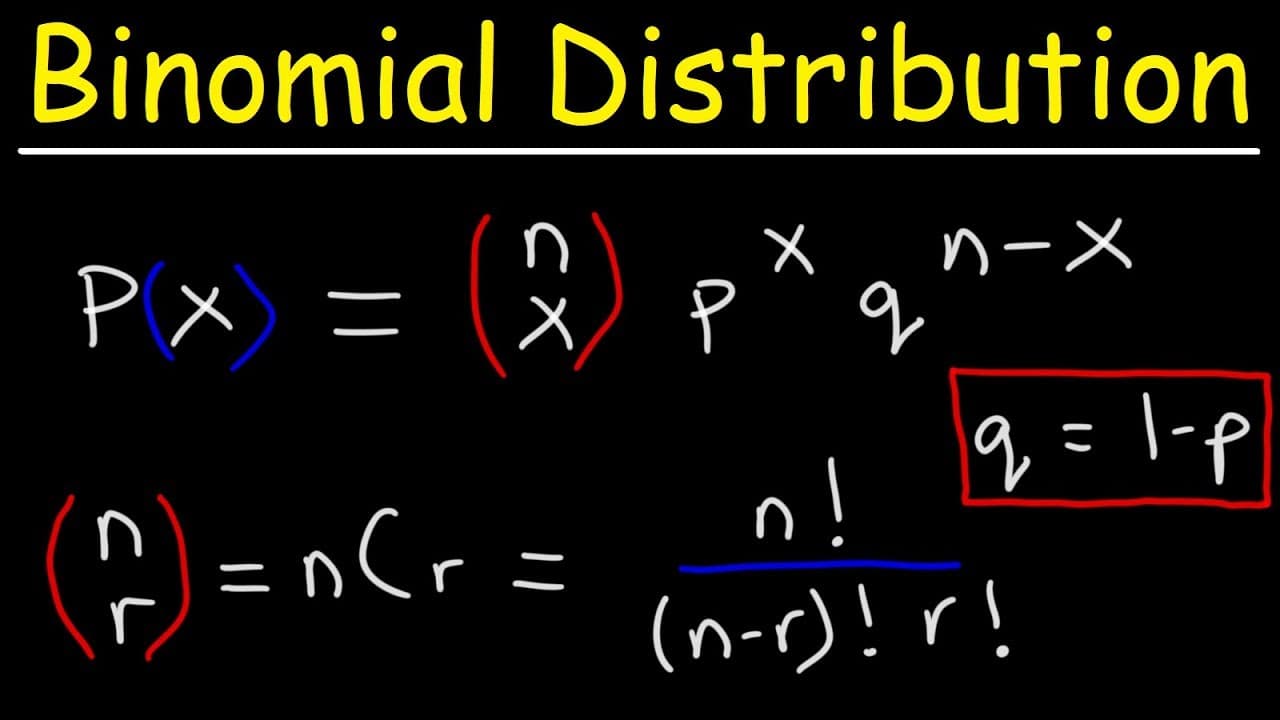
- ☺️ The formula for calculating the probability of a specific outcome in a binomial distribution is P(X) = (nCx) * (p^x) * (q^(n-x)).
- ☺️ The combination formula, nCx, is used to calculate the number of ways to choose x items from a set of n items.
- ✖️ The mean of a binomial distribution is equal to the number of trials multiplied by the probability of success.
- 🫚 The standard deviation of a binomial distribution is equal to the square root of the product of the number of trials, the probability of success, and the probability of failure.
- 😆 The probability of success and failure, denoted as p and q, respectively, can be calculated based on the specific problem.
Install to Summarize YouTube Videos and Get Transcripts
Explore YouTube Video Summarizer or Get YouTube Transcript Extractor
Questions & Answers
Q: What is the formula used to calculate the probability of a specific outcome in a binomial distribution?
The formula is P(X) = (nCx) * (p^x) * (q^(n-x)), where n is the number of trials, x is the number of successful events, p is the probability of success, and q is the probability of failure.
Q: How do you calculate the combination formula?
The combination formula, nCx, is calculated as n! / (x! * (n-x)!), where n is the total number of items and x is the number of items chosen.
Q: In the example of rolling a six-sided die 12 times, what are the values of n, x, p, and q?
In this example, n = 12 (the number of trials), x = 5 (the number of successful events), p = 1/6 (the probability of rolling a four), and q = 5/6 (the probability of not rolling a four).
Q: How do you calculate the probability of answering exactly 6 questions correctly on a multiple-choice test?
To calculate the probability, you need to use the formula P(X) = (nCx) * (p^x) * (q^(n-x)). In this example, n = 20 (the number of questions), x = 6 (the number of correct answers), p = 1/4 (the probability of guessing the correct answer), and q = 3/4 (the probability of guessing the wrong answer).
Q: How do you calculate the mean and standard deviation of a binomial distribution?
The mean of a binomial distribution is calculated as n * p, where n is the number of trials and p is the probability of success. The standard deviation is calculated as sqrt(n * p * q), where n is the number of trials, p is the probability of success, and q is the probability of failure.
Summary & Key Takeaways
-
The video explains how to calculate the probability of getting a specific outcome in a binomial distribution.
-
It provides an example of rolling a six-sided die 12 times and finding the probability of rolling a four five times.
-
Another example involves a multiple-choice test with 20 questions and finding the probability of answering exactly 6 questions correctly.
-
The video also demonstrates how to find the probability of selecting a certain number of students who are enrolled in algebra out of a random sample.
Read in Other Languages (beta)
Share This Summary 📚
Summarize YouTube Videos and Get Video Transcripts with 1-Click
Try YouTube Summary with ChatGPT & Claude or YouTube Transcript Generator
Explore More Summaries from The Organic Chemistry Tutor 📚



Summarize YouTube Videos and Get Video Transcripts with 1-Click
Try YouTube Summary with ChatGPT & Claude or YouTube Transcript Generator