What Is the History of Modern Anatomy?
TL;DR
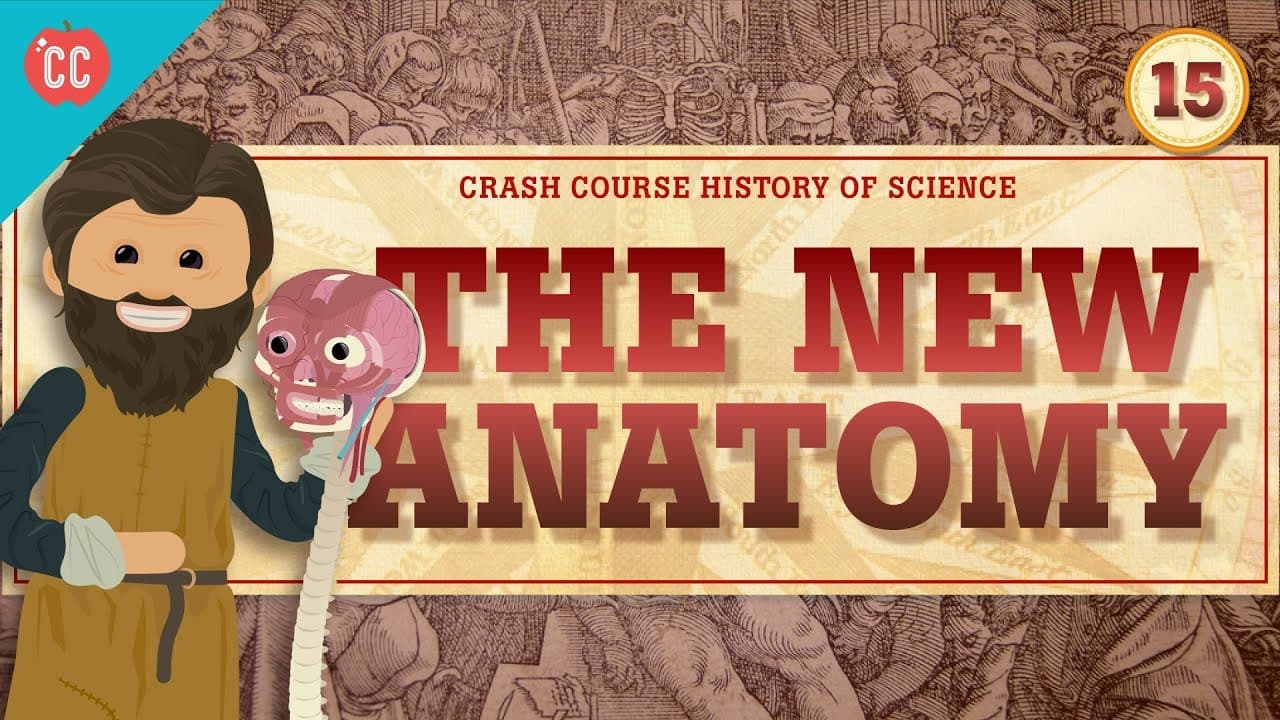
Andreas Vesalius revolutionized anatomy in the 16th century with his book 'De Humani Corporis Fabrica', challenging Galen's ancient theories. William Harvey later advanced understanding by describing blood circulation, refuting Galen's liver-based blood production theory. The microscope, pioneered by van Leeuwenhoek, further transformed biology, revealing microscopic life and inspiring future scientific exploration.
Transcript
In the 1500s and 1600s, the work of Copernicus and Galileo, among many others, reshaped how natural philosophers in western Europe thought about the question, where are we? But there’s another question to consider that’s at least equally daunting, what is life? And to try to answer that question, three tools stand out as being especially useful: ..... Read More
Key Insights
- Andreas Vesalius published 'De Humani Corporis Fabrica' in 1543, redefining anatomical study.
- Vesalius challenged Galen's theories, using human dissection to correct misconceptions.
- William Harvey discovered blood circulation, disproving Galen's liver-based blood production.
- Harvey introduced rigorous measurement in medical research, emphasizing scientific methodology.
- The microscope, invented by Anton van Leeuwenhoek, unveiled a microscopic world previously unseen.
- Van Leeuwenhoek's work led to the discovery of single-celled organisms, expanding biological understanding.
- Jan Swammerdam used microscopes to study life cycles and muscle contraction, enhancing life sciences.
- Robert Hooke's 'Micrographia' popularized microscopy, introducing the term 'cell' to describe living tissue.
Install to Summarize YouTube Videos and Get Transcripts
Explore YouTube Video Summarizer or Get YouTube Transcript Extractor
Questions & Answers
Q: How did Andreas Vesalius revolutionize anatomy?
Andreas Vesalius revolutionized anatomy by publishing 'De Humani Corporis Fabrica' in 1543, which challenged the long-standing Galenic theories that had dominated medical understanding for centuries. By conducting human dissections himself, Vesalius provided accurate descriptions and detailed illustrations of the human body, correcting many of Galen's misconceptions derived from animal dissections. His work established a new paradigm in anatomical study, focusing on direct observation and systematic understanding of the body's structure.
Q: What was William Harvey's contribution to medical science?
William Harvey's major contribution to medical science was his discovery of blood circulation, which he published in 1628 in 'Exercitatio Anatomica de Motu Cordis et Sanguinis in Animalibus'. Harvey demonstrated that blood moves in a continuous circuit throughout the body, refuting Galen's theory that the liver produced blood. His work introduced the concept of rigorous measurement and experimentation in medical research, significantly advancing the understanding of human physiology and influencing future scientific methodologies.
Q: What role did the microscope play in scientific discovery?
The microscope, invented by Anton van Leeuwenhoek, played a crucial role in scientific discovery by revealing a previously unseen microscopic world. This invention allowed scientists to observe single-celled organisms and intricate structures within living tissues, fundamentally transforming biological sciences. The microscope's ability to magnify small details opened new avenues for research, leading to significant advancements in microbiology, cell theory, and the understanding of life's complexity at the microscopic level.
Q: Who was Anton van Leeuwenhoek and what did he discover?
Anton van Leeuwenhoek was a Dutch scientist known as the 'father of microbiology' for his pioneering work with the microscope. He discovered an entire world of microscopic life, including single-celled organisms, which he called 'animalcules'. Van Leeuwenhoek's observations, shared with the Royal Society, significantly advanced the understanding of microbiology and demonstrated the importance of instrumentation in scientific knowledge-making. His work laid the foundation for future discoveries in the field of microbiology.
Q: What was the significance of Robert Hooke's 'Micrographia'?
Robert Hooke's 'Micrographia', published in 1665, was significant as the first book of microscope-enabled observations of the natural world. It popularized the use of the microscope in scientific research and introduced the term 'cell' to describe the basic structural unit of living organisms. The book's detailed and artistic illustrations captured the public's imagination and demonstrated the potential of visual observation in scientific discovery, making it a scientific bestseller of its time.
Q: How did Jan Swammerdam contribute to life sciences?
Jan Swammerdam contributed to life sciences by using the microscope to study the structure and development of life. He meticulously dissected animal and plant tissues, observing processes such as insect metamorphosis and muscle contraction. Swammerdam's work provided insights into the complexity of life cycles and cellular structures, marking a critical turn in the life sciences by combining detailed anatomical study with microscopic observation. His discoveries paved the way for advancements in developmental biology and physiology.
Q: What misconceptions did Vesalius correct in Galen's theories?
Andreas Vesalius corrected several misconceptions in Galen's theories through his work 'De Humani Corporis Fabrica'. He disproved Galen's belief that the human lower jaw consisted of two bones, that the major blood vessels originated in the liver, and that men had more teeth than women. Vesalius also overturned the idea that the heart was the center of thought and feeling, asserting instead that the brain and nerves held this role. His corrections were based on direct human dissection, challenging centuries-old anatomical beliefs.
Q: What impact did the invention of the microscope have on biology?
The invention of the microscope had a profound impact on biology by allowing scientists to observe and study microscopic organisms and structures that were previously invisible. This breakthrough led to the discovery of single-celled organisms, detailed cellular structures, and complex biological processes. The microscope facilitated advancements in microbiology, cell theory, and the understanding of life's fundamental building blocks. It transformed biology from a descriptive to an experimental science, opening new research fields and enhancing scientific knowledge.
Summary & Key Takeaways
-
Andreas Vesalius's 'De Humani Corporis Fabrica' in 1543 marked a significant shift in anatomical study, challenging Galen's ancient theories with human dissection and detailed illustrations. Vesalius's work laid the foundation for modern anatomy by emphasizing a systematic understanding of the human body as interconnected systems.
-
William Harvey's discovery of blood circulation in 1628 refuted Galen's theory of liver-based blood production. Harvey's work introduced rigorous measurement and experimentation into medical research, significantly advancing the understanding of human physiology and laying groundwork for future scientific methodologies.
-
The invention of the microscope by Anton van Leeuwenhoek unveiled a microscopic world, leading to the discovery of single-celled organisms and transforming biological sciences. Robert Hooke's 'Micrographia' popularized microscopy, introducing the term 'cell' and highlighting the importance of visual observation in scientific discovery.
Read in Other Languages (beta)
Share This Summary 📚
Summarize YouTube Videos and Get Video Transcripts with 1-Click
Try YouTube Summary with ChatGPT & Claude or YouTube Transcript Generator
Explore More Summaries from CrashCourse 📚




Summarize YouTube Videos and Get Video Transcripts with 1-Click
Try YouTube Summary with ChatGPT & Claude or YouTube Transcript Generator