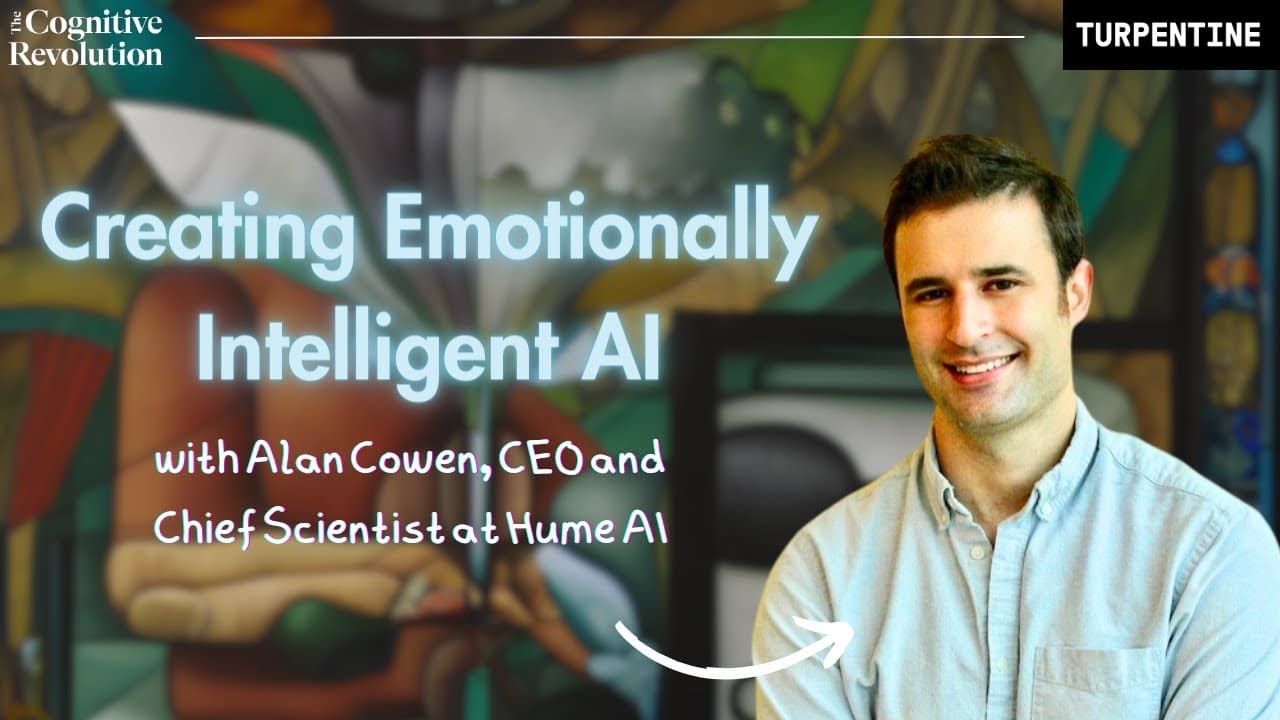
How Does Hume CEO Alan Cowen Create Emotionally Aware AI?
TL;DR
Hume CEO Alan Cowen says emotionally aware AI can understand human emotion by measuring facial expressions, vocal signals, speech patterns, and reactions across time. Hume AI distinguishes momentary positive emotions from broader well-being and trains culturally sensitive, multimodal models to optimize for human welfare. Read on to see how its data, custom models, applications, and ethical safeguards work.
Transcript
already with a pre-existing knowledge that gets it to well beyond human level it should be like way better than the than any human on earth at understanding emotional importances just from the start because it's already learned from way more data than any human on earth has seen that informs our understanding of emotional importances in everyday in... Read More
Key Insights
- AI can surpass human ability in understanding emotional importances by learning from vast datasets.
- Predicting human well-being involves analyzing emotional expressions and reactions over long periods.
- Cultural differences influence emotional expression, requiring custom models for accurate AI predictions.
- Expressions like anger, fear, and love are more universally recognized across cultures than general emotional scales.
- AI models must be trained to prioritize human well-being over other objectives, such as financial gain.
- Training AI on human interactions helps it understand emotional affordances and optimize for positive emotions.
- The interplay of language and emotional expression in AI can enhance customer service and mental health assessments.
- AI's ability to predict emotional states depends on its training data and the diversity of cultural inputs.
- "happiness is sort of the in the- moment experience of positive emotions" (5:02)
- "we give researchers and developers the tools to measure and optimize for human well-being" (5:27)
- "you have to measure it in a very multifaceted way people value the richness of emotional experience" (5:33)
- "it's not a one-dimensional thing it's not about just cute cat videos or funny things or just a all the time" (5:40)
- "love is important you know positive surprise excitement is important" (5:52)
Install to Summarize YouTube Videos and Get Transcripts
Explore YouTube Video Summarizer or Get YouTube Transcript Extractor
Questions & Answers
Q: How does Hume AI define happiness and well-being?
Hume AI describes happiness as the in-the-moment experience of positive emotions. Well-being also includes how people reflect on those experiences, which the transcript calls satisfaction with life.
Q: How does Hume AI teach AI to understand human emotions?
Hume AI measures signals including speech prosody, vocal bursts, facial expressions, and dynamic reactions. Its multimodal models use those signals to predict emotional states and how actions may affect human well-being over time.
Q: Why is emotion treated as more than a single scale?
Alan Cowen says emotional experience is rich and cannot be reduced to one dimension. Love, positive surprise, excitement, happiness, and satisfaction can each matter when measuring well-being.
Q: How does Hume AI account for cultural differences in emotional expression?
Hume AI collects data from diverse populations and trains models to reflect variations in how emotions are expressed and perceived. Custom models can further adapt predictions to particular populations and contexts.
Q: What role do custom models play in Hume AI's platform?
Custom models let users adapt the technology to their own data and use cases. They can target outcomes such as customer satisfaction or mental health indicators while accounting for the relevant context.
Q: What can emotionally aware AI be used for?
The existing page identifies customer service, mental health assessments, and broader user-experience optimization as potential applications. In each case, emotional predictions can provide information about people's reactions or well-being.
Q: How does Hume AI approach the ethics of emotionally aware AI?
Hume AI established a 10-member Ethics Committee and six guiding principles for empathic AI. It also published measurement practices for low, medium, and high-risk uses and identified supported and unsupported use cases.
Q: What is the long-term goal of emotionally aware AI?
The goal is for AI to predict how actions affect human well-being, not merely whether they increase a bank-account number. Cowen says this requires predicting emotional expressions, reactions, and states over long time scales.
Summary & Key Takeaways
-
AI can be trained to recognize and predict human emotions by analyzing facial expressions, vocal signals, and speech patterns. This involves collecting extensive data and creating models that consider cultural differences in emotional expression. By prioritizing human well-being, AI can enhance interactions and decision-making processes.
-
Hume AI focuses on teaching AI to optimize for human happiness and well-being. Their technology uses multimodal data to predict emotional states and improve experiences in fields like customer service and mental health. Custom models help address cultural variations in emotional expression.
-
The development of emotionally aware AI involves understanding and predicting how actions affect human emotions over time. By leveraging large datasets and advanced modeling techniques, AI can learn to prioritize human well-being, providing valuable insights for businesses and enhancing user interactions.
Read in Other Languages (beta)
Share This Summary 📚
Summarize YouTube Videos and Get Video Transcripts with 1-Click
Try YouTube Summary with ChatGPT & Claude or YouTube Transcript Generator
Explore More Summaries from Cognitive Revolution "How AI Changes Everything" 📚





Summarize YouTube Videos and Get Video Transcripts with 1-Click
Try YouTube Summary with ChatGPT & Claude or YouTube Transcript Generator