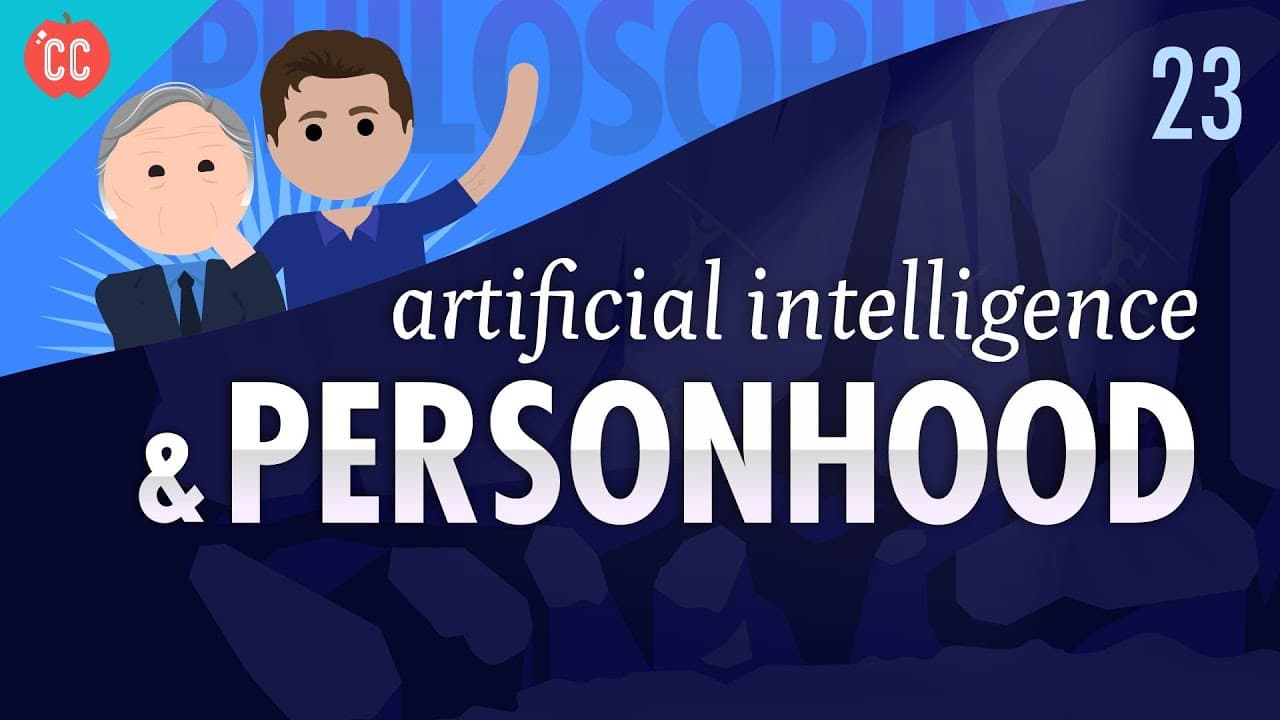
Can Artificial Intelligence Become a Person?
TL;DR
A machine could qualify as a person if its behavior, intentions, emotions, and understanding meet the same standards used to recognize human persons. The Turing Test treats convincing humanlike behavior as evidence of strong AI, while the Chinese Room argues that successful symbol manipulation may occur without genuine understanding, leaving machine personhood unresolved.
Transcript
Crash Course Philosophy is brought to you by Squarespace. Squarespace: share your passion with the world Ok, guys, real talk. Uhh, I’m kinda worried. I think my brother John might be a robot. I know, it sounds ridiculous. He looks like a human. Pretty much. And he acts like a human. Most of the time. But how could I really-100-percent-for-sure know... Read More
Key Insights
- Weak AI is a machine or system that imitates a limited aspect of human intelligence. Calculators, spell-check, auto-correct, phone assistants, email proofreading, and commute planning illustrate narrow abilities that resemble thought without matching the full range of human cognition.
- Strong AI is an inorganic system that actually thinks as humans do. The transcript distinguishes it from increasingly capable weak AI and states that no strong AI system has yet been designed, leaving its possible behavior and recognition open to philosophical debate.
- The Turing Test is a text-based comparison between a concealed human and a concealed machine. An evaluator may ask both participants anything, and the machine passes if its answers successfully convince the evaluator that it is the human participant.
- Turing’s standard is strictly behavior-based because it treats an indistinguishable performance as sufficient evidence of thought. This reflects the ordinary practice of attributing understanding and intentionality to others when their behavior consistently displays those qualities.
- William Lycan’s Harry is a humanoid robot who displays emotions, intentions, preferences, skills, friendship, and the ability to move beyond programming. Lycan argues that discovering motor oil instead of blood inside Harry should not reduce him from a person to something merely person-like.
- Programming is not necessarily a valid reason to deny a robot personhood because humans also begin with genetic predispositions and receive extensive social instruction. Parents and teachers shape language, manners, tool use, and other behaviors, while both humans and Harry can exceed their initial programming.
- The Chinese Room is John Searle’s argument that correct symbol manipulation does not establish genuine understanding. A person who knows no Chinese can follow English instructions and produce convincing Chinese responses, even though that person understands none of the exchanged messages.
- The systems response is an objection claiming that the complete Chinese Room understands Chinese even if its human component does not. Just as no single brain region must independently know English, understanding might belong to the combined system of person, instructions, and symbols.
Install to Summarize YouTube Videos and Get Transcripts
Explore YouTube Video Summarizer or Get YouTube Transcript Extractor
Questions & Answers
Q: What is the difference between weak AI and strong AI?
Weak AI mimics a limited part of human intelligence within a relatively narrow range of abilities. The transcript lists calculators, spell-check, auto-correct, phone assistants, email proofreading, and commute planning as examples. Strong AI would go further by actually thinking as humans do, with an inorganic system performing whatever human brains do. The transcript says weak AI exists, but strong AI has not yet been designed.
Q: How does the Turing Test evaluate artificial intelligence?
The Turing Test places an evaluator in text conversations with two concealed participants, one human and one machine. The evaluator may ask any questions, while both participants may respond freely and may even lie. If the machine convinces the evaluator that it is the human, it passes. Turing treats that successful humanlike performance as evidence that the machine has strong AI.
Q: Why is the Turing Test considered behavior-based?
The Turing Test judges a machine entirely through its observable conversational behavior rather than its material construction or hidden internal processes. Turing’s position is that if people cannot distinguish the machine’s thinking performance from a human’s, there is no meaningful difference for the test. The transcript connects this approach to everyday life, where people infer understanding and intentionality from how others behave.
Q: What does William Lycan’s robot Harry show about personhood?
Harry is presented as a humanoid robot with lifelike skin, emotions, intentions, preferences, social relationships, and varied abilities. He plays golf and viola, becomes nervous, makes love, enjoys expensive gin, and is regarded as a friend. Lycan argues that discovering motor oil inside Harry should not erase those person-like qualities. Different origins and physical materials do not, by themselves, disqualify him from personhood.
Q: Why does programming not automatically disqualify a robot from personhood?
Lycan argues that humans are also programmed in meaningful senses. Genetic code creates predispositions, while parents and teachers shape language, toilet use, table manners, and many other behaviors. Humans can go beyond this programming, but the imagined robot Harry can do so as well. Therefore, being programmed cannot establish a decisive difference between human persons and an adaptable artificial being.
Q: Can lacking a soul, blood, or reproduction rule out machine personhood?
The transcript argues that these proposed boundaries are insufficient. Even if God gives humans souls, there is no stated reason that God could not give one to Harry. Harry’s inability to reproduce also fails as a test because many humans cannot reproduce and remain persons. Likewise, replacing blood with motor oil changes Harry’s material constitution without necessarily changing his intentions, emotions, relationships, or cognitive status.
Q: How does the Chinese Room challenge the Turing Test?
The Chinese Room imagines a person who cannot speak Chinese but uses English instructions to select Chinese characters in response to written messages. Native speakers may believe the person understands Chinese because the responses are convincing. Yet the person only manipulates symbols and understands none of their meaning. Searle uses this case to argue that passing a behavioral test does not prove genuine understanding or strong AI.
Q: What is the systems response to the Chinese Room argument?
The systems response accepts that the individual inside the room does not know Chinese but argues that the complete system might understand it. That system includes the person, code book, symbols, inputs, and outputs. The transcript compares this with a human brain, where no particular region must independently know English. Understanding may therefore belong to the organized whole rather than any single component.
Summary & Key Takeaways
-
Weak AI reproduces limited aspects of human intelligence, as seen in calculators, spell-check, auto-correct, and phone assistants. Strong AI would do what human brains do and actually think like people. Although weak AI has existed for a long time and continues improving, the transcript says strong AI has not yet been designed.
-
Alan Turing proposed a behavior-based test in which someone holds text conversations with a human and a machine without knowing which is which. If the machine convinces the evaluator that it is human, Turing considers it strongly intelligent. The approach reflects how people ordinarily infer other minds from observable behavior.
-
John Searle’s Chinese Room challenges the idea that convincing behavior proves understanding. William Lycan’s robot Harry supports the opposing case for machine personhood because Harry displays intentions, emotions, friendship, and adaptability. Together, these arguments show why neither artificial construction nor humanlike performance alone conclusively settles whether a machine is a person.
Read in Other Languages (beta)
Share This Summary 📚
Summarize YouTube Videos and Get Video Transcripts with 1-Click
Try YouTube Summary with ChatGPT & Claude or YouTube Transcript Generator
Explore More Summaries from CrashCourse 📚



Summarize YouTube Videos and Get Video Transcripts with 1-Click
Try YouTube Summary with ChatGPT & Claude or YouTube Transcript Generator