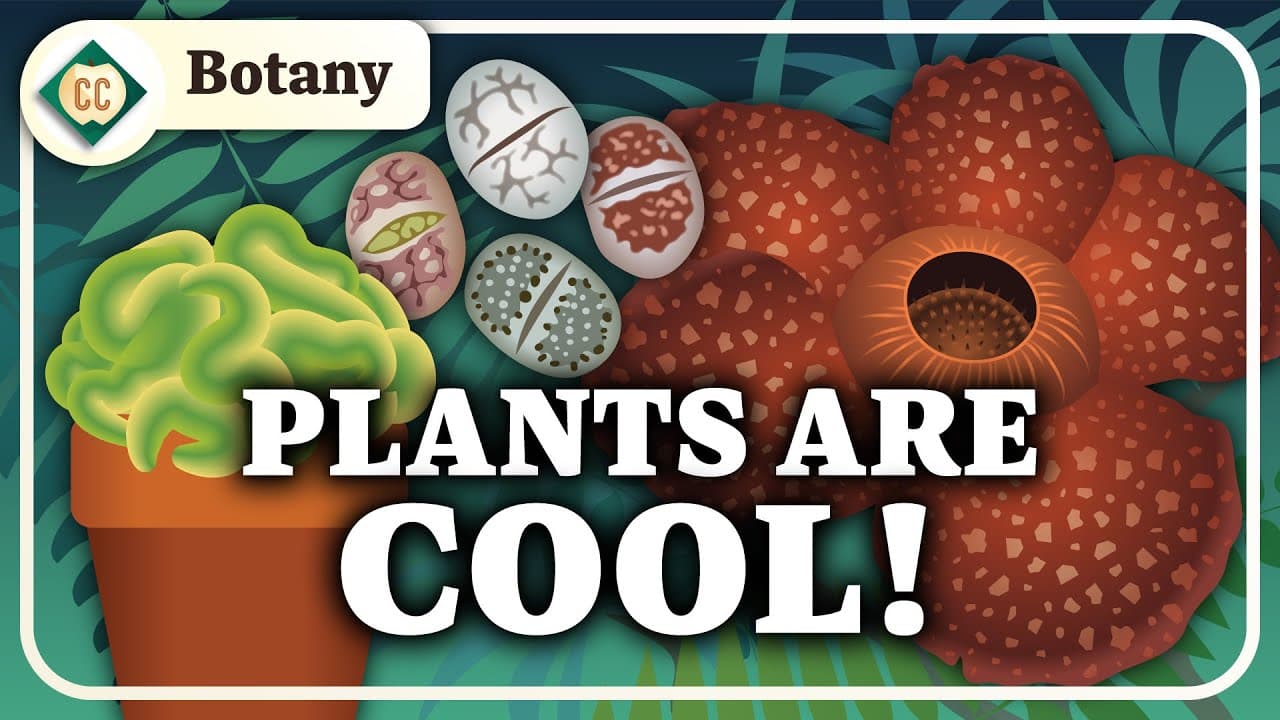
What is Botany? Crash Course Botany #1
TL;DR
Plants are more than just green organisms; they communicate, protect themselves, and provide essential resources for all living creatures.
Transcript
the world of plants may seem quiet and calm but you don't need to go much farther than your front door to find drama afoot like that sweet summery scent of freshly cut grass it's actually the plant equivalent of a scream through chemicals grass is sounding a warning call to nearby plants which start putting up their defensive Dukes getting ready to... Read More
Key Insights
- 😒 Plants use chemical signals to communicate and protect themselves from threats.
- 😋 Humans and all living organisms rely on plants for essential resources like oxygen, food, and medicine.
- 🌱 Botanical literacy helps understand the language of plants and their relationship to the world.
- 👯 Indigenous peoples and enslaved individuals have contributed valuable knowledge to botany throughout history.
- 👻 Agriculture revolutionized human societies, allowing settlements and specialization of labor.
- 😒 Plants have a wide range of uses, from materials for clothing and shelter to medicines and flavorings.
- 🌱 Botany explores the structure, function, and genetic traits of plants.
Install to Summarize YouTube Videos and Get Transcripts
Explore YouTube Video Summarizer or Get YouTube Transcript Extractor
Questions & Answers
Q: How do plants communicate with each other?
Plants release chemicals to warn nearby plants of potential danger, triggering their defensive responses. They can also attract predator insects to those that are eating them.
Q: Why do plants release special chemicals when they are being attacked by insects?
By releasing special chemicals, plants attract predator insects that feed on the insects causing damage, leading to a natural balance in the ecosystem.
Q: What is the significance of plants in human civilization?
Plants provide oxygen, food, shelter, and medicine for humans. They have shaped our societies and allowed us to settle in permanent settlements.
Q: How did the alliance between humans and plants in agriculture shape history?
Around 10,000 years ago, humans began growing plants as crops in exchange for a steady supply of food. This led to the development of agriculture and the growth of human populations.
Summary & Key Takeaways
-
Grass releases chemicals to warn nearby plants of potential damage, triggering their defense mechanisms against insects.
-
Plants have a complex network of connections, releasing chemicals to attract predators to insects that are eating them.
-
Human civilization and life as we know it depend on plants for oxygen, food, medicine, shelter, and more.
Read in Other Languages (beta)
Share This Summary 📚
Summarize YouTube Videos and Get Video Transcripts with 1-Click
Try YouTube Summary with ChatGPT & Claude or YouTube Transcript Generator
Explore More Summaries from CrashCourse 📚



Summarize YouTube Videos and Get Video Transcripts with 1-Click
Try YouTube Summary with ChatGPT & Claude or YouTube Transcript Generator