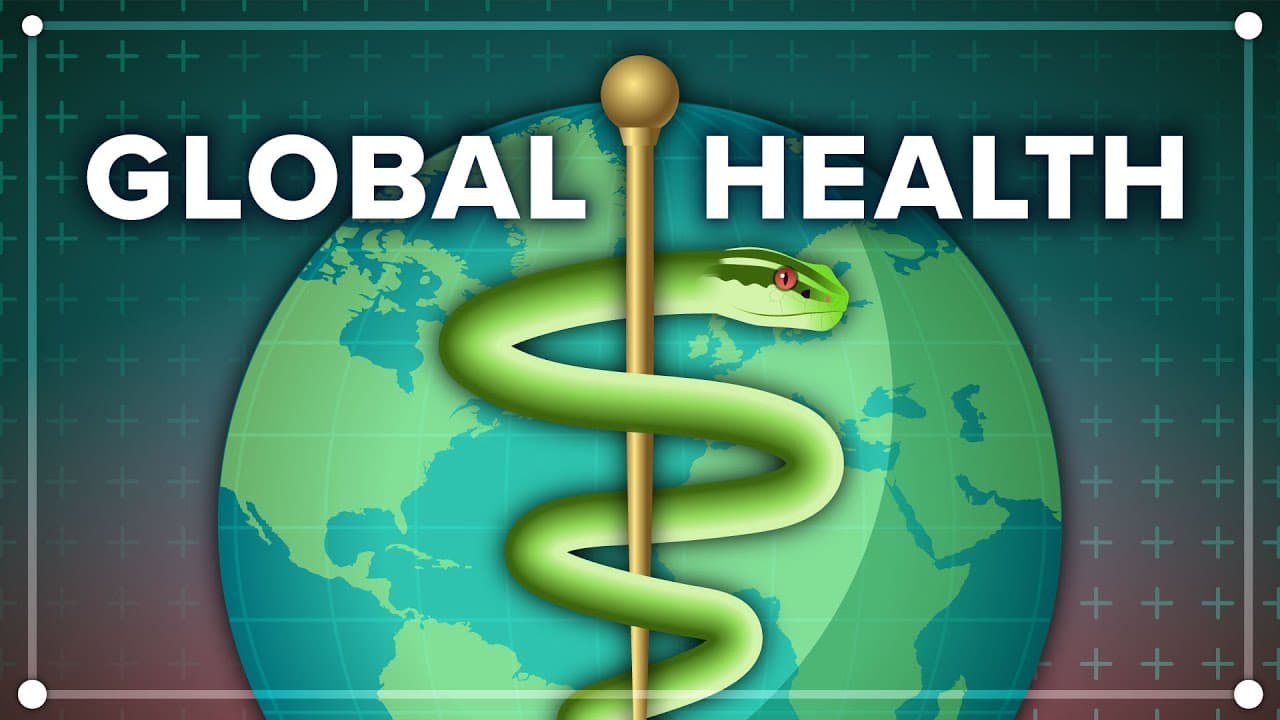
Global Health: Crash Course Public Health #9
TL;DR
Global health is a public health approach that seeks to improve health worldwide while eliminating health-equity gaps linked to nationality, income, and gender. Crash Course Public Health #9 explains why non-communicable diseases now cause most deaths, how the World Health Organization coordinates international action, and how mass education and vaccination helped end naturally acquired smallpox after its last confirmed case in 1977. Read on to understand why protecting health requires cooperation across borders.
Transcript
humans across the globe have become very interconnected and so has our health no matter how we try to slice and dice up our planet with political and geographical boundaries Health that remains a species-wide concern in some cases our health has blurred these boundaries and in other ways that human health has been decided by them but with over 7 bi... Read More
Key Insights
- 🧑⚕️ Global Health seeks to improve health for all and reduce health inequities caused by nationality, income, and gender.
- 🥺 Communicable diseases were historically the leading causes of death, but non-communicable diseases now prevail globally.
- 😫 The World Health Organization plays a crucial role in setting international health standards, collecting data, and coordinating emergency responses.
- 🧑⚕️ Disease surveillance and global cooperation are essential in addressing health inequities and disease distribution.
- 🦻 Aid dependency can be a short-term solution, but addressing the root causes of poverty and injustice is necessary for sustainable health improvements.
- 🧑⚕️ Mental health and maternal health are areas where global health efforts have fallen short, with inadequate funding and varying levels of care worldwide.
Install to Summarize YouTube Videos and Get Transcripts
Explore YouTube Video Summarizer or Get YouTube Transcript Extractor
Questions & Answers
Q: What is global health?
Global health is a public health approach focused on improving health for everyone in the world. It also aims to eliminate health-equity gaps resulting from factors such as nationality, income, and gender.
Q: Why is human health a global concern?
People around the world are highly interconnected, and pathogens can cross political and geographic boundaries through trade, travel, and tourism. With over 7 billion people living in about 200 countries, protecting health often requires coordinated international action.
Q: When was the World Health Organization established?
The World Health Organization was established in April 1948 as a United Nations special agency devoted to monitoring and improving global health. Its constitution set the objective of helping all peoples attain the highest possible level of health.
Q: What does the World Health Organization do?
The WHO sets international health standards and collects and analyzes health data from around the world. It also monitors new and existing diseases and helps countries coordinate emergency responses and research.
Q: What are communicable diseases?
Communicable diseases spread from one living thing to another through pathogens such as bacteria and viruses. Those pathogens can travel through respiratory droplets, blood, saliva, and other routes.
Q: Why do communicable diseases require a globally coordinated response?
Pathogens do not stop at national borders and can move internationally with people and resources. Without coordination, a disease suppressed in one part of the world can reappear elsewhere, making elimination resemble a game of whack-a-mole.
Q: How was smallpox eradicated?
In 1959, the WHO adopted the mission of eradicating smallpox, which required ensuring that nobody on Earth still had the disease. After coordinated interventions across dozens of countries and mass education and vaccination campaigns, the last confirmed case of naturally acquired smallpox was identified in Somalia in 1977.
Q: What causes most deaths worldwide today?
Most deaths today are caused by non-communicable, or non-infectious, diseases such as cancer. These conditions are linked to genetic, environmental, and behavioral factors, and their share of deaths increased as communicable-disease rates declined.
Summary & Key Takeaways
-
Global Health is a public health approach focused on improving health for all and reducing health equity gaps.
-
Communicable diseases, such as malaria and the flu, are not the leading causes of death in most places worldwide.
-
Non-communicable diseases, such as cancer and heart disease, are the leading causes of death globally, with their prevalence influenced by a country's income.
Read in Other Languages (beta)
Share This Summary 📚
Summarize YouTube Videos and Get Video Transcripts with 1-Click
Try YouTube Summary with ChatGPT & Claude or YouTube Transcript Generator
Explore More Summaries from CrashCourse 📚



Summarize YouTube Videos and Get Video Transcripts with 1-Click
Try YouTube Summary with ChatGPT & Claude or YouTube Transcript Generator