What Is Reinforcement Learning and How Does It Work?
TL;DR
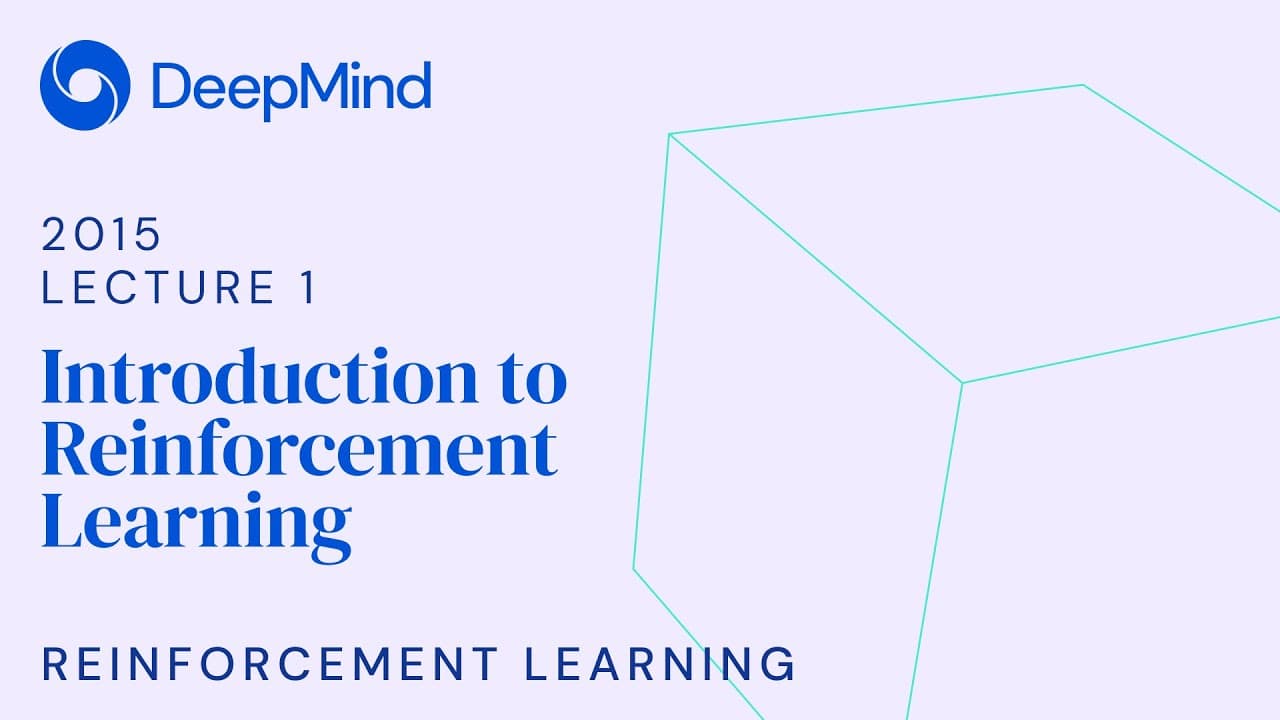
Reinforcement learning is the science of making decisions through trial and error, using rewards instead of a supervisor who supplies the correct action. It studies how an agent can choose sequences of actions to achieve the best results, connecting machine learning with optimal control, neuroscience, psychology, operations research, game theory, utility theory, and bounded rationality.
Transcript
okay um So the plan for today is we're just going to start with a little bit of of admin just to outline what this course is um about particularly for those of you who are actually doing this for credit and I know that's probably uh about half of the audience here um there's a few people just auditing it or trying to learn something about reinforce... Read More
Key Insights
- Reinforcement learning is the science of decision-making, focused on finding effective ways to select actions and sequences of actions. Its broad relevance comes from the fact that decision problems appear across computer science, engineering, mathematics, neuroscience, psychology, and economics.
- The reinforcement learning problem is based on trial and error rather than direct supervision. An agent is not shown the correct action for a situation, but instead receives a reward signal indicating that an outcome was good, bad, worth positive points, or worth negative points.
- A reward signal is feedback about the quality or value of an outcome, not an instruction identifying the best action. This distinction separates reinforcement learning from supervised learning, where a supervisor provides examples of the correct response.
- Optimal control is the engineering counterpart of reinforcement learning described in the lecture. It examines how to choose a sequence of actions optimally so that the resulting outcome is as good as possible, using many methods related to those studied in reinforcement learning.
- The dopamine system is presented as a major subject in neuroscience related to reward and decision-making. The lecture states that dopamine reflects one of the main algorithms covered by the course and that the brain's reward system is widely studied in neuroscience.
- Classical and operant conditioning are psychological approaches to understanding why animal behavior changes in response to rewards. The lecture connects these traditions, including work associated with Skinner, to the central reinforcement learning question of how rewards shape decisions and behavior.
- Economics studies related decision problems through game theory, utility theory, and bounded rationality. These areas examine how and why people choose actions when attempting to optimize utility, placing reinforcement learning within a broader scientific investigation of decision-making.
- The course materials offer two complementary textbook styles. Sutton and Barto provide a readable, intuitive overview across roughly 400 pages, while Csaba Szepesvári's Algorithms for Reinforcement Learning presents the main ideas more concisely and rigorously in fewer than 100 pages.
Install to Summarize YouTube Videos and Get Transcripts
Explore YouTube Video Summarizer or Get YouTube Transcript Extractor
Questions & Answers
Q: What is reinforcement learning?
Reinforcement learning is the science of decision-making and a branch of machine learning. It studies how an agent can select actions, including sequences of actions, to obtain the best results. Instead of receiving correct answers from a supervisor, the agent learns through trial and error from rewards that indicate whether outcomes are good, bad, positively valued, or negatively valued.
Q: How does reinforcement learning differ from supervised learning?
Reinforcement learning differs from supervised learning because no supervisor identifies the correct action to take in each situation. The learner instead receives a reward signal after acting. That signal evaluates the result, such as assigning positive or negative points, but it does not explicitly reveal which action was best. Learning must therefore proceed through trial and error.
Q: What does a reward signal tell a reinforcement learning agent?
A reward signal tells an agent how good, bad, or valuable an outcome was. It might indicate that a result was worth three points or minus ten points, as the lecture illustrates. It does not tell the agent that a particular action was correct or optimal, so the agent must use experience to discover effective behavior.
Q: Why is reinforcement learning relevant to many scientific fields?
Reinforcement learning is relevant across many fields because it addresses the fundamental problem of making decisions optimally. Computer science studies it as machine learning, engineering and mathematics connect it with optimal control, and operations research examines related optimization problems. Neuroscience, psychology, and economics also investigate how rewards, conditioning, utility, and strategic considerations influence decisions.
Q: How is optimal control related to reinforcement learning?
Optimal control is described as an engineering and mathematical approach to essentially the same type of problem studied in reinforcement learning. It asks how to decide a sequence of actions optimally so that the final results are as good as possible. Although different fields may use different names, many of their problems and methods substantially overlap.
Q: How does neuroscience connect dopamine with reinforcement learning?
The lecture connects reinforcement learning with neuroscience through the brain's dopamine and reward systems. Dopamine is described as reflecting one of the main algorithms studied in the course, while a large part of the brain is said to be devoted to this system. Researchers study it to understand mechanisms believed to underlie human decision-making.
Q: How does psychology relate conditioning to reinforcement learning?
Psychology relates to reinforcement learning through classical conditioning and operant conditioning, including work going back to Skinner. These traditions investigate how and why animals behave as they do when rewards are provided. The lecture presents the theory underlying reward-driven behavioral responses as essentially connected to reinforcement learning and its account of decision-making.
Q: Which textbooks are recommended for studying reinforcement learning?
The main recommended textbook is Sutton and Barto's Introduction to Reinforcement Learning, which is available free online and emphasizes readable explanations, intuition, and broad ideas. The course uses notation from its second-edition draft. For a shorter and more mathematically rigorous treatment, the lecture recommends Csaba Szepesvári's Algorithms for Reinforcement Learning, which covers the main ideas concisely.
Summary & Key Takeaways
-
Reinforcement learning studies how decisions can be optimized when an agent receives rewards but is not told which action is correct. The lecture introduces the problem setting, the structure of an RL agent, possible solution methods, and the key components involved in solving sequential decision-making problems through trial and error.
-
The field sits at the intersection of several disciplines concerned with decision-making. Machine learning calls it reinforcement learning, engineering and mathematics connect it with optimal control, and operations research studies related optimization questions. Neuroscience, psychology, and economics examine comparable ideas through reward systems, conditioning, game theory, utility theory, and bounded rationality.
-
The course follows Sutton and Barto's Introduction to Reinforcement Learning for readable explanations and broad intuition, using notation from its second-edition draft. Algorithms for Reinforcement Learning by Csaba Szepesvári is recommended as a shorter, more mathematically rigorous alternative for students who prefer concise theoretical treatment over extensive intuitive discussion.
Read in Other Languages (beta)
Share This Summary 📚
Summarize YouTube Videos and Get Video Transcripts with 1-Click
Try YouTube Summary with ChatGPT & Claude or YouTube Transcript Generator
Explore More Summaries from Google DeepMind 📚

Summarize YouTube Videos and Get Video Transcripts with 1-Click
Try YouTube Summary with ChatGPT & Claude or YouTube Transcript Generator