Q&A 129: Did Life Get a Ride to Venus from our Missions? And More...
TL;DR
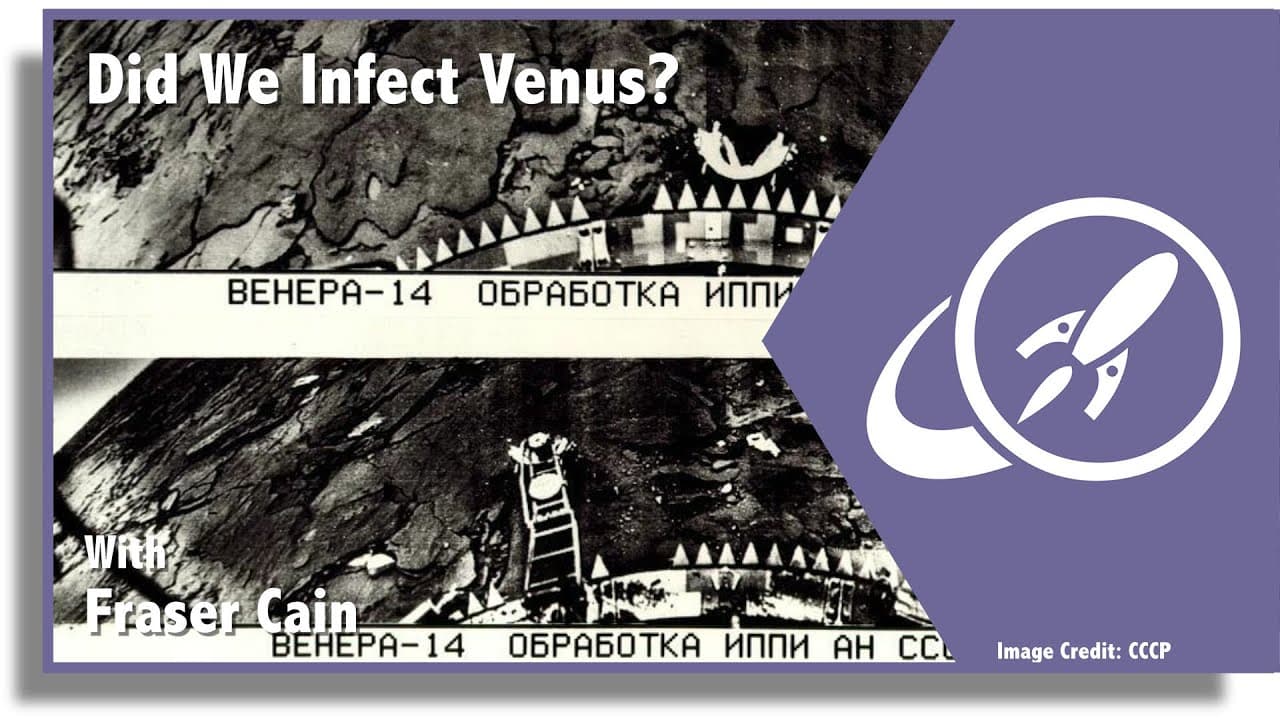
Earth microbes may have ridden to Venus on Venera spacecraft, but they almost certainly died because Venus’s clouds contain intensely hostile sulfuric acid and its surface reaches 475°C at 90 atmospheres of pressure. Even surviving microbes replicating for decades could not explain a planet-wide atmospheric signal of 20 atoms per billion. The episode also examines terraforming Venus and why discovering microbial life elsewhere would matter. Read on for the specific reasoning.
Transcript
it's question show time your questions my answers as always wherever you are across my channel a question pops in your brain just write it down i'll gather them up and i'll answer them here of course there were a million questions about venus so let's start with that and then we'll go into some of the other questions lisa brown is it possible that ... Read More
Key Insights
- 🛟 The environment on Venus is extremely hostile, making it unlikely for Earth life to survive there.
- ⬛ Terraforming Venus would require the delivery of large amounts of hydrogen, which is lacking on the planet.
- 🛟 The discovery of microbial life beyond Earth would have significant implications for understanding the origin and distribution of life in the universe.
- 🪐 The presence of phosphine in Venus' atmosphere is still a mystery, with potential implications for our understanding of chemical processes on other planets.
- 🚀 Launch companies typically have insurance to cover the costs of failed rocket launches and compensate payload owners.
- 🥶 Astronauts aboard the International Space Station experience weightlessness, similar to the feeling of free-falling.
- 🖤 The size and origin of supermassive black holes are still not fully understood, with theories including primordial black holes and black hole mergers.
Install to Summarize YouTube Videos and Get Transcripts
Explore YouTube Video Summarizer or Get YouTube Transcript Extractor
Questions & Answers
Q: Did life hitch a ride to Venus on the Venera spacecraft?
Microbes probably did ride aboard Venera spacecraft, but they almost certainly died after entering Venus’s atmosphere. The sulfuric acid in the cloud tops is more extreme than any environment where Earth life has been found, while microbes descending farther would face 475°C temperatures and 90 atmospheres of pressure.
Q: Could spacecraft contamination explain the planet-wide atmospheric signal on Venus?
No, even an exotic Earth microbe that survived and replicated for decades would not plausibly explain the signal across the entire planet. The detected signal accounts for 20 atoms out of every billion atoms in Venus’s atmosphere, and the speaker says life could not fill the whole biosphere in such a short period.
Q: Could Earth microbes survive in the cloud tops of Venus?
No known Earth life could survive the sulfuric acid found in Venus’s cloud tops. This remains true even at altitudes where the temperature and pressure are comparable to conditions on Earth.
Q: Can extremophiles be used to terraform Venus?
Extremophiles alone would not be enough because organic life needs hydrogen to sequester carbon dioxide. Venus is extremely dry and contains very few hydrogen atoms, so large amounts of hydrogen would first have to be delivered.
Q: Why does Venus have so little hydrogen?
Free hydrogen rises high in Venus’s atmosphere and is struck by the solar wind. Because Venus lacks a large magnetosphere like Earth’s, that hydrogen is driven away, progressively drying the atmosphere.
Q: How might hydrogen be delivered for terraforming Venus?
The proposed approach is to crash many comets or asteroids into Venus’s atmosphere, delivering hydrogen in the form of water. Extremophiles could then be introduced to help convert and lock away atmospheric material, reducing the pressure over time.
Q: Why would discovering microbial life beyond Earth be important?
It would be the first observed instance of life anywhere in the universe beyond Earth. That discovery would immediately raise questions about whether life on Earth is related to life on Venus, Mars, or Enceladus.
Q: What would unrelated extraterrestrial microbes imply about life in the universe?
If extraterrestrial microbes were unrelated to Earth life, that would indicate life formed independently in more than one place. The speaker argues that multiple independent origins within one solar system would suggest life is widespread across the galaxy and universe.
Summary & Key Takeaways
-
The environment on Venus is not suitable for Earth microbes to survive, even in its cloud tops where temperature and pressure are similar to Earth. Even if microbes survived, it would not explain the planet-wide signal found in the atmosphere.
-
Terraforming Venus by seeding it with extremophiles to break down the hostile atmosphere is not feasible due to the lack of hydrogen on Venus.
-
The search for microbial life beyond Earth is exciting as it would be the first instance of life elsewhere in the universe, raising questions about the origin and distribution of life.
-
Phosphine, a potential biosignature, has been detected in the atmosphere of Venus, but its origin is still unknown. If it is not produced by biology, it could still lead to new discoveries about chemical processes in other planets.
-
Spaceships that carry other company's payloads are insured, and the launch company would be responsible for compensating the payload owner in case of failure.
-
Astronauts onboard the International Space Station experience weightlessness, which is similar to the feeling of free-falling. It takes time for their bodies to adjust to this sensation.
-
The size of black holes, especially supermassive ones, is not fully understood. There are theories about primordial black holes, direct collapse black holes, and the possibility of black hole mergers contributing to their mass.
-
Rogue intergalactic stars have been observed between galaxies, indicating that stars exist outside of galactic systems. These stars may account for a significant portion of the universe's mass.
Read in Other Languages (beta)
Share This Summary 📚
Summarize YouTube Videos and Get Video Transcripts with 1-Click
Try YouTube Summary with ChatGPT & Claude or YouTube Transcript Generator
Explore More Summaries from Fraser Cain 📚
Summarize YouTube Videos and Get Video Transcripts with 1-Click
Try YouTube Summary with ChatGPT & Claude or YouTube Transcript Generator