How Do You Calculate the Surface Area and Lateral Area of a Square-Based Pyramid in Geometry?
TL;DR
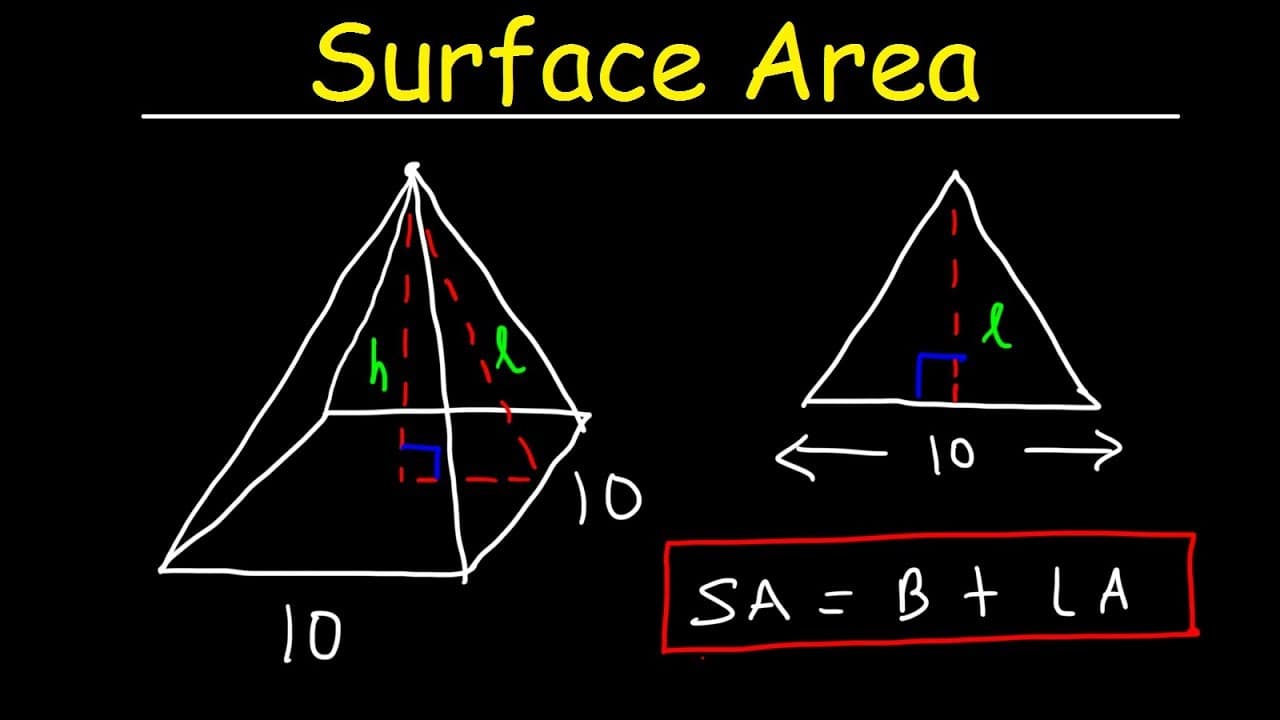
To find the total surface area of a square-based pyramid, add the square base area to the combined area of its four triangular faces. For a base side of 10 units and pyramid height of 12 units, the slant height is 13, the lateral area is 260, and the total surface area is 360 square units. Read on for each calculation and formula.
Transcript
in this lesson we're going to talk about how to calculate the surface area of a square based pyramid so how can we calculate the surface area of this pyramid we're going to say this is 10 that's 10 and the height of the pyramid that's going to be 12 units long so with this information calculate the total surface area of the pyramid so we need to ca... Read More
Key Insights
- "now the total surface area is the area of the base plus the lateral area so we have the area of the base that's 100." (0:50)
- "so the area is going to be one half base times height so the base is 10 the height is 13." (2:19)
- "the lateral area is going to be the total area for all four triangles so it's going to be four times 65 which is 260." (2:35)
- "so to calculate the total area it's going to be the area of the base which is 100 plus the lateral area which is 260." (2:49)
Install to Summarize YouTube Videos and Get Transcripts
Explore YouTube Video Summarizer or Get YouTube Transcript Extractor
Questions & Answers
Q: How do you calculate the surface area of a square-based pyramid?
Calculate the area of the square base, then add the lateral area formed by the four triangular faces. In the example, the base area is 100 square units and the lateral area is 260 square units, giving a total of 360 square units.
Q: What is the total surface area formula for a square-based pyramid?
The total surface area is the area of the base plus the lateral area. The lateral area is the combined area of all four triangular faces.
Q: How do you calculate the area of the square base?
Square the side length of the base. With a side length of 10 units, the base area is 10 squared, or 100 square units.
Q: How do you find the slant height of the pyramid?
Use the Pythagorean theorem with half the base side and the vertical height. In the example, those lengths are 5 and 12, so the slant height is the square root of 169, which is 13 units.
Q: Why is half of the base side used to find the slant height?
The right triangle used for the calculation runs from the center of the square base to the midpoint of one side. Since the full side is 10 units, that section is 5 units.
Q: How do you calculate the area of one triangular face?
Use one half times the triangle's base times its height. With a base of 10 units and a slant height of 13 units, one triangular face has an area of 65 square units.
Q: How do you calculate the lateral area of the pyramid?
Multiply the area of one triangular face by four because the square-based pyramid has four triangular faces. Each face has an area of 65 square units, so the lateral area is 260 square units.
Q: What is the total surface area when the base side is 10 units and the pyramid height is 12 units?
The total surface area is 360 square units. This comes from adding the 100-square-unit base area to the 260-square-unit lateral area.
Summary & Key Takeaways
-
To calculate the surface area of a square based pyramid, calculate the area of the base (squared side length) and the lateral area (sum of the areas of the four triangles).
-
Use the Pythagorean theorem to find the slant height of the triangles formed by the sides and the height of the pyramid.
-
The area of each triangle is half the product of the base and the height.
-
Add the area of the base and the lateral area to find the total surface area of the pyramid.
Read in Other Languages (beta)
Share This Summary 📚
Summarize YouTube Videos and Get Video Transcripts with 1-Click
Try YouTube Summary with ChatGPT & Claude or YouTube Transcript Generator
Explore More Summaries from The Organic Chemistry Tutor 📚



Summarize YouTube Videos and Get Video Transcripts with 1-Click
Try YouTube Summary with ChatGPT & Claude or YouTube Transcript Generator