What Is Deep Learning for Computer Vision?
TL;DR
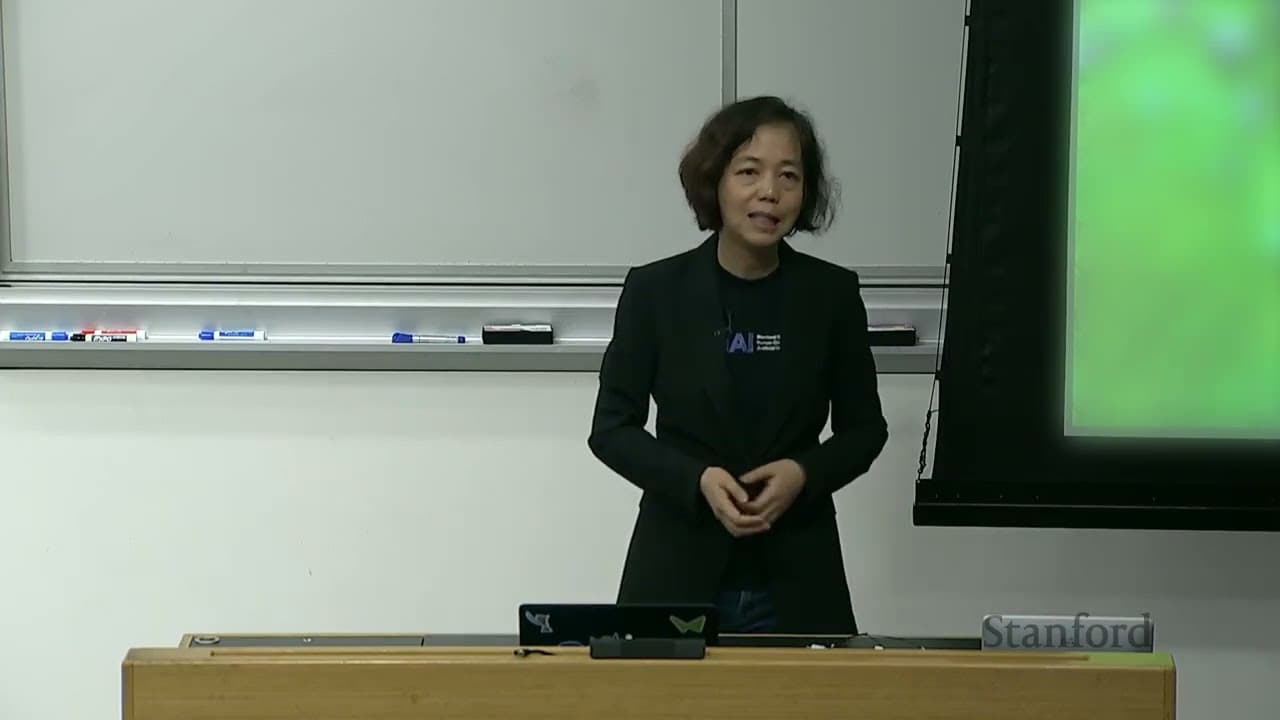
Deep learning is revolutionizing computer vision by using neural networks to interpret and understand visual data. This lecture provides an introduction to the intersection of AI, deep learning, and computer vision, covering the history, key concepts, and future directions of the field. It highlights the importance of interdisciplinary approaches and the role of data in advancing visual intelligence.
Transcript
This is CS231n. And I'm Professor Fei-Fei Li from computer science department. I will be co-teaching this quarter with Professor Ehsan Adeli and my graduate student Zane. So you'll meet them as well as our wonderful TA team that you will meet later. So I just want to get started. So this is what excites me, that AI has become such an interdisciplin... Read More
Key Insights
- Deep learning is a set of algorithmic techniques built around neural networks.
- Computer vision is an integral part of AI, essential for unlocking visual intelligence.
- The Cambrian explosion is linked to the onset of visual sensors, driving intelligence evolution.
- Backpropagation is a key learning rule in neural networks, enabling error correction.
- ImageNet dataset was crucial in demonstrating the power of deep learning in visual recognition.
- Neural networks model non-linear functions to classify and interpret visual data.
- Generative models can create new images, blending understanding and creativity.
- AI's impact on society includes both beneficial applications and ethical challenges.
Install to Summarize YouTube Videos and Get Transcripts
Explore YouTube Video Summarizer or Get YouTube Transcript Extractor
Questions & Answers
Q: How does deep learning enhance computer vision?
Deep learning enhances computer vision by utilizing neural networks to model complex patterns in visual data. These networks, through layers of computation, can learn to recognize and classify images, detect objects, and even generate new images. This approach allows machines to interpret visual information with high accuracy, enabling applications from autonomous vehicles to medical imaging.
Q: What is the significance of the ImageNet dataset?
The ImageNet dataset is significant because it provided a large-scale collection of labeled images that enabled the training of high-capacity deep learning models. This dataset was pivotal in demonstrating the effectiveness of convolutional neural networks (CNNs) for image recognition tasks, leading to breakthroughs in accuracy and sparking the deep learning revolution in computer vision.
Q: Why is backpropagation important in neural networks?
Backpropagation is important because it is a learning rule that allows neural networks to adjust their weights based on the error of their predictions. By propagating the error backward through the network, it enables the fine-tuning of parameters to minimize the difference between predicted and actual outcomes, thus improving the network's accuracy and performance in tasks such as image classification.
Q: How do neural networks model non-linear functions?
Neural networks model non-linear functions by stacking multiple layers of neurons, where each layer applies a non-linear activation function to its inputs. These layers transform the input data through a series of non-linear mappings, enabling the network to capture complex patterns and relationships in the data. This capability is essential for tasks like image recognition, where linear models might fail.
Q: What are the challenges in computer vision?
Challenges in computer vision include the need for large amounts of labeled data, handling variations in lighting and perspective, and understanding context and relationships within images. Additionally, ensuring fairness and reducing bias in AI models, as well as addressing privacy concerns, are significant challenges. Technical hurdles include improving model efficiency and generalization to new, unseen data.
Q: How do generative models work in computer vision?
Generative models in computer vision work by learning the underlying distribution of visual data and then generating new images that resemble the training data. Techniques such as Generative Adversarial Networks (GANs) and Variational Autoencoders (VAEs) use neural networks to create realistic images, enabling applications like image synthesis, style transfer, and data augmentation.
Q: What is the role of interdisciplinary approaches in AI?
Interdisciplinary approaches in AI are crucial as they integrate insights from fields like neuroscience, cognitive science, and computer science to advance understanding and innovation. By combining expertise from different domains, researchers can develop more robust algorithms, address complex problems, and ensure that AI technologies are aligned with human values and societal needs.
Q: What are the ethical considerations in AI and computer vision?
Ethical considerations in AI and computer vision include ensuring fairness, transparency, and accountability in AI systems. Addressing biases in training data, protecting user privacy, and preventing misuse of technology are critical. Additionally, the societal impact of AI, such as job displacement and decision-making autonomy, must be carefully managed to ensure that AI benefits humanity as a whole.
Summary & Key Takeaways
-
Deep learning is transforming computer vision by employing neural networks to understand and interpret images. This lecture introduces the historical and conceptual foundations of this transformation, highlighting the interdisciplinary nature of AI. Key developments, such as the ImageNet dataset and backpropagation, have propelled advancements in visual intelligence.
-
The lecture traces the evolution of vision from the Cambrian explosion to modern AI, underscoring the role of data and computation in driving deep learning's success. It also addresses the societal implications of AI, emphasizing the need for ethical considerations in its application.
-
Future directions in computer vision include tackling complex tasks like video classification and 3D reconstruction. The field continues to advance with new models and techniques, promising further integration of AI into various domains while highlighting the importance of human-centered approaches.
Read in Other Languages (beta)
Share This Summary 📚
Summarize YouTube Videos and Get Video Transcripts with 1-Click
Try YouTube Summary with ChatGPT & Claude or YouTube Transcript Generator
Explore More Summaries from Stanford Online 📚




Summarize YouTube Videos and Get Video Transcripts with 1-Click
Try YouTube Summary with ChatGPT & Claude or YouTube Transcript Generator