How Can Virtualization Reshape Cybersecurity?
TL;DR
Virtualization can serve as a translation layer between applications, security policies, and physical infrastructure, enabling consistent protection across compute, networks, storage, data centers, and clouds. By combining micro-segmentation, application context, least-privilege controls, and automation, this architecture can reduce attack surfaces, detect threats more effectively, restrict lateral movement, and coordinate responses as applications move.
Transcript
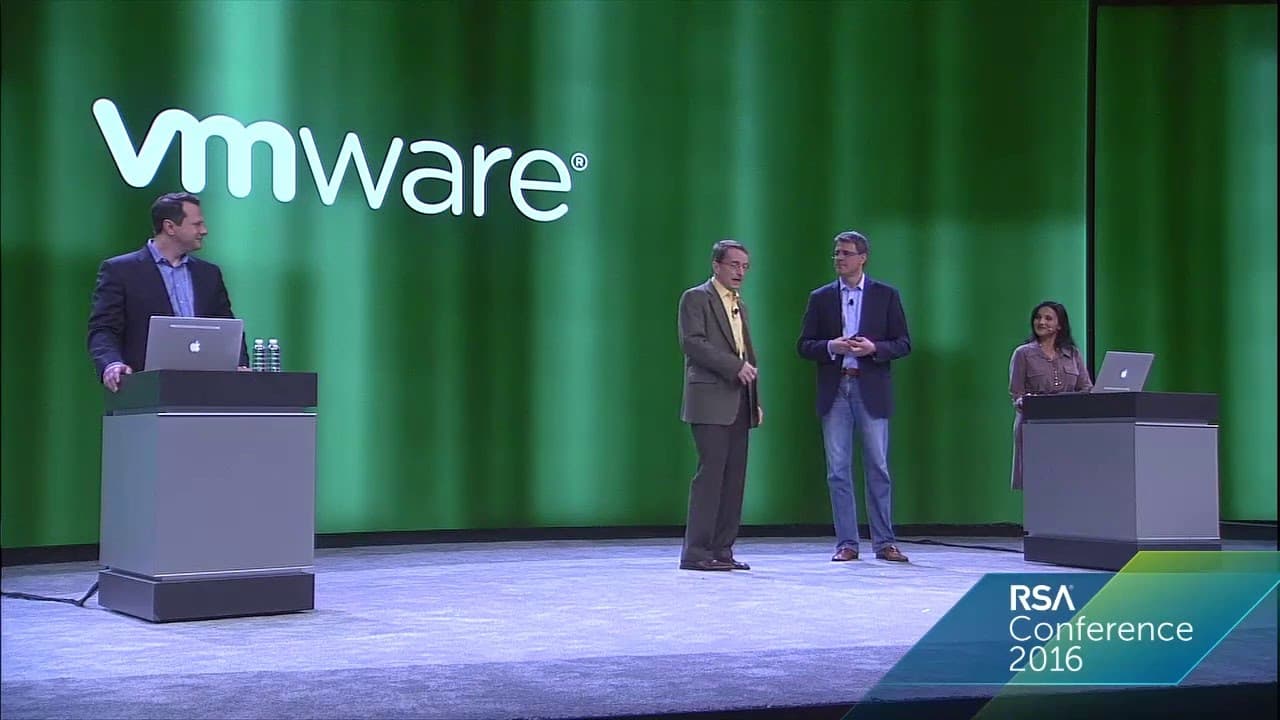
Good afternoon. It is a pleasure to be here at RSA, uh, Conference twenty sixteen, and it's been a number of years since I've been able to be on stage at RSA Conference. Uh, having done so several times with Intel and my many years there, as well as when RSA worked for me when I was at, uh, EMC. So it is a great pleasure to be back here today with ... Read More
Key Insights
- Executive disagreement is a fundamental cybersecurity obstacle because CEOs identify reputation as the primary asset, while CIOs and CISOs identify regulated data. Without a shared understanding of what requires protection, organizations struggle to align business priorities, security policies, resources, and operational decisions.
- Perceived cyberattack risk differs sharply across leadership roles. CEOs estimated a 25 percent chance of a serious attack within twelve months, while technology and security executives estimated almost 50 percent, creating a gap that can limit executive empowerment and attention.
- Security investment is producing diminishing returns because IT spending is approximately flat, security spending is increasing by 10 to 20 percent, and breach costs are rising even faster. The pattern suggests that purchasing more individual tools does not resolve the underlying architectural problem.
- Modern application growth resembles an unplanned city because applications, devices, and cloud connections proliferate without security being built into the underlying infrastructure. A typical application connects to seven cloud services, while security teams are commonly asked to protect the resulting environment only after it exists.
- The application is a network because modern software combines web services, application servers, database servers, containers, and scale-out components across shared infrastructure. Protecting a single server stack is therefore insufficient when internal application data and communications traverse a broader physical and virtual environment.
- The great security divide is the inability to translate organizational policies into coordinated enforcement across many security tools. A true security architecture must connect policy objectives with available controls and services instead of relying on a sprawling collection of isolated products.
- Virtualization is a ubiquitous abstraction layer that aligns applications with physical infrastructure across compute, networking, storage, data centers, and clouds. Its application awareness and infrastructure context allow security controls to follow workloads and connect information that separate tools cannot easily coordinate.
- Micro-segmentation works by creating a secure overlay network across physical infrastructure regardless of whether that infrastructure is protected, reliable, or trusted. It restricts lateral movement, governs internal data-center traffic, and applies policies and services through the virtualization layer as applications move.
Install to Summarize YouTube Videos and Get Transcripts
Explore YouTube Video Summarizer or Get YouTube Transcript Extractor
Questions & Answers
Q: Why do executives and security leaders disagree about cyber risk?
Executives and security leaders focus on different assets, priorities, and risk estimates. CEOs identified reputation as the most important asset and business growth as their highest-priority initiative. CIOs and CISOs focused on regulated data and protection against attacks. CEOs estimated a 25 percent chance of a serious attack within twelve months, while informed technology leaders estimated almost 50 percent.
Q: Why is increased cybersecurity spending not stopping breach losses?
Cybersecurity spending alone does not solve the problem because organizations are adding tools without a unifying architecture. Overall IT spending is approximately flat, security spending is increasing by 10 to 20 percent, and breach costs are increasing even faster. The result is diminishing returns: companies invest more in protection but continue falling behind as risks, complexity, and potential losses grow.
Q: How have modern applications changed cybersecurity requirements?
Modern applications are no longer tightly bound to one monolithic server stack. They combine web services, application servers, databases, scale-out systems, containers, and cloud services across shared infrastructure that cannot necessarily be trusted. Because a typical application connects to seven cloud services, protecting a fixed infrastructure perimeter does not adequately secure all of its components, communications, and internal data flows.
Q: What is missing from conventional enterprise security programs?
A coherent security architecture is missing from many conventional programs. Organizations have policies they want enforced and numerous security products that provide specialized services, but they lack a reliable way to align the two. This gap leaves policies disconnected from operational controls, encourages tool sprawl, and makes consistent protection difficult across applications, infrastructure, data centers, and cloud environments.
Q: How does virtualization provide a cybersecurity architecture?
Virtualization provides an abstraction layer that connects applications above with physical infrastructure below. It spans compute, networking, storage, multiple data centers, and clouds, giving security systems both application context and infrastructure context. Rather than treating virtualization only as something that must be secured, organizations can use it to apply policies, coordinate services, and protect workloads consistently as they move.
Q: What is micro-segmentation and how does it improve security?
Micro-segmentation creates a secure overlay network that can operate across physical infrastructure regardless of whether the underlying environment is protected, reliable, or trusted. It reduces opportunities for lateral movement, governs traffic inside the data center, and enables policies and security services to move with applications through the virtualization layer. VMware reported more than 1,200 NSX customers, with over half using it explicitly for micro-segmentation.
Q: How can virtualization support least-privilege security?
Virtualization can support least privilege by placing controls close to individual applications and workloads instead of granting broad access across a highly privileged environment. This approach can sharply reduce the attack surface and isolate application components. Because policies can be implemented through the virtualization layer, protections can remain associated with applications as they move across the underlying infrastructure.
Q: How does virtualization improve threat detection and response?
Effective detection depends on context, and virtualization provides visibility into both applications and the infrastructure beneath them. That combined context helps connect suspicious activity with the workload, network, and control environment involved. Virtualization also supports the cloud principle of automating everything, allowing prevention, detection, and response to build on one another in a coordinated and repeatable security process.
Summary & Key Takeaways
-
Business and technology leaders assess cybersecurity through different lenses. CEOs identify reputation and business growth as central concerns, while CIOs and CISOs prioritize regulated data and protection against attacks. Their estimates of serious attack risk also differ, making it harder for security teams to obtain the authority and resources needed for enterprise-wide protection.
-
Modern applications resemble networks because they consist of distributed web services, application servers, databases, containers, and cloud connections running on infrastructure that cannot automatically be trusted. Security teams are often involved only after these interconnected environments have developed, leaving them to manage complex systems that were not originally designed with security as a foundational requirement.
-
A virtualization-based security architecture can connect applications and policies with the infrastructure beneath them. Micro-segmentation creates secure overlay networks, limits lateral movement, and allows policies and services to follow applications. The same layer supplies context for detection and supports automated prevention, detection, and response across diverse infrastructure environments.
Read in Other Languages (beta)
Share This Summary 📚
Summarize YouTube Videos and Get Video Transcripts with 1-Click
Try YouTube Summary with ChatGPT & Claude or YouTube Transcript Generator
Explore More Summaries from RSAC Cybersecurity 📚




Summarize YouTube Videos and Get Video Transcripts with 1-Click
Try YouTube Summary with ChatGPT & Claude or YouTube Transcript Generator