How Do You Add Large Numbers Using Long Addition? | Math
TL;DR
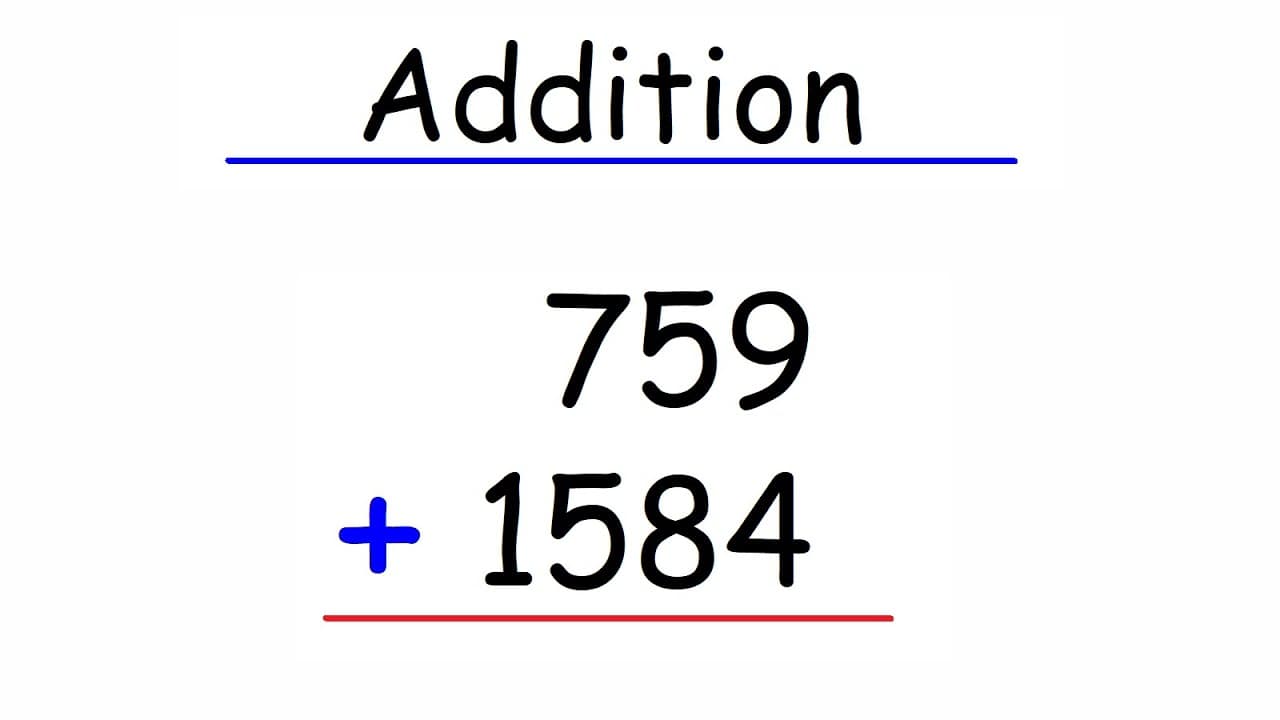
To add large numbers using long addition, line up the numbers by place value and add each column from right to left. When a column totals 10 or more, write its last digit and carry the other digit into the next column. The lesson demonstrates this process with examples such as 45 + 38 = 83 and 1,584 + 759 = 2,343, so read on for clear, step-by-step practice.
Transcript
in this lesson we're going to focus on addition add in two large numbers together particularly long addition so let's say if we want to add 43 and 26 together how can we do that well what we need to do is we need to line them up like this once we do that we simply need to add each column of numbers so starting from the right let's add the first col... Read More
Key Insights
- ↔️ Long addition involves aligning two numbers and adding each column from right to left.
- 🍹 Carry over is necessary when the sum in a column is 10 or more.
- 🪘 Practice examples are provided to reinforce understanding and skill in using the long addition method.
- 🪈 The order of writing the numbers does not affect the final answer.
Install to Summarize YouTube Videos and Get Transcripts
Explore YouTube Video Summarizer or Get YouTube Transcript Extractor
Questions & Answers
Q: What is the long addition method?
Long addition is a method for adding numbers by lining them up and working through their columns. Add each column from right to left, carrying into the next column whenever a result is 10 or more.
Q: How do you line up numbers for long addition?
Write the numbers so their corresponding place-value columns align. Once they are lined up, begin adding with the column on the far right.
Q: Why do you add from right to left in long addition?
Starting on the right lets you handle a result of 10 or more before working on the next column. Any carried digit is then included in the column immediately to the left.
Q: What do you do when a column totals 10 or more?
Write the last digit of the total in the current column and carry the other digit into the next column. For 5 + 8 = 13, write 3 and carry 1.
Q: How do you calculate 45 + 38 using long addition?
First add the right column: 5 + 8 = 13, so write 3 and carry 1. Then calculate 1 + 4 + 3 = 8, giving a final answer of 83.
Q: How do you calculate 146 + 75 using long addition?
Add 6 + 5 to get 11, write 1, and carry 1. Next, 1 + 4 + 7 = 12, so write 2 and carry 1; then 1 + 1 = 2, giving 221.
Q: How do you calculate 1,584 + 759 using long addition?
From the right, 4 + 9 = 13; then the carried 1 plus 8 and 5 equals 14. Next, the carried 1 plus 5 and 7 equals 13, and the final carried 1 plus 1 equals 2, producing 2,343.
Q: Does the order of the numbers affect the answer in long addition?
No, the order in which the numbers are written does not change the final answer. The lesson explicitly notes this while adding 1,584 and 759.
Summary & Key Takeaways
-
In long addition, you align the two numbers and add each column from right to left.
-
Carry over any numbers that are 10 or more, and add them to the next column.
-
Practice examples are provided to demonstrate the long addition method.
Read in Other Languages (beta)
Share This Summary 📚
Summarize YouTube Videos and Get Video Transcripts with 1-Click
Try YouTube Summary with ChatGPT & Claude or YouTube Transcript Generator
Explore More Summaries from The Organic Chemistry Tutor 📚





Summarize YouTube Videos and Get Video Transcripts with 1-Click
Try YouTube Summary with ChatGPT & Claude or YouTube Transcript Generator