How Are Service Robots Entering Everyday Work?
TL;DR
Service robots are becoming commercially practical because investment is increasing, component costs are decreasing, and accessible indoor environments simplify mobility. Successful deployment still depends on matching each robot to a constrained operating domain, assessing failure consequences, and adding safety measures that remain effective when navigation fails, especially for heavier machines near stairs or people.
Transcript
Thank you. And, um, yeah, this is, uh, was not a long-planned talk, but, uh, was the opportunity, and I said, "Wow." I didn't realize that there were repeat talks in three eighty, but I got introduced or invited to come back, so I said, "I'll take it. Take that opportunity." Um, and so the title, Service Robots Are Here Too, is basically the same t... Read More
Key Insights
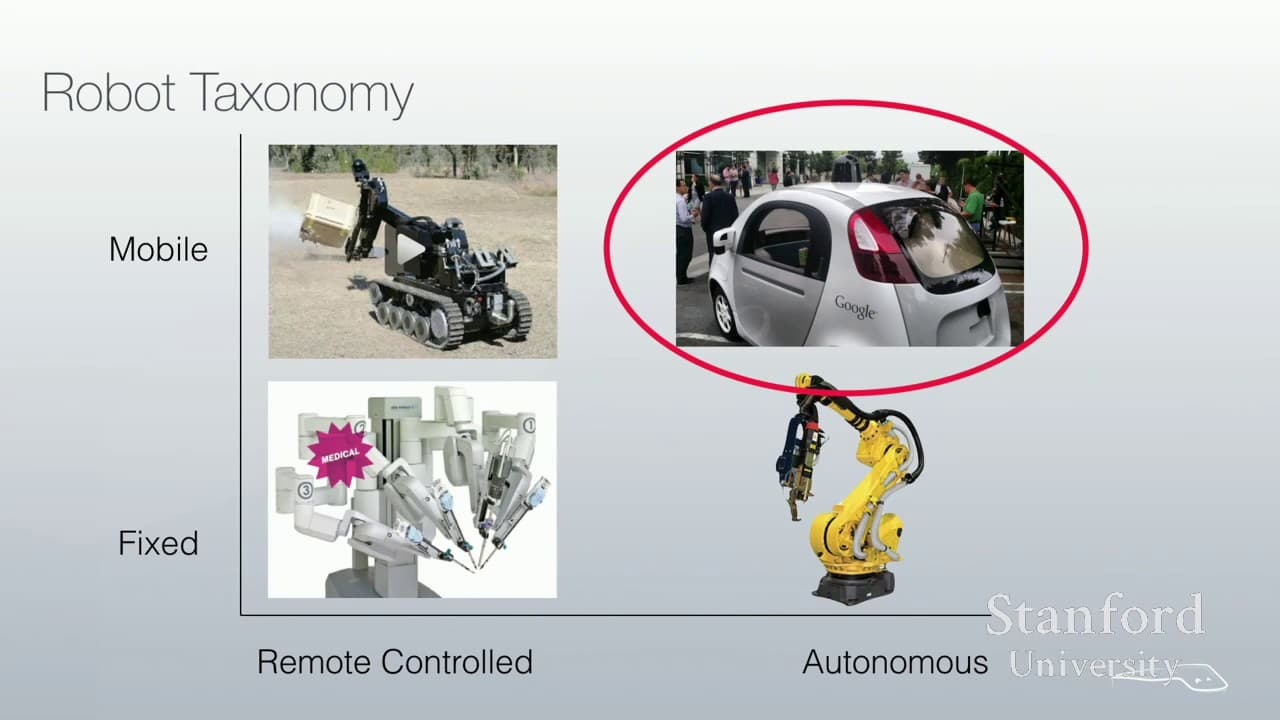
- A useful robot taxonomy separates machines by autonomy and mobility. Factory systems are autonomous but usually stationary, surgical and bomb-disposal systems are remotely controlled, and service applications increasingly combine autonomous decision-making with movement through spaces shared by people.
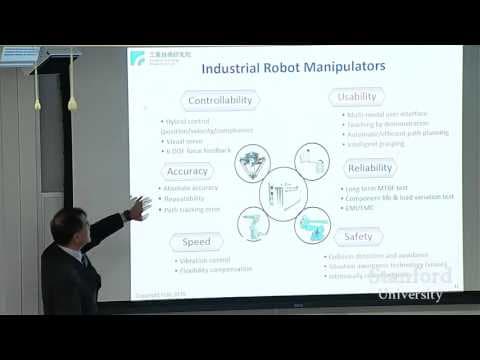
- Industrial robots usually operate in constrained environments and behind safety cages. Vision-guided systems can recognize objects, estimate their poses, remove them from conveyors, and place them correctly, but collaborative arms from Rethink Robotics and Universal Robots were presented as exceptions to the dominant fenced model.
- The da Vinci surgical system is a sophisticated remotely controlled tool with almost no autonomy. It can filter a surgeon's natural tremors and hold its position while the surgeon rests, supporting long procedures without independently performing the surgery.
- Autonomous vehicles qualify as robots because they combine sensing, actuation, and movement through the world. Roads simplify the physical terrain, but surrounding vehicles travel at relatively high speeds, creating a different challenge from navigation inside controlled buildings.
- Sidewalk delivery works more reliably when providers limit service to surveyed neighborhoods. Starship's described approach maps sidewalks in advance, accepts areas with suitable conditions, and instructs robots to avoid streets where damaged or unsuitable paths would make travel unreliable.
- Commercial buildings are favorable environments for wheeled service robots because accessibility requirements provide routes for wheelchair users. Ramps and other accessible paths also benefit robots, making indoor commercial spaces, including hotels, more practical than arbitrary outdoor terrain.
- Safety systems must remain effective when autonomous navigation is imperfect. A mapped keep-out zone near stairs is insufficient if navigation can fail, so a robot also needs a way to detect the ground and prevent movement toward a dangerous drop.
- Robot weight determines the severity of a possible failure. A lightweight Roomba falling down stairs is unlikely to kill someone, while a hundred-pound or three-hundred-pound robot could cause serious harm, so heavier platforms demand stronger safety analysis and safeguards.
Install to Summarize YouTube Videos and Get Transcripts
Explore YouTube Video Summarizer or Get YouTube Transcript Extractor
Questions & Answers
Q: What is a useful taxonomy for classifying robots?
A useful taxonomy classifies robots according to autonomy and mobility. Factory robots can operate autonomously while remaining fixed in constrained work cells. Surgical and bomb-disposal robots can be mobile or highly capable but remain controlled by people. The category most relevant to service robotics combines autonomous operation with movement through environments where the machine must sense conditions and act without continuous human control.
Q: Do robots need to look humanoid to count as robots?
Robots do not need a humanoid form. The proposed definition focuses on functional characteristics such as sensing, actuation, and movement through the world. An autonomous car can therefore be considered a robot even though it resembles a vehicle rather than a person. Industrial arms, drones, delivery machines, and other non-humanoid systems also fit the category when they perceive conditions and perform physical actions.
Q: How do modern factory robots operate?
Factory robots generally repeat the same work autonomously in constrained environments, often behind safety cages. Earlier systems relied heavily on precise, predetermined motion. Newer systems increasingly use vision to make choices, such as identifying objects on a conveyor, determining their position and orientation, grasping them properly, and placing them into the required pose. Robots designed to work near people remain exceptions to the dominant fenced arrangement.
Q: How does the da Vinci surgical system assist surgeons?
The da Vinci system functions primarily as a sophisticated remote-controlled surgical tool rather than an autonomous robot. A surgeon controls nearly all of its actions. The system can filter natural hand tremors and can hold instruments steady when the surgeon disengages control temporarily. This lets the surgeon rest or move their hands during a seven-hour or eight-hour procedure before resuming precise laparoscopic work.
Q: Why are commercial buildings suitable for service robots?
Commercial buildings are suitable because accessibility requirements create routes that accommodate wheelchair users, including ramps where stairs would otherwise block wheeled movement. Those same features help mobile robots reach destinations without climbing steps. This makes indoor commercial spaces, including hotels, attractive starting points for deployment, although designers must still inspect each building for hazards such as exposed staircases and unsafe transitions.
Q: How can sidewalk delivery robots handle uneven routes?
Sidewalk delivery robots can reduce navigation difficulty by operating only in areas that have been surveyed and mapped beforehand. The approach described for Starship involves checking neighborhood sidewalks before committing to service, identifying routes that are in suitable condition, and directing robots away from problematic streets. This limits the operating domain instead of promising arbitrary delivery across every sidewalk and surface.
Q: Why are mapped keep-out zones insufficient near stairs?
A mapped keep-out zone depends on the navigation system behaving correctly every time. If navigation has any chance of failure, the robot could cross the virtual boundary and approach a staircase. Designers therefore need an additional way to detect the ground or recognize a drop. Physical hazard sensing provides protection when localization, mapping, or planned motion does not work as expected.
Q: How does robot weight affect safety requirements?
Robot weight changes the potential consequences of losing control near stairs or people. A lightweight Roomba uses a simple cliff sensor, and a fall is unlikely to be fatal because the machine weighs roughly five pounds or less according to the discussion. A hundred-pound robot presents a different risk, while a three-hundred-pound robot is more alarming, so heavier systems require more rigorous safeguards and harm assessment.
Summary & Key Takeaways
-
Service robots can be classified by autonomy and mobility. Factory robots repeatedly perform programmed work in constrained areas, remotely controlled systems extend human capabilities, and autonomous mobile robots sense and move through changing environments. A robot does not need a humanoid appearance if it combines sensing, actuation, movement, and task-directed behavior.
-
Operating terrain strongly shapes robot design and commercial feasibility. Rough outdoor terrain remains difficult and expensive, roads are structured but contain fast-moving vehicles, and sidewalks may require advance surveys and mapped restrictions. Commercial interiors are especially attractive because accessibility requirements commonly provide ramps and wheelchair-compatible routes that wheeled robots can also use.
-
Safety engineering must account for navigation failure rather than assuming map restrictions will always work. A lightweight Roomba can use a simple cliff sensor because a fall has limited consequences, while a hundred-pound or three-hundred-pound robot creates much greater danger. Robot weight, stairs, detection redundancy, and potential harm must guide deployment decisions.
Read in Other Languages (beta)
Share This Summary 📚
Summarize YouTube Videos and Get Video Transcripts with 1-Click
Try YouTube Summary with ChatGPT & Claude or YouTube Transcript Generator
Explore More Summaries from Stanford Online 📚


Summarize YouTube Videos and Get Video Transcripts with 1-Click
Try YouTube Summary with ChatGPT & Claude or YouTube Transcript Generator