Is War a Natural Instinct in Humans or a Cultural Thing?
TL;DR
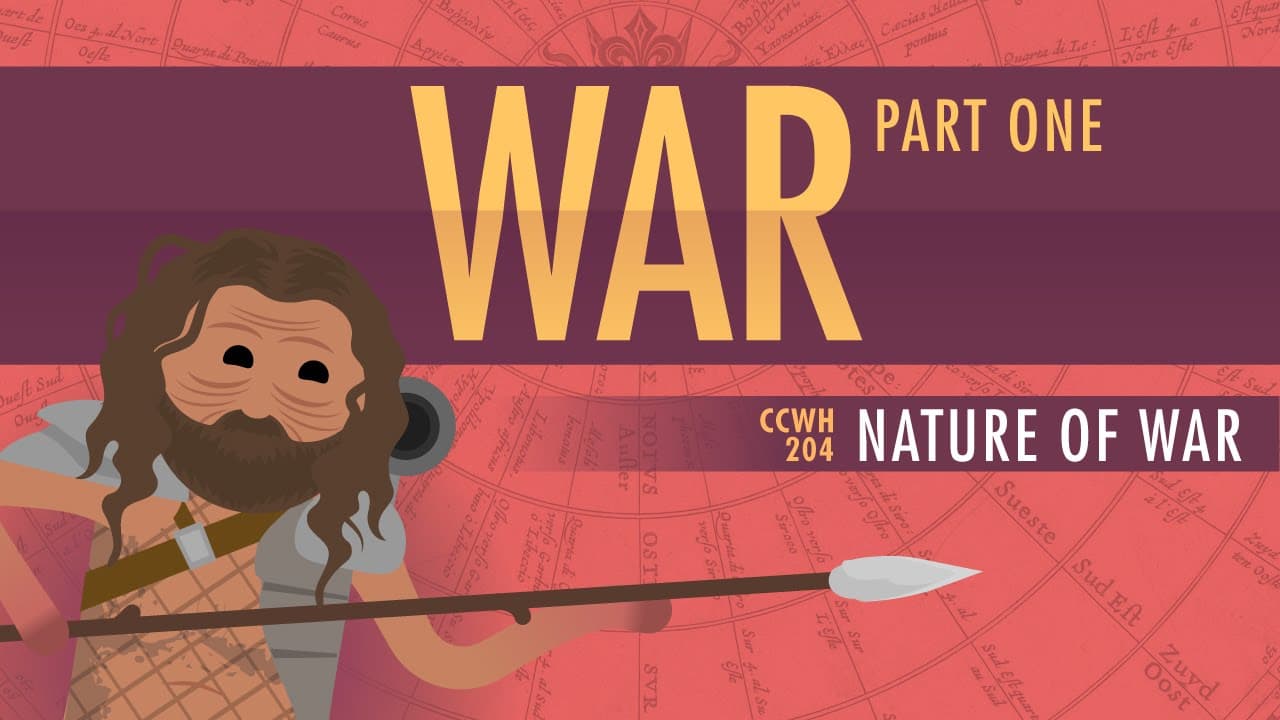
War may stem from both human instincts and cultural influences. While historical evidence suggests early humans exhibited violent behavior for resources, aggression isn’t inevitable; many live peacefully. Modern warfare often revolves around loyalty and excitement rather than survival, highlighting the importance of choice and evolving social institutions in addressing violence.
Transcript
Hi, I'm John Green, this is Crash Course World History, and today we're going to respond to your many requests and talk about a controversial subject: War. So here at Crash Course we're really not that into the history of war, partly because we feel it's been discussed well elsewhere and partly because we haven't really figured out a way to tackle ... Read More
Key Insights
- John Green discusses the controversial topic of war, questioning whether it is an intrinsic part of human nature or a cultural construct.
- The debate between Hobbes and Rousseau is central, with Hobbes viewing humans as naturally warlike and Rousseau seeing them as peaceful until corrupted by civilization.
- Anthropological evidence suggests that pre-civilization societies were violent, indicating that Hobbes might be closer to the truth regarding human nature.
- John Green highlights that while aggression might be innate, it is not inevitable, as many people live without resorting to violence.
- The evolutionary perspective suggests that competition for resources like food and mates could have driven early human violence and warfare.
- Modern warfare is less about resources and more about loyalty to comrades and the excitement and transcendence some soldiers feel in combat.
- Marlantes' insights reveal that soldiers may experience a sense of joy and power in destruction, complicating the narrative of war as purely negative.
- The video warns against deterministic views of war, emphasizing human choice and the evolution of institutions that can break the cycle of violence.
Install to Summarize YouTube Videos and Get Transcripts
Explore YouTube Video Summarizer or Get YouTube Transcript Extractor
Questions & Answers
Q: What is the main topic of the video?
The video explores whether war is an inherent part of human nature or a cultural construct. John Green examines philosophical debates, anthropological evidence, and evolutionary perspectives to determine if humans are naturally warlike or if war is a product of societal influences.
Q: How does John Green address the Hobbes versus Rousseau debate?
John Green discusses the Hobbes versus Rousseau debate, where Hobbes views humans as naturally warlike, while Rousseau believes humans were peaceful until corrupted by civilization. He presents anthropological evidence suggesting pre-civilization societies were violent, aligning more with Hobbes' perspective.
Q: What role does anthropology play in the discussion?
Anthropology provides insights into pre-civilization societies, suggesting that they were violent, supporting the idea that aggression might be an innate human trait. This evidence is used to challenge Rousseau's view of humans as naturally peaceful and supports Hobbes' perspective on human nature.
Q: How does the video address the idea of war as an evolutionary trait?
The video explores the idea that competition for scarce resources like food and mates could have driven early human violence and warfare. This evolutionary perspective suggests that aggression may be innate, but John Green emphasizes that it is not inevitable, as many people live peacefully.
Q: What insights does Karl Marlantes provide about soldiers' experiences in war?
Karl Marlantes provides insights into soldiers' experiences, revealing that they may feel a sense of transcendence and joy in destruction during combat. This complicates the narrative of war as purely negative, highlighting the complex emotions soldiers experience and the powerful motivators of loyalty and excitement.
Q: What warning does John Green give about deterministic views of war?
John Green warns against deterministic views of war, emphasizing that while aggression might be innate, war is not inevitable. He highlights the importance of human choice and the evolution of institutions that can break the cycle of violence, arguing against fatalistic conclusions about war.
Q: How does John Green suggest modern warfare differs from early human violence?
Modern warfare differs from early human violence in that it is less about resources and more about loyalty to comrades and the excitement and transcendence some soldiers feel in combat. This shift reflects changes in societal structures and motivations for fighting.
Q: What is the overall message of the video regarding human nature and war?
The overall message is that while aggression might be an innate trait, war is not an inevitable part of human nature. John Green emphasizes the role of human choice, societal evolution, and the potential for institutions to break the cycle of violence, challenging deterministic views of war.
Summary & Key Takeaways
-
John Green explores whether war is an inherent part of human nature or a cultural construct, referencing philosophical debates and anthropological evidence. He discusses the views of Hobbes and Rousseau, suggesting that pre-civilization societies were violent, indicating that aggression might be innate.
-
While aggression may be part of human nature, John argues that it is not inevitable, as many people live peacefully. He explores evolutionary perspectives, suggesting that competition for resources could have driven early human violence and war, but modern warfare is more about loyalty and excitement.
-
The video warns against deterministic views, highlighting the importance of human choice and the evolution of institutions that can break the cycle of violence. Marlantes' insights reveal the complex emotions soldiers feel, including joy in destruction, complicating the narrative of war as purely negative.
-
(Content reviewed on 2026-08-27.)
Read in Other Languages (beta)
Share This Summary 📚
Summarize YouTube Videos and Get Video Transcripts with 1-Click
Try YouTube Summary with ChatGPT & Claude or YouTube Transcript Generator
Explore More Summaries from CrashCourse 📚

Summarize YouTube Videos and Get Video Transcripts with 1-Click
Try YouTube Summary with ChatGPT & Claude or YouTube Transcript Generator