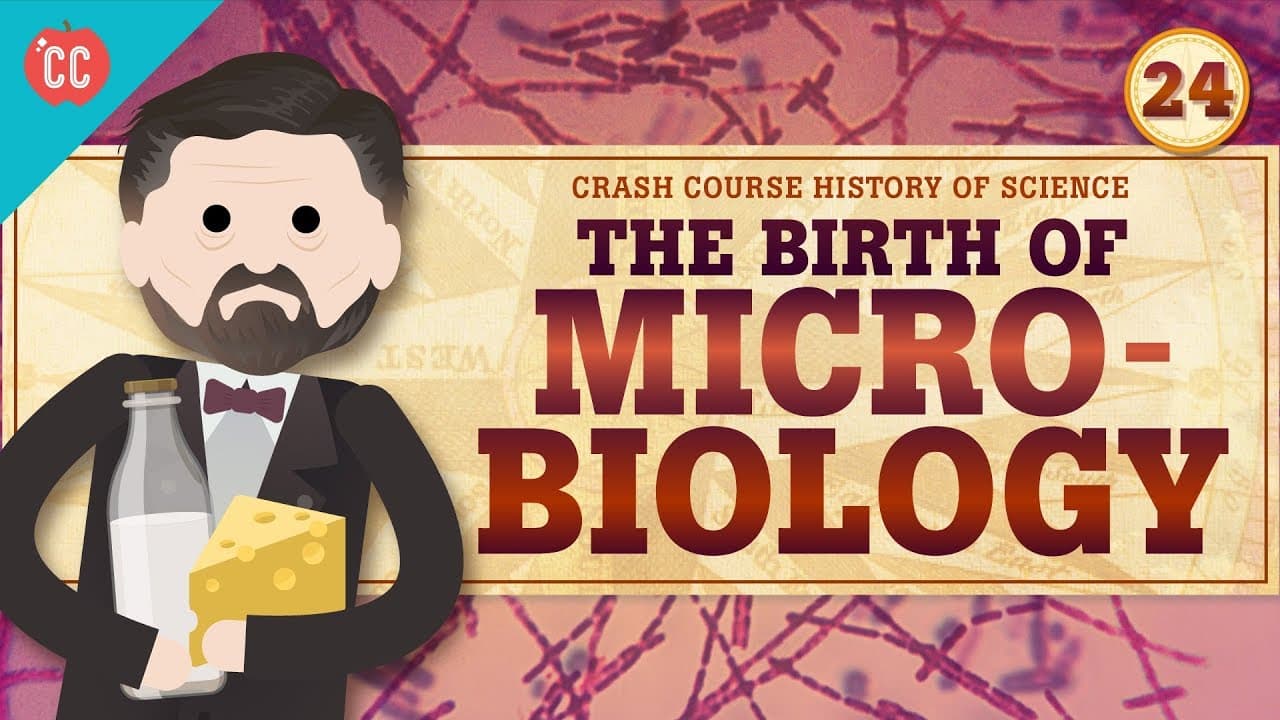
What Is Germ Theory? Micro-Biology: Crash Course History of Science #24
TL;DR
Germ theory holds that pathogenic microorganisms cause infectious diseases, replacing the idea that foul-smelling air was the cause. In 1854, John Snow linked a London cholera outbreak that killed over six hundred people to a public well, while Louis Pasteur later connected microbes to fermentation, spoilage, pasteurization, and hygienic medicine. Read on to see how cell theory and experiments transformed medicine and microbiology.
Transcript
What makes beer? Single-celled organisms. What makes us cough and feel like sleeping for twelve straight hours Straight? Single-celled organisms. AKA microbes, germs, the tiny machines that allow us to digest—and can kill us. “What is life?” Turns out, life is relentless, everywhere on earth! [Intro Music Plays] Microbes are invisible: they’re sing... Read More
Key Insights
- Germ theory posits that microorganisms are the cause of infectious diseases.
- John Snow's work on cholera in London highlighted the role of contaminated water in spreading disease.
- Louis Pasteur developed pasteurization, a process to kill microbes in liquids, revolutionizing food safety.
- Pasteur's experiments disproved spontaneous generation, supporting the theory of biogenesis.
- Robert Koch established bacteriology, identifying specific microbes responsible for diseases like tuberculosis.
- Koch's postulates provided a framework for linking specific germs to specific diseases.
- Pasteur and Koch's work led to the development of vaccines and improved medical hygiene practices.
- The transition from miasma to germ theory transformed medical science and public health strategies.
Install to Summarize YouTube Videos and Get Transcripts
Explore YouTube Video Summarizer or Get YouTube Transcript Extractor
Questions & Answers
Q: What is germ theory, and how did it change medicine?
Germ theory holds that germs, or pathogenic microorganisms, cause infectious diseases. It challenged miasma theory, which blamed disease on foul-smelling air, and supported improved hygiene, sterilization, vaccination, and targeted disease prevention.
Q: What is cell theory, and why was it important to microbiology?
Around 1837, Matthias Schleiden and Theodor Schwann proposed that every living thing consists of one or more cells and that the cell is the fundamental unit of life. This framework, strengthened by microscope-enabled evidence, helped scientists study the single-celled organisms central to microbiology.
Q: What was miasma theory?
Miasma theory claimed that diseases came from foul-smelling air produced by rotting meat, swamps, and other putrefying sources. It seemed plausible because dangerous microbes often grow on dirty, smelly material, even though the smell is a byproduct rather than the infectious cause.
Q: What did John Snow discover during the 1854 cholera outbreak?
John Snow mapped cholera cases around Broad Street in London’s Soho neighborhood, where the epidemic killed over six hundred people. He saw that cases clustered around a public well and persuaded the council to remove its pump handle; infections then decreased, although the outbreak was already declining.
Q: How did Louis Pasteur contribute to microbiology?
Louis Pasteur is credited as a co-founder of microbiology and the founder of modern zymology, the science of fermentation. He connected yeast to wine fermentation in 1857, argued that microbes cause spoilage and disease-like processes, patented pasteurization in 1865, and helped develop hygienic medical practices.
Q: What is fermentation, and what did Pasteur discover about it?
Fermentation converts sugar molecules into ethanol, or alcohol, and carbon dioxide, usually through bacteria or yeast in food production. Pasteur observed that microscopic yeast on grape skins makes grape juice ferment into wine and that sterilizing the skins prevents fermentation.
Q: What is pasteurization, and how does it work?
Pasteurization is Louis Pasteur’s patented process of heating liquids such as milk to between sixty and one hundred degrees Celsius to kill microbes. Compared with earlier canning, it used a lower temperature and therefore preserved tastes and textures.
Q: Why was disproving spontaneous generation important?
Spontaneous generation was the belief that living things naturally arise from certain environments. Pasteur argued from his observations that living things can grow only from other living things, supporting biogenesis and strengthening the emerging scientific account of microbes.
Summary & Key Takeaways
-
Germ theory, developed in the 19th century, fundamentally changed medical science by identifying microorganisms as the cause of infectious diseases. Key contributors like Louis Pasteur and Robert Koch advanced this theory, leading to the creation of vaccines and improved hygiene practices, which significantly reduced disease spread and mortality rates.
-
John Snow's investigation into a cholera outbreak in London demonstrated the importance of clean water sources in preventing disease. His work, alongside Pasteur's and Koch's, shifted the medical community's understanding from miasma theory to germ theory, highlighting the role of microbes in disease transmission.
-
Pasteur's development of pasteurization and Koch's bacteriological research laid the groundwork for modern microbiology. Their discoveries enabled the identification of disease-causing microbes, facilitating the development of targeted treatments and preventive measures, such as vaccines, that continue to save lives today.
Read in Other Languages (beta)
Share This Summary 📚
Summarize YouTube Videos and Get Video Transcripts with 1-Click
Try YouTube Summary with ChatGPT & Claude or YouTube Transcript Generator
Explore More Summaries from CrashCourse 📚


Summarize YouTube Videos and Get Video Transcripts with 1-Click
Try YouTube Summary with ChatGPT & Claude or YouTube Transcript Generator