What Is Contractarianism and Why Is It Important?
TL;DR
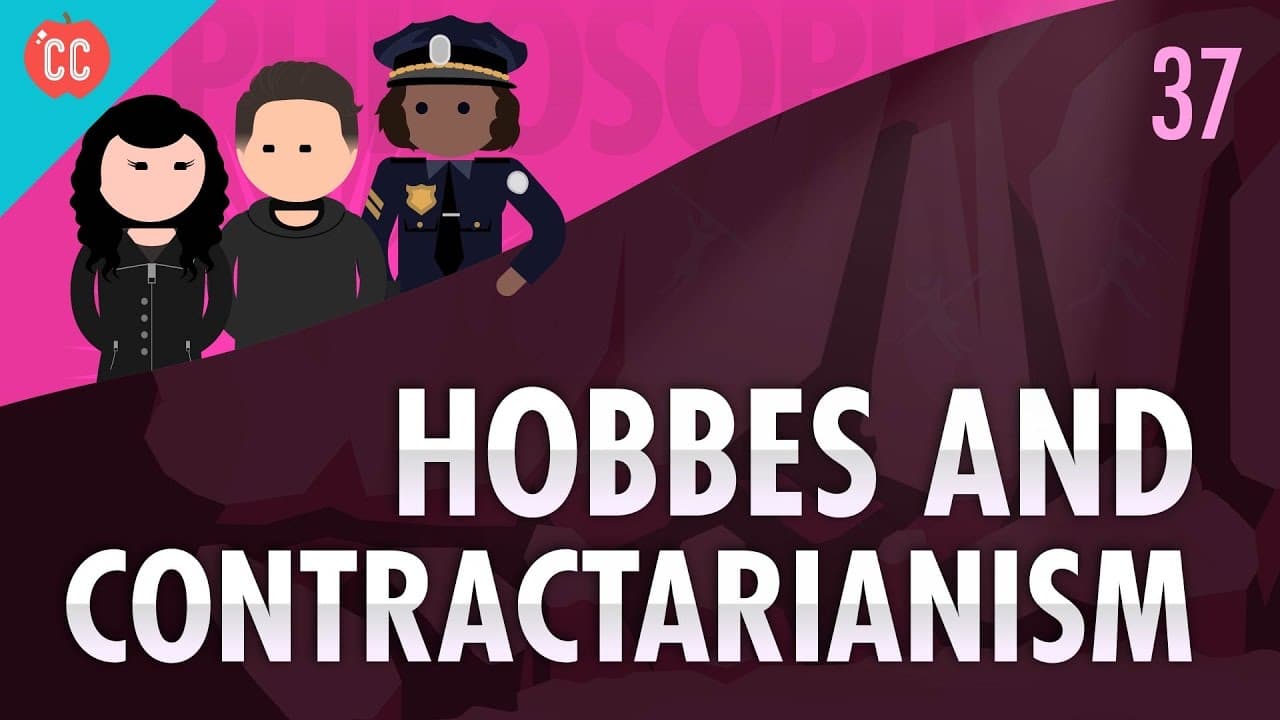
Contractarianism, as proposed by Thomas Hobbes, asserts that morality arises from social contracts formed by rational individuals seeking mutual benefits, preventing chaos in a 'state of nature.' It highlights the importance of trust in cooperation and the flexibility of morality based on group consensus, rejecting coercive systems like slavery in favor of agreements that enhance individual well-being.
Transcript
Imagine a world without rules. Nothing is illegal. Nothing is immoral. Everyone is absolutely free. This might sound like utopia to you, but according to 17th century British philosopher Thomas Hobbes, it would actually be your worst nightmare. Hobbes called this hypothetical time, with no rules to govern our behavior, “the state of nature.” And he... Read More
Key Insights
- Thomas Hobbes described a world without rules as a 'state of nature,' where life is chaotic and dangerous, emphasizing the need for social contracts to ensure security.
- Morality, according to Hobbes, is not inherent or divine but emerges from agreements made by rational individuals seeking mutual benefits.
- Social contracts involve trading some freedoms for the benefits of cooperative living, creating a structured society that contrasts with the chaotic state of nature.
- Implicit contracts are agreements we find ourselves in without explicit consent, like obeying laws for societal benefits, while explicit contracts are consciously agreed upon.
- The Prisoner's Dilemma illustrates the complexities in contractarianism, showing that cooperation is beneficial but relies on mutual trust between parties.
- Defection, or breaking a contract for self-interest, is common among strangers due to lack of trust but less so among acquaintances due to social repercussions.
- Contractarianism disallows coercive agreements, like slavery, as contracts must improve individuals' lives compared to being outside the system.
- Morality in contractarianism is flexible, created and modified by collective agreements, but requires adherence to chosen obligations.
Install to Summarize YouTube Videos and Get Transcripts
Explore YouTube Video Summarizer or Get YouTube Transcript Extractor
Questions & Answers
Q: What is the 'state of nature' according to Thomas Hobbes?
The 'state of nature' is a hypothetical condition described by Thomas Hobbes where there are no rules or laws governing behavior. In this state, life is chaotic and dangerous, characterized by a 'war of all against all.' Hobbes argued that in such a scenario, life would be 'solitary, poor, nasty, brutish, and short,' emphasizing the necessity of social contracts for security and order.
Q: How does Hobbes view morality in the context of contractarianism?
Hobbes views morality as a construct that emerges from agreements made by free, rational, and self-interested individuals. Unlike divine or natural law theories, Hobbes suggests that morality is not inherent or given but is created when individuals recognize the benefits of cooperation over conflict. This pragmatic approach sees morality as a product of social contracts that provide mutual benefits and security.
Q: What is the difference between implicit and explicit contracts?
Explicit contracts are those agreements that individuals consciously enter into, such as legal contracts or citizenship oaths. Implicit contracts, on the other hand, are those we find ourselves bound by without explicit consent, like following societal laws and norms. These implicit agreements provide benefits like safety and public services, and while not formally agreed upon, they are essential for societal functioning.
Q: What role does the Prisoner's Dilemma play in understanding contractarianism?
The Prisoner's Dilemma is a scenario that illustrates the challenges in contractarianism, particularly the importance of trust in cooperative agreements. It shows that while cooperation is beneficial, rational individuals might choose to defect to minimize personal risk, leading to suboptimal outcomes. This dilemma highlights the need for trust and mutual assurance in maintaining social contracts for collective benefit.
Q: Why does defection occur more among strangers than acquaintances?
Defection, or breaking a contract for self-interest, occurs more among strangers due to the lack of trust and the absence of social repercussions. Among acquaintances, social ties and the potential for future interactions discourage defection, as violating agreements can lead to social ostracism and damaged relationships. This social cost acts as a deterrent, promoting cooperation among those who know each other.
Q: How does contractarianism view coercive systems like slavery?
Contractarianism inherently rejects coercive systems like slavery because contracts must be entered into freely and improve the lives of those involved. A system that enslaves individuals cannot be legitimate, as it fails to provide a better alternative to living outside the system. Contractarianism insists on voluntary agreements that enhance individual welfare, ruling out any form of coercion or oppression.
Q: What makes contractarianism a flexible moral theory?
Contractarianism is flexible because it bases morality on collective agreements, allowing it to adapt as social norms and values change. Since morality is not seen as fixed or divine, it can evolve with societal consensus. However, despite this flexibility, contractarianism demands adherence to obligations once they are chosen, holding individuals accountable for the responsibilities they voluntarily accept.
Q: How does contractarianism ensure individuals keep their obligations?
Contractarianism ensures individuals keep their obligations by starting with the premise that people freely choose their responsibilities. This choice implies a commitment to uphold these agreements, as they are entered into with the understanding of mutual benefit. The theory holds individuals to a high standard of accountability, as breaking contracts undermines the trust and cooperation essential for societal functioning.
Summary & Key Takeaways
-
Contractarianism, proposed by Thomas Hobbes, suggests that morality arises from social contracts made by rational individuals seeking mutual benefits. Without rules, society would exist in a chaotic 'state of nature,' but contracts provide security and cooperation.
-
Social contracts can be explicit or implicit, with individuals trading some freedoms for societal advantages. The Prisoner's Dilemma highlights the importance of trust in maintaining these agreements, as cooperation is beneficial but not guaranteed.
-
Contractarianism allows for flexible morality, determined by group consensus, but insists on fulfilling chosen obligations. It rejects coercive systems like slavery, as contracts must enhance individuals' lives compared to existing independently.
Read in Other Languages (beta)
Share This Summary 📚
Summarize YouTube Videos and Get Video Transcripts with 1-Click
Try YouTube Summary with ChatGPT & Claude or YouTube Transcript Generator
Explore More Summaries from CrashCourse 📚


Summarize YouTube Videos and Get Video Transcripts with 1-Click
Try YouTube Summary with ChatGPT & Claude or YouTube Transcript Generator