How to Perform Chi-Square and Fisher's Exact Tests in GraphPad Prism
TL;DR
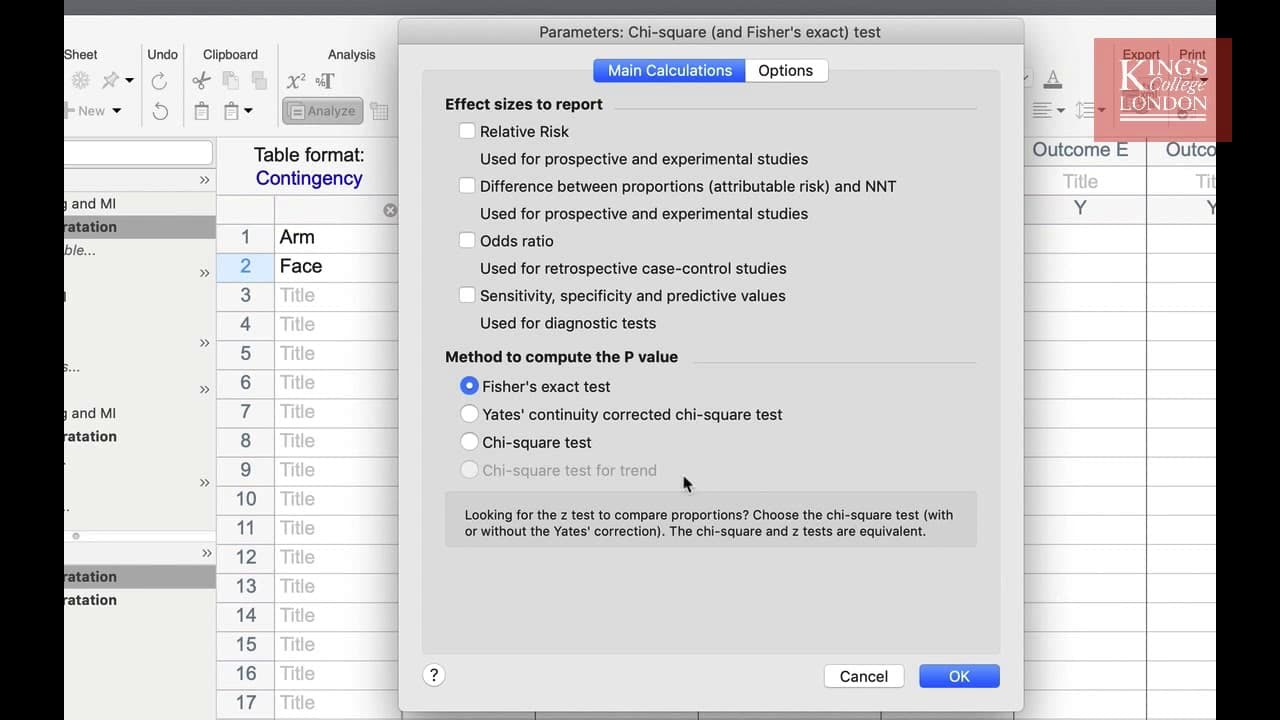
To perform chi-square and Fisher's exact tests in GraphPad Prism, create a contingency table, input your data, and follow the analysis steps using the appropriate test options. These tests allow you to compare categorical data and evaluate the significance of observed outcomes, where a p-value below 0.05 typically suggests rejecting the null hypothesis.
Transcript
hello I'm James Clark from King's College London and in this short video I'm going to show you how to carry out a chi-square test and a Fisher's exact test for contingency data a chi-squared test or Fisher's exact test should be used when comparing data from two or more groups when the outcome is a categorical variable such as the presence or absen... Read More
Key Insights
- 👥 Chi-square and Fisher's exact tests are used to compare categorical data from different groups.
- 👻 GraphPad Prism allows for easy creation of contingency tables and analysis of the data.
- 🏆 The null hypothesis of these tests states that the proportions of one variable are independent of the other variable.
- 😀 P-values below the chosen threshold indicate that the null hypothesis can be rejected.
- 🥳 Odds ratios and confidence intervals provide information about the likelihood of an event occurring.
- 🏃 Changes to the data in the contingency table can be quickly analyzed without re-running the tests.
Install to Summarize YouTube Videos and Get Transcripts
Explore YouTube Video Summarizer or Get YouTube Transcript Extractor
Questions & Answers
Q: What is the purpose of a chi-square test and Fisher's exact test?
The purpose of these tests is to compare data from different groups with categorical variables, such as disease presence or absence, to determine if there is a significant difference between the groups.
Q: How do you create a contingency table in GraphPad Prism?
To create a contingency table, go to the file menu and choose "New Data Table and Graph" or "New Project File." Then select "Contingency" from the options and import or enter your data.
Q: What is the null hypothesis for a chi-square test?
The null hypothesis for a chi-square test states that the relative proportions of one variable are independent of the second variable.
Q: How are the results of the tests interpreted?
The p-values from the tests determine the significance of the results. If the p-value is less than the chosen threshold (usually 0.05), the null hypothesis is rejected. The odds ratios and confidence intervals provide information about the likelihood of an event occurring.
Summary & Key Takeaways
-
The video demonstrates how to create a contingency table in GraphPad Prism and import or enter data for analysis.
-
It explains the null hypothesis for conducting chi-square and Fisher's exact tests and how to perform these tests in Prism.
-
The results of the tests are interpreted, and the odds ratios and confidence intervals are calculated for the data.
Read in Other Languages (beta)
Share This Summary 📚
Summarize YouTube Videos and Get Video Transcripts with 1-Click
Try YouTube Summary with ChatGPT & Claude or YouTube Transcript Generator
Explore More Summaries from Dory Video 📚




Summarize YouTube Videos and Get Video Transcripts with 1-Click
Try YouTube Summary with ChatGPT & Claude or YouTube Transcript Generator